








Follow-up care after vertigo assesses if the symptoms have cleared, if the balance system is continuing to recover, and if there is any cause for the dizziness to have come back to be assessed. Some people will still experience dizziness or a feeling of instability with some movements even after the spinning has ceased.
Others may still experience some imbalance when turning suddenly, walking through busy areas, or getting out of bed. Some people feel fine for weeks or months, and then suddenly complain of dizziness again. This can be concerning if the vertigo came back following physiotherapy, particularly after it appeared to be successful.
Follow-up care helps answer an important question: has the balance system recovered, is some dysfunction still present, or is the dizziness now coming from another cause?
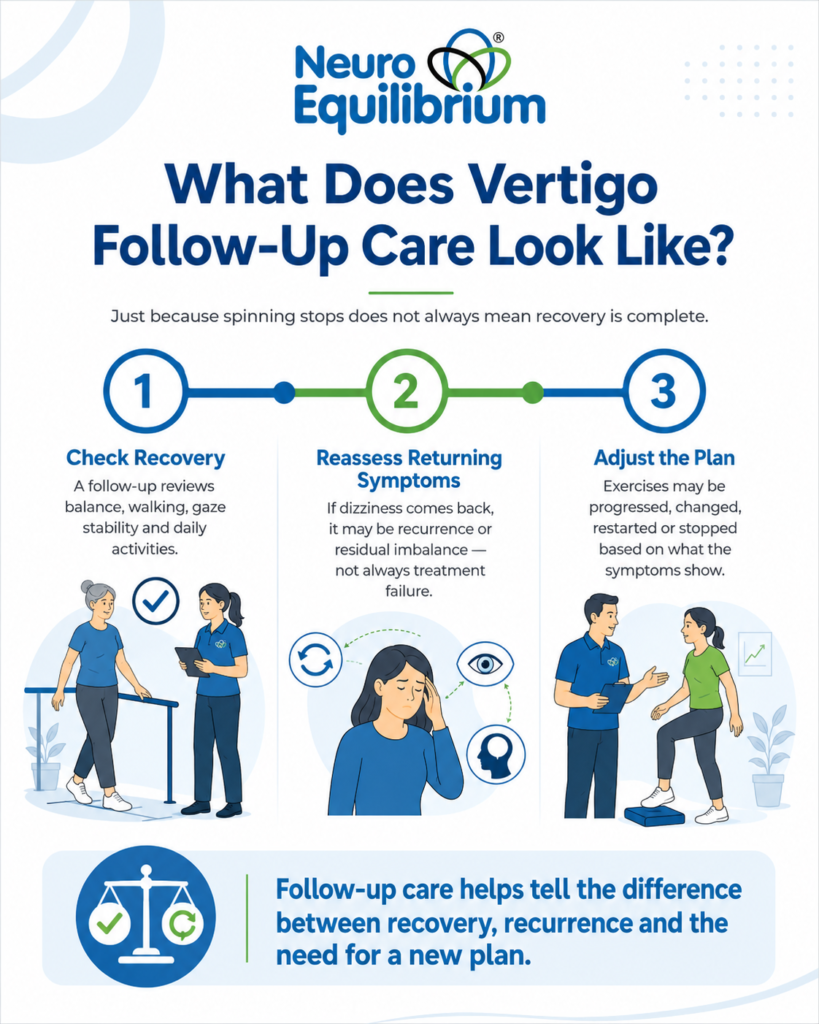
A follow-up to vestibular rehab will not be a repetitive appointment. It is an opportunity to check recovery, adjust exercises, identify recurrence early, and make sure treatment still matches the cause of the symptoms.
Why Is Follow-Up Care Important Even When Vertigo Feels Better?
While improvement in symptoms is a key component of recovery, it is not the only measure of improvement.
The balance system depends on what is happening to the inner ear, eyes, muscles, joints, and brain in their communication or interaction. After a vestibular issue, the brain might require time and repeated movement practice in order to be comfortable again in everyday activities.
The evidence for the benefits of vestibular rehabilitation for peripheral vestibular disorders is strong and has successfully demonstrated improved balance function, gaze stability, dizziness, and functional abilities.
A follow-up appointment allows the clinician to assess whether improvements are continuing outside the clinic.
At the time of the vestibular rehab follow-up, emphasis could be placed not just on decreasing dizziness, but on whether or not the person can turn their head while walking without falling. Are they able to use stairs with confidence? Do driving around too many roads, shopping at the grocery store, or watching TV still cause symptoms? Is there a return to normal work or exercise activities?
These answers help determine whether rehabilitation can end, should continue, or needs to be progressed.
Related Guides
- Benign Paroxysmal Positional Vertigo: Why It Happens & How to Fix It Fast
- Gaze Stabilization Exercises: The Foundation of Balance Recovery After Vertigo
- Red Flags: When Vertigo Signals a Medical Emergency
Does Vertigo Recurrence After Physiotherapy Mean the Treatment Failed?
Vertigo recurrence after physiotherapy does not necessarily mean that the previous treatment was ineffective.
This is especially true if you have a condition like BPPV or Benign Paroxysmal Positional Vertigo. BPPV occurs when tiny calcium crystals move into a part of the inner ear where they do not normally belong. These crystals may be moved out of the affected canal using an appropriate canal-repositioning manoeuvre. The correct manoeuvre depends on the affected canal and side and should be performed or advised under appropriate specialist supervision.
But crystals can be dislodged at any later time.
BPPV can recur even after successful treatment. [VERIFY the 2026 seven-year study and 47.1%] recurrence figure before retaining the exact statistic. This shows why patients should understand that another episode can occur even after the first one has been successfully treated.
Therefore, if positional spinning returns weeks, months, or years later, it may represent a new BPPV episode rather than a failure of the earlier treatment.
The key is to reassess, rather than to repeat previous exercises.
How Can You Tell the Difference Between Recurring Vertigo and Normal Recovery?
Dizziness following treatment does not necessarily mean recurrence.
Residual dizziness is a condition that some people may have. Although the spinning sensation may be gone, a person may still experience a floating sensation, mild imbalance, hesitation while walking, or sensitivity to rapid movements.
This may occur as a result of brain adaptation following the initial vestibular issue.
Symptoms often give clues as to the pattern.
If the spinning sensation is sudden when lying down in bed and the same as it was before the BPPV treatment, the chances of recurrence increase. Mild imbalance while walking or difficulty keeping vision stable during head movements may suggest that the balance system is still adapting.
If symptoms are mainly triggered by visually stimulating environments, scrolling screens, traffic, or supermarkets, they may indicate visual-motion sensitivity or another vestibular condition.
That is one of the reasons why a follow-up with a Vestibular Rehab is important. The clinician isn’t just asking if the patient is still dizzy. They ask about the nature of the dizziness, the factors that bring it up, and changes in the dizziness since treatment.
What Happens During a Vestibular Rehab Follow-Up Appointment?
A follow-up typically starts with comparing the person’s symptoms to what they experienced prior to treatment.
The vestibular specialist or therapist may ask questions about walking, head movement, work, exercise, driving, stairs, falls, sleep, headaches, and situations in which the person continues to experience dizziness.
Depending on the diagnosis, balance, eye movement, gaze stability, walking, and positional tests might be repeated.
If spinning has returned, it might be necessary to position test again for a patient who has already had BPPV treatment. It is recommended to re-evaluate BPPV patients after treatment or observation to determine if symptoms are improved or persistent.
The therapist can determine if the exercises were challenging before the rehabilitation but are now easy.
The vestibular rehab follow-up may involve progressing, simplifying, changing, or discontinuing exercises rather than continuing the same program unchanged.
When Should Vestibular Rehabilitation Exercises Be Changed or Stopped?
Vestibular rehabilitation is intended to adapt to the benefits gained from improvements in the balance system.
Doing the same simple exercise over and over might not give very much more benefit. It’s also important not to make it too hard too soon, as it can make symptoms needlessly uncomfortable.
Peripheral Vestibular Rehabilitation (PVR) guidelines for clinical practice recommend that once key therapy goals are met, symptoms are resolved, or progress is plateauing, therapy may be discontinued.
For instance, if the person first starts getting dizzy when they move the head slowly, then they can practice head movement while they are walking. A person with a difficult balance on a level surface might move to more difficult balance activities.
Vestibular Rehabilitation at NeuroEquilibrium may include individual gaze-stabilization exercises, balance retraining, habituation exercises, and, if applicable, technology-supported or VR-based Rehabilitation. The program is tailored to the individual’s diagnosis and response, and not a standard set of exercises for all individuals.
Should You Restart Your Old Exercises if Vertigo Comes Back?
Not automatically.
If there is a recurrence of vertigo following physiotherapy, it may be tempting to do the same exercises or manoeuvres again. However, the new dizziness may be due to a different cause.
During another episode, even BPPV can involve another semicircular canal or the other ear. Other vestibular conditions like persistent vestibular weakness, persistent post-vestibular dysfunction (PPPD) or vestibular migraine may also cause dizziness different from the original problem.
This implies that the proper exercise will be different based on the diagnosis at the time.
A manoeuvre to reposition the crystals is not the same as stabilisation of gaze manoeuvres performed for vestibular weakness. There is another purpose of habituation exercises.
Since it is clear the symptoms have returned, it may be better to have a vestibular rehab follow-up or specialist review than to guess which of the old treatments to reopen.
Why Might Dizziness Continue Even After BPPV Has Been Corrected?
A tricky situation is when positional testing reveals improvement in BPPV symptoms, but the individual does not feel completely normal.
When the room doesn’t spin anymore, walking around the room may still feel shaky. Turns of the head might be uncomfortable. Places of activity can be intimidating.
This does not necessarily indicate that the repositioning manoeuvre was unsuccessful.
Previous research has demonstrated that although treatment is effective in some patients, dizziness may remain after treatment in others, and a recent long-term study has shown that a significant number of people who had been successfully treated for BPPV continued to have residual dizziness.
In these cases, rehabilitation may be directed toward resumption of confidence in motion, balance, and comfort of normal head and body motion.
It is another situation where it should not be taken for granted that the vertigo will return following the physiotherapy, so it will have to be assessed again. It’s not always a true recurrence of imbalance; it’s continued imbalance.
Shortcode:-
What Symptoms Mean You Should Return for Vertigo Follow-Up Care?
Follow-up is especially beneficial when symptoms cease to improve or when there is a clear change in symptoms.
A review should be undertaken when:
- Turning in bed, looking up, bending down, or getting up are all activities where spinning returns.
- After a few days, there is a relapse of dizziness.
- Walking is still wobbly after performing the exercises.
- The blurriness or instability in vision persists with head movement.
- Crowds, traffic, supermarkets, or screens still induce strong dizziness.
- Near falls or falls due to balance problems.
- The symptoms worsen when exercising, rather than being manageable and temporary.
- Symptoms develop that include hearing changes, tinnitus, severe headaches, or ear fullness.
The pattern may provide the clinician with an indication of whether the underlying problem has recurred or another balance dysfunction is a concern.
When Does Recurrent Dizziness Need More Testing Instead of More Physiotherapy?
In some cases, it’s not another exercise program that’s the right next step.
The balance system may need to be reassessed if the symptoms have changed significantly, do not appear to be a result of the diagnosis, or if the diagnosis is not correct.
Vestibular investigations can evaluate various components of the inner ear and balance system. Not every patient needs every vestibular test. Depending on the symptoms, examination findings and suspected cause, assessment may include tests such as Videonystagmography (VNG), Video Head Impulse Testing (vHIT), Dynamic Visual Acuity or Subjective Visual Vertical. More specialised tests such as VEMP may be considered when clinically relevant. NeuroEquilibrium employs state-of-the-art vestibular diagnostics to identify which specific aspect of the balance system is compromised, and then select the appropriate treatment.
This is useful when the vertigo comes back following physiotherapy, but doesn’t feel like what the person experienced in the past.
Treatment is most effective if it follows the diagnosis, not if every dizzy spell is treated alike.
Can Vertigo Be Prevented From Coming Back After Rehabilitation?
No one exercise can ensure that vertigo will not return.
With some vestibular disorders, it is important to continue with normal movement and maintain a level of physical activity necessary to help the brain retain the adaptations that have been developed during the rehabilitation process. A small maintenance program can also be provided by a physiotherapist if appropriate.
In the case of BPPV, it can happen after successful treatment. It is still under study whether long-term rehabilitation or a self-rehabilitation programme can prevent recurrence; therefore, patients should be cautious about claims that exercises are a one-and-done cure for BPPV recurrence.
Early recognition of symptoms is more beneficial.
A person who is familiar with the symptoms of past BPPV – who understands what it feels like, which symptoms to come back and visit when spinning returns, and returns promptly will be able to receive the right treatment much sooner.
Why Choose NeuroEquilibrium for Vertigo Follow-Up Care?
Vertigo follow-up care should not just be about saying if vertigo is “better” or “not better.”
It should define what has gotten better, what still doesn’t allow one to have a normal life, and whether it is a return of dizziness or a brand new one.
NeuroEquilibrium’s methods involve an individualized vestibular rehabilitation program, gaze-stabilization and balance exercises, specialized vestibular assessment and diagnosis, canalith repositioning procedures (where appropriate), and advanced testing of the vestibular system when further investigation is warranted.
This means that the patient receives an appropriate treatment for their individual balance dysfunction, and the next step is not the same stage used the previous time.
What Does Recovery Look Like After Vestibular Rehabilitation?
Healing from vertigo is not often a one-and-done sort of therapy appointment and never once more thinking about balance.
Some individuals complete therapy when symptoms are gone, and they are able to resume normal activities. Others require more time in the rehab program. Later, some will have a recurrence of vertigo following the physiotherapy treatment, and a re-evaluation of the original diagnosis will be required.
A follow-up with a planned vestibular rehabilitation program helps to clarify those differences.
If spinning returns, balance stops improving, or dizziness becomes different from before, a reassessment can determine that treatment needs to be restarted, modified, or even shifted to a new approach.
The NeuroEquilibrium approach is one in which follow-up care is built around that diagnosis-first approach: checking recovery, detecting recurrence early, and supporting patients to get back to daily motion with a more stable and confident sense of balance.
Frequently Asked Questions
What happens if vertigo keeps coming back?
Frequent vertigo can also be a symptom of other conditions like BPPV, Ménière’s disease, vestibular migraine, or other vestibular disorders. Recurrent episodes may impact balance, balance confidence, and activities of daily living. If vertigo persists, then a specialist assessment should be undertaken to determine the cause and to plan for long-term treatment to minimise future episodes.
How long does it take for vertigo to go away after physical therapy?
Recovery time is dependent on the cause and severity of the condition, and many individuals feel recovery occurs after weeks of beginning vestibular rehabilitation therapy. For some patients, a couple of sessions are enough to give them the relief and balance they need, while others may need to receive several months of therapy to obtain optimal balance and symptom control
Can vertigo be cured by physiotherapy?
Yes, physiotherapy can be very effective in treating many vestibular complaints. Vestibular Rehabilitation Therapy (VRT) is a therapeutic intervention that employs certain exercises to enhance balance, alleviate dizziness, and retrain the brain’s balance system to compensate for inner ear issues. In cases of BPPV, certain positioning exercises carried out by trained professionals can offer a lot of relief.
Why did my vertigo go away and come back?
If the cause of the vertigo has not been completely cleared up, or if triggers like stress, insufficient sleep, dehydration, migraine, and some head movements remain, the condition may recur. Certain conditions, such as BPPV and Ménière’s disease, may lead to repeat cases. Knowing what triggers and what treatment plan can help minimize the risk of recurrence.
How do I stop getting vertigo again?
Depending on the cause, prevention of future vertigo episodes depends on several factors. Drinking plenty of fluids, getting proper sleep, dealing with stress, avoiding known triggers, and doing the recommended vestibular exercises can help. Having regular follow-up with a healthcare professional and prompt treatment of recurring symptoms will help to achieve better long-term balance and reduce the risk of further attacks.