

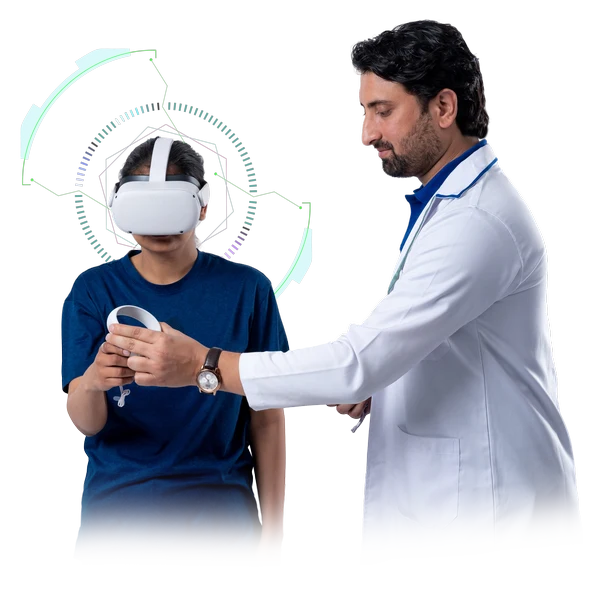
Vertigo is a symptom, not a disease. It refers to the false sensation of movement or spinning, while dizziness or lightheadedness can have entirely different causes. Because over 40 different conditions can lead to vertigo or imbalance, accurate diagnosis is the key to lasting recovery.
Many patients try to manage symptoms with temporary medications. However, these only suppress dizziness and may delay the brain’s natural healing process. A structured diagnostic process ensures that the root cause is identified, whether it lies in the inner ear, brain, or systemic factors, allowing the right treatment to begin immediately.
NeuroEquilibrium follows a structured, stepwise process designed to evaluate both function and structure.
History and Symptom Analysis
The process begins with a detailed discussion of symptoms such as onset, triggers, duration, and frequency. The clinician reviews medical history, associated conditions, and lifestyle factors that may influence balance.
Physical and Neurological Examination
A focused examination checks eye movements, coordination, balance, and posture. Specific positional maneuvers such as the Dix-Hallpike or Supine Roll Test may be performed to identify Benign Paroxysmal Positional Vertigo (BPPV) by observing eye movement patterns known as nystagmus.
Functional Vestibular Tests
If required, the patient undergoes a set of specialized vestibular tests collectively called the Vertigo Profile Test. These assess how the balance system is functioning in real time and are more informative than structural imaging during the early stages of a disorder.
Imaging and Systemic Evaluation
When neurological symptoms or red flags are present, additional tests such as MRI or CT scans are ordered to rule out stroke, brain tumors, multiple sclerosis, or acoustic neuroma. Basic health checks for blood pressure, blood sugar, anemia, or vitamin D levels may also be performed to exclude systemic causes.
Test | What It Measures | Why It Matters |
Videonystagmography (VNG) | Tracks eye movements during visual and positional changes. | Identifies the affected canal in BPPV and distinguishes between inner ear and brain-related vertigo. |
Subjective Visual Vertical (SVV) | Evaluates perception of vertical orientation. | Detects imbalances in the otolith organs responsible for sensing gravity. |
Dynamic Visual Acuity (DVA) | Assesses how clearly a person can see during head movement. | Identifies weakness in the Vestibulo-Ocular Reflex (VOR), essential for stable vision while moving. |
Video Head Impulse Test (vHIT) | Measures eye movement during rapid head turns. | Evaluates the function of individual semicircular canals and is useful for diagnosing Vestibular Neuritis. |
Vestibular Evoked Myogenic Potentials (VEMP) | Measures muscle response to sound stimuli. | Assesses the otolith organs and helps diagnose Ménière’s Disease and Superior Canal Dehiscence Syndrome. |
Posturography | Evaluates balance and body stability on stable or moving surfaces. | Determines how the eyes, feet, and inner ears coordinate to maintain balance and predicts fall risk. |
Audiometry (Hearing Test) | Measures hearing sensitivity across frequencies. | Identifies hearing loss associated with balance conditions like Ménière’s Disease or Labyrinthitis. |
Learn more:
VNG Test | vHIT Test | VEMP Test | Posturography | SVV Test | DVA Test
MRI or CT scans are not the first-line tests for vertigo. They are used only when central causes are suspected, such as stroke, tumors, or demyelinating conditions. Vestibular function tests can often detect abnormalities hours or even days earlier than MRI scans, making them critical for timely diagnosis.
To ensure accuracy, patients are advised to follow a few guidelines before testing:
A complete Vertigo Profile Test, which includes VNG, SVV, and DVA, typically takes about 90 minutes, while individual tests such as VEMP last 30 to 45 minutes. All tests are safe, painless, and non-invasive, though brief dizziness may occur as part of the evaluation.
The results of vestibular diagnostics allow clinicians to pinpoint the exact cause of dizziness. Identifying the affected ear or nerve helps determine whether the issue lies in the inner ear, vestibular nerve, or central pathways.
Once the underlying cause is confirmed, NeuroEquilibrium specialists design a personalized plan that may include:
Explore Vestibular Rehabilitation Therapy (VRT)
While vertigo is often benign, certain symptoms require urgent evaluation:
If these occur, emergency imaging and neurological assessment are recommended immediately.
MRI scans show structural changes in the brain, while vestibular tests measure how the balance system functions. Many patients with vertigo have normal MRI results because their symptoms come from functional imbalance, not structural damage.
Yes, all vestibular tests are safe, non-invasive, and performed under expert supervision. Some may temporarily induce dizziness, which is normal and necessary for diagnosis.
The complete evaluation, including consultation and functional tests, usually takes between 1.5 and 2 hours.
Preliminary findings are often discussed on the same day, with a detailed report provided after complete analysis.
You will receive a customized treatment plan that may include vestibular rehabilitation, medication, or repositioning maneuvers, depending on your diagnosis.
A chronic imbalance workup should start with a detailed symptom history, fall history, medication review, hearing and tinnitus check, positional testing for BPPV, balance examination, and targeted vestibular testing where needed. Tests may include audiometry, VNG, VEMP, vHIT, rotary chair testing, or posturography depending on symptoms. NeuroEquilibrium’s approach is to identify whether the imbalance is coming from the inner ear, vision, nerves, brain, muscles, medications, or multiple systems together.
BPPV is usually evaluated with positional tests such as the Dix-Hallpike test and supine roll test. Ménière’s disease is assessed using clinical history, audiometry, and vestibular tests when needed. Vestibular neuritis may require clinical examination, VNG, vHIT, caloric testing, and balance assessment. NeuroEquilibrium’s view is that no single test confirms every balance disorder; the right diagnosis comes from combining symptoms, examination, audiometry, and targeted vestibular testing.
Vestibular tests are generally safe and are designed to measure how the inner ear, eyes, and brain work together for balance. Some tests may briefly trigger dizziness because they are checking how the balance system responds to movement, position changes, or visual stimulation. Tests such as VNG, VEMP, rotary chair, vHIT, audiometry, and posturography measure different parts of the balance system. NeuroEquilibrium recommends selecting tests based on symptoms rather than doing every test for every patient.
VNG measures eye movements and helps assess positional dizziness, nystagmus, and vestibular weakness. VEMP evaluates otolith organ and vestibular nerve pathway function. Rotary chair testing measures the vestibular-ocular reflex during controlled movement and is useful for bilateral or subtle vestibular deficits. NeuroEquilibrium’s view is that these tests are complementary, not interchangeable. The right test depends on the patient’s symptoms, history, and suspected balance disorder.
Vertigo, Headaches, nausea, or ringing in your ears? Find its root cause. Talk to expert.