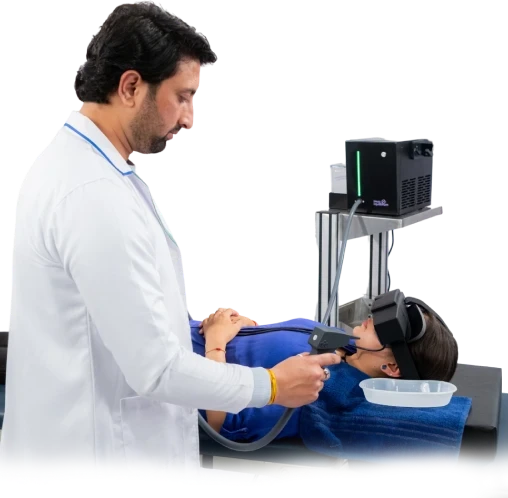
The NeuroEquilibrium Vestibular Assessment Platform provides doctors with a robust and efficient tool for diagnosing and managing vertigo and balance disorders, improving patient care and treatment outcomes.
Patient Voices
Real stories of recovery – in their own words, in their own language.

MD, PhD, ENT Surgeon
And all the way from Cyprus!
In my private practice, I have added to my diagnostic arsenal, the NeuroEquilibrium equipment. Since I have started using it, I am able to get the exact diagnosis to treat my patients – at times, diagnosing up to three underlying causes. Just diagnosing someone who has chronic vertigo, which was never properly examined and diagnosed earlier, is almost half the treatment! Patients feel relieved and satisfied with just that they have finally been diagnosed and not left untreated with a feeling of being abandoned and alone.
I would recommend NeuroEquilibrium to any ENT doctor who wants to expand his practice with world-class quality and powerful diagnostic equipment. It has helped my practice and my patients are very happy.
Maurya ENT Research Centre Kanker Bagh, Patna
I have been using the VNG, SVV, DVA and CCG from NeuroEquilibrium for the last four months. I am completely satisfied with the performance of the equipment and would like my newly emerging neurotologist colleagues to go for this equipment. Apart from the instruments, the patient history proforma for Vertigo cases is extremely helpful in arriving at a proper conclusion, Wishing you a successful future
D.L.O, M.S Centre For ENT, Hearing Care & Vertigo
Through my decades of experience in the medical field, Vertigo has always been a challenging problem to treat. These patients are often full of anxiety and dread. The NeuroEquilibrium platform has enabled me to thoroughly and systematically evaluate these patients starting with a detailed history to the highly advanced neurotological tests. The inputs from the Neurotology and Neurology team help me to plan treatment which is best suited for each patient. The NeuroEquilibrium platforms also helps avoid unwanted drug interactions and side effects especially in elderly patients who are usually on medication for other disorders. Customized Vestibular Rehabilitation therapy, provided by NeuroEquilibrium, is an important treatment component in the management of vertigo patients to ensure a long-lasting recovery. NeuroEquilibrium is offering cutting edge technology which is possibly the most advanced globally. It is indeed very satisfying to see my patients fully recover after correct diagnosis and treatment.
MBBS, MS, DNB, MNAMS , Max Smart Super Specialty Hospital, Saket
I run a super-specialty Otology Clinic and see many patients complaining of vertigo and imbalance. These patients are of all age groups from children to middle aged and often elderly.
Vertigo is a very unsettling problem and these patients are in distress. These patients are sometimes suffering for years and have been to many doctors of various specialties with little relief. The NeuroEquilibrium system has helped me in the management of these patients using equipment with the latest technology to provide a scientific evaluation of the balance system. Interpretation provided by super-specialist doctors at Neuroequilibrium further helps me to plan the most appropriate and customized treatment for each patient. I have been working with Neuroequilibrium for more than two years and I have seen the platform evolve to a world class product and service.
I am committed to excellence in my work and I believe that NeuroEquilibrium is helping me to provide the best and most scientific management for my patients with vertigo and balance disorders. Ultimately ‘the proof of the pudding’ is a happy and satisfied patient!
MS DNB DLO DHA , MedFirst Healthcare Pvt. Ltd.
Treating vertigo patients is a challenging medical problem because of the many presentations which the patient may show and the many disorders which can cause vertigo.
Patients often come suffering from this problem since years together, going from one doctor to the other and taking medicines just to suppress the symptoms.
The NeuroEquilibrium system has enabled me to do a scientific evaluation of these patients with the most advanced set of equipment. It is a robust system that carries out detailed evaluation in a systematic manner with active support at the back end.
The Neuroequilibrium App is interactive and responsive, providing the referring ENT Specialist as well as the patient with medication advice as well as corrective exercises.
The panel of ENT and Neurologist at Neuroequilibrium help me with their inputs to diagnose and plan the best treatment for our patients.
The Vestibular Rehabilitation Therapy given by NeuroEquilibrium has further helped in long-term rehab of the patients suffering from balance disorders and helped these patients become more steady reducing their risk of falls.
I would like to conclude by saying that the NeuroEquilibrium platform has helped me diagnose and scientifically treat vertigo patients. This has helped them to return more balanced and confident and help put an end to their long standing discomfort.
Consultant ENT Surgeon
This comprehensive approach and the diagnostic platform is very beneficial for medical practitioners to access the cause of balance disorders and to provide proper treatment and rehabilitation to the patient.
There is no single blood test that directly diagnoses vertigo, but doctors may order blood tests to identify underlying causes. Common tests include a complete blood count (CBC) to check for infections or anemia, blood sugar levels to rule out hypoglycemia, thyroid function tests, and vitamin levels such as Vitamin B12. These tests help detect conditions that may contribute to dizziness rather than vertigo itself.
Videonystagmography is often worth it if vertigo is frequent, severe, or difficult to diagnose. This test evaluates inner ear and brain balance function by tracking eye movements in response to different stimuli. It helps doctors determine whether vertigo is caused by inner ear disorders or neurological issues, making it valuable for accurate diagnosis and targeted treatment.
Vertigo is not always caused by a vitamin deficiency, but low levels of Vitamin B12 and sometimes vitamin D have been linked to dizziness and balance problems in some individuals. Deficiencies can affect nerve function and inner ear health, but most vertigo cases are related to conditions like inner ear disorders rather than just nutritional issues.
Vertigo is diagnosed using a combination of physical exams and specialized tests. A common test is the Dix-Hallpike Test, which helps identify positional vertigo by triggering symptoms through specific head movements. Other tests may include hearing tests, balance assessments, and imaging like MRI if a neurological cause is suspected.
Vertigo can be treated by both ENT (ear, nose, and throat) specialists and neurologists, depending on the cause. ENT doctors usually manage vertigo related to inner ear problems, such as BPPV or Ménière’s disease, while neurologists handle cases linked to the brain, such as migraines or stroke-related dizziness. In many cases, patients may be referred between both specialists for comprehensive care.
Vertigo, Headaches, nausea, or ringing in your ears? Find its root cause. Talk to expert.