







That is the part most people are never told. You had a spell of spinning, it was treated or it settled on its own, and then one morning you turn over in bed and the room tilts again. It is easy to assume something was missed, or that you are back to square one. Usually neither is true. But vertigo that keeps returning is a pattern, and patterns have reasons. The rest of this article walks through those reasons, explains how to tell a repeat attack from lingering dizziness, and describes how a specialist works out which one you are actually dealing with.
Why does my vertigo keep coming back?
Vertigo can return because the original condition has recurred, because a different balance disorder is now causing symptoms, or because the spinning has improved but a persistent unsteadiness has stayed behind. Some conditions, such as Ménière’s disease and vestibular migraine, are episodic by nature. Finding which of these applies to you is what determines the right next step.
There is an idea tucked inside that short answer that changes how you think about the whole problem: vertigo is a symptom, not a diagnosis. Several different problems in the inner ear and brain can produce exactly the same spinning feeling, and they behave very differently over time. So when vertigo keeps returning, “how do I stop the spinning?” is the less useful question. “What is producing or causing it this time?” is the one that gets you somewhere.
What recurring vertigo actually means
Ask ten people what they mean by “my vertigo is back” and you will get at least three different stories.
The first is the one doctors usually mean by recurrent vertigo: distinct attacks with a clear start and finish, and a completely normal life in between. You know exactly when it began and when it stopped.
The second is quieter and, in some ways, harder to live with. The violent spinning stopped weeks ago, but a floaty, off-balance feeling never quite left. It gets louder in a crowded market, on an escalator, or while scrolling reels on your phone. Nothing is spinning, yet nothing feels steady either.
The third is a mix of both: a background unsteadiness most days, plus the occasional sharp spin when you look up to a shelf or lie down at night.
Each story has its own list of likely causes. Working out which one is yours, and saying so clearly at your appointment, is one of the most useful things you can do.
What causes recurring vertigo?
The most common reasons vertigo returns include:
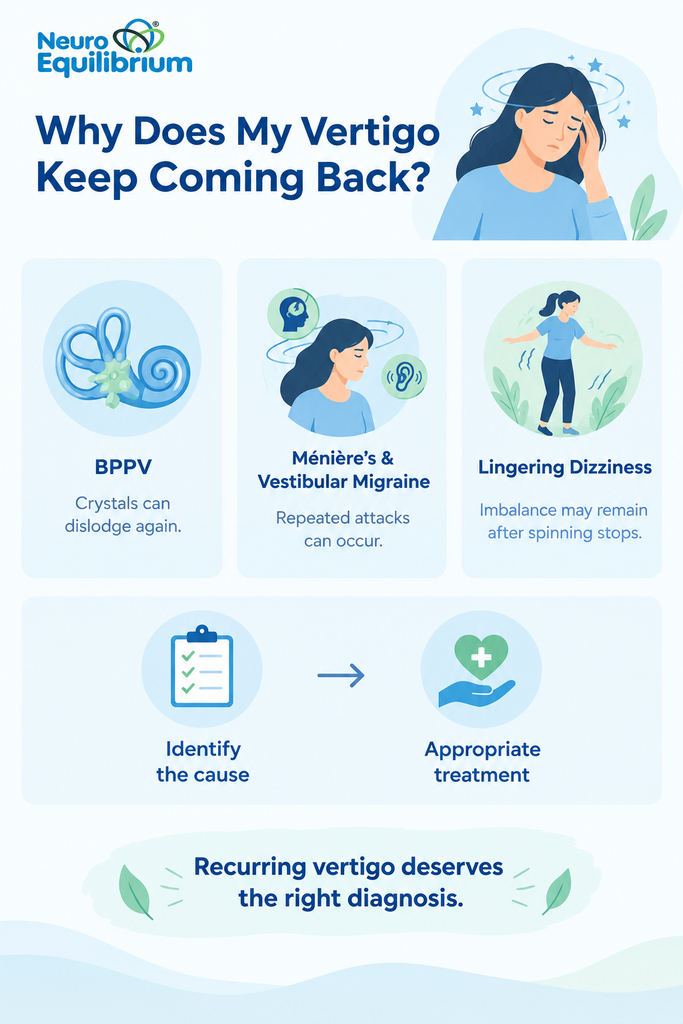
- BPPV recurring after successful treatment, because the inner-ear crystals can dislodge again
- An episodic condition such as Ménière’s disease or vestibular migraine, which cause repeated attacks as part of their nature
- A second balance problem developing after the first one, for example BPPV appearing after vestibular neuritis
- Incomplete recovery, where residual dizziness or imbalance persists after the spinning has stopped
- Persistent postural-perceptual dizziness (PPPD), a chronic dizziness that can develop after any vestibular event
- A diagnosis that no longer explains everything, meaning the cause needs to be reassessed
Let’s take these one at a time.
Can BPPV come back after treatment?
Yes. If there is one thing to take from this article, it is that BPPV returning is common, expected, and usually simple to deal with.
Benign paroxysmal positional vertigo (BPPV) happens when tiny calcium crystals in the inner ear drift out of the chamber where they belong and settle in one of the semicircular canals. Each time your head moves a certain way, the loose crystals slide, and the brain receives a false “we’re spinning” message. That is why BPPV is so tied to position: turning in bed, lying back at the dentist, bending to tie a shoe, looking up to the top shelf.
The treatment is a set of repositioning maneuvers (you may have heard of the Epley or Semont maneuver), in which the head is moved through a specific sequence to guide the crystals back out of the canal. When the right maneuver is chosen for the right canal, most people improve within one or two sessions.
But the maneuver does not glue the crystals in place. They can come loose again, weeks or years later. In one prospective study that followed patients for a year after successful repositioning, about a quarter experienced a recurrence, and nearly all of them settled again after the maneuver was repeated. In other words, BPPV coming back is a known feature of the condition, not evidence that the first treatment was wrong or done badly.
There are two situations, though, where “recurring BPPV” deserves a second look rather than simply another maneuver:
- The attacks never fully stopped. If positional spinning continues after treatment, the crystals may be in a different canal than first thought, or on the other side, and the maneuver needs to be re-matched to the actual finding on positional testing.
- The symptoms have changed character. If the new episodes last for hours rather than seconds, or come with hearing changes or headache, it may not be BPPV this time at all.
Can other vestibular conditions cause repeated vertigo attacks?
They can, and this is where a careful history matters more than anything.
Ménière’s disbease
Ménière’s disease is an inner ear disorder in which fluid pressure builds up abnormally. It produces attacks of vertigo that typically last from about twenty minutes to several hours, often with a feeling of fullness in one ear, ringing (tinnitus), and hearing that fluctuates, muffling during an attack and partly recovering afterwards. Some people have attacks weeks or months apart; others have clusters over a few days and then a long quiet spell.
Because Ménière’s is episodic by nature, repeated attacks are simply what the condition looks like. The goal of treatment is to reduce how often and how hard the attacks hit, and to protect hearing over time, which is a very different plan from treating BPPV.
Vestibular migraine
Vestibular migraine is one of the most frequently overlooked causes of recurrent dizziness, partly because people expect a migraine to mean a headache. It does not have to. Many people with vestibular migraine have spinning, rocking or a sense of motion as their main symptom, with only light sensitivity, sound sensitivity, or a history of migraines earlier in life as the clue. Attacks can last anywhere from a few minutes to a few days, and common triggers include poor sleep, skipped meals, stress, hormonal changes and certain foods.
If your vertigo keeps returning and you have ever had migraines, or migraines run in your family, this possibility is worth raising with your doctor.
Vestibular neuritis and what can follow it
Vestibular neuritis is usually a one-off event: a viral-type inflammation of the balance nerve causes days of severe spinning, followed by gradual recovery as the brain compensates for the weaker ear. It does not typically cause repeated attacks.
So why do some people feel vertigo “coming back” months after neuritis? Two common explanations. First, the inflamed ear can shed crystals, so BPPV sometimes develops after neuritis, producing brief positional spins on top of the earlier illness. Second, if the brain’s compensation is incomplete, a lingering unsteadiness can remain, worse with fast head turns or in the dark. That is not neuritis returning; it is recovery that has stalled, and it is one of the clearest situations where vestibular rehabilitation may help.
Other, less common inner ear disorders can also produce repeated episodes. The point is not to memorise them, but to recognise that different causes leave different fingerprints in the timing, duration and accompanying symptoms of each attack.
Is recurring vertigo the same as residual dizziness?
No, and confusing the two is one of the main reasons people feel their treatment “did not work.”
A recurring vertigo attack is a distinct episode of spinning with a beginning and an end. Residual dizziness is what some people feel after the spinning has been treated: a vague lightheadedness, a floating or swaying sensation, a feeling of being “not quite steady,” without true rotation. It is well recognised after successful BPPV repositioning and is thought to reflect the balance system taking time to recalibrate. For most people it fades over days to a few weeks.
Persistent imbalance is a third thing again. Here the problem is unsteadiness on your feet rather than a sensation in your head. It often shows up when walking on uneven ground, in dim light, or when turning quickly, and it can follow any vestibular condition that has left one ear weaker.
Then there is motion or visual sensitivity: dizziness provoked by scrolling screens, moving crowds, supermarket aisles, or being a passenger in a car. This is common in vestibular migraine and in PPPD.
Why does this distinction matter? Because a repeat positional attack, a residual floaty feeling, and a walking imbalance each call for a different response. One may need a repositioning maneuver; another may need reassurance and time; the third may need structured rehabilitation. Describing your symptoms accurately helps your doctor choose correctly.
What is PPPD, and why does it feel like vertigo that never left?
Persistent postural-perceptual dizziness, or PPPD, is a recognised chronic condition in which non-spinning dizziness, unsteadiness or a swaying feeling is present on most days for three months or longer. It typically gets worse when you are upright, when you move, and when you are exposed to busy visual environments, and it often begins after a triggering event such as BPPV, vestibular neuritis, a migraine flare or a period of intense anxiety.
PPPD is not the same as repeated short spinning attacks. The original inner ear problem may have recovered fully; what persists is the way the balance system and brain have adapted, with the brain relying too heavily on vision and staying on high alert for movement. It is a genuine disorder, it is diagnosable, and it responds best to a combination of approaches, typically including vestibular rehabilitation and, where appropriate, strategies to address the anxiety loop that keeps it going.
If your “recurring vertigo” is really a constant background dizziness that flares in crowds or on screens, PPPD is worth discussing.
When the first diagnosis does not explain everything
Sometimes symptoms return because the picture has changed since the first assessment. A person can have more than one vestibular condition at the same time. BPPV and vestibular migraine can coexist. A weak ear from an earlier neuritis can make later BPPV attacks feel far worse than they otherwise would. Symptoms can also evolve: what began as short positional spins may now include hour-long episodes or hearing change, which shifts the likely cause.
None of this means the original assessment was wrong. It means the balance system is dynamic, and a diagnosis made during one type of episode may not cover a later, different type. When vertigo keeps returning, or the character of the attacks changes, a fresh evaluation can be more useful than repeating the previous treatment.
How is the cause of recurring vertigo diagnosed?
It starts with your story, not with machines. A specialist will want to know how long each attack lasts, whether that is seconds, minutes, hours or days, what sets it off, what comes with it (hearing change, ear fullness, headache, blurred or jumping vision), and how you feel on the days in between. If you can, keep a simple note of your attacks before the appointment. That timeline alone rules a surprising amount in and out.
The examination then looks at eye movements, because the inner ear and the eyes are wired together; a problem in the balance organ produces characteristic involuntary eye movements. Positional testing checks whether crystals are present and, if so, in which canal.
Depending on what the history suggests, vestibular testing may follow. Videonystagmography (VNG), which records eye movements with small cameras during different head positions and stimuli, helps identify which ear and which part of the balance system is involved. Other tests may assess the balance nerve’s response to fast head movements, the function of the gravity-sensing parts of the ear, or overall balance under different conditions. A hearing test is often part of the work-up when Ménière’s disease is a possibility.
The purpose of all this is localisation: not just confirming that you have vertigo, but identifying where the problem is and which of the causes above best explains your pattern.
When should you see a specialist for recurring vertigo?
Occasional, brief positional spinning that has been diagnosed before and settles quickly may simply need a repeat maneuver. But it is reasonable to seek a specialist evaluation when:
- vertigo has returned more than once in a year, or is becoming more frequent
- the episodes now last longer, or feel different from the earlier ones
- new symptoms have appeared, such as hearing change, ear fullness, tinnitus or headache
- dizziness or imbalance is present most days, even between attacks
- the symptoms are affecting your confidence to walk, drive, work or go out
- previous treatment helped only partly, or not at all
Symptoms that need urgent medical attention
Most recurring vertigo comes from the inner ear and is not dangerous. However, dizziness that starts suddenly and is accompanied by any of the following should be treated as an emergency: weakness or numbness of the face, arm or leg; difficulty speaking or understanding speech; facial drooping; double vision; a severe new headache unlike any before; fainting; chest pain; or sudden inability to stand or walk. These can be signs of a stroke or other neurological problem, and prompt evaluation matters.
How is recurring vertigo managed?
There is no single treatment for vertigo that keeps returning, because there is no single cause. Management depends entirely on what the evaluation finds.
For recurrent BPPV, the answer is usually a repeat repositioning maneuver matched to the canal involved, sometimes with guidance on home maneuvers for people who have frequent, well-characterised recurrences. For Ménière’s disease, treatment focuses on reducing attack frequency and monitoring hearing, and may include dietary measures, medication or, in selected cases, procedures. Vestibular migraine is generally managed the way migraine is: identifying triggers, regularising sleep and meals, and, where episodes are frequent, preventive medication under a doctor’s supervision.
Vestibular rehabilitation, a structured, exercise-based programme that retrains the brain’s balance responses, is appropriate for selected conditions rather than all of them. It is often recommended when an ear has been left weaker after neuritis, when residual imbalance persists after BPPV, and as a core part of treating PPPD. It is not a treatment for active BPPV itself, which is why the diagnosis has to come first.
Medication has a place for short-term relief during severe attacks, but it does not address the underlying cause and long-term use of vertigo-suppressing tablets can slow the brain’s natural compensation. If you have been on such tablets for a long time, it is worth discussing with your doctor, but do not stop or change any prescribed medicine on your own.
The takeaway
Vertigo that keeps coming back is asking a question, and the question is “why,” not “how do I make it stop faster.” For many people the answer turns out to be BPPV again, which is common and readily treated again. For others it is an episodic condition such as Ménière’s disease or vestibular migraine, a second problem layered on top of the first, or a persistent dizziness such as PPPD that needs a different approach altogether. The treatment that fits one of these can be the wrong tool for the next.
If your vertigo has returned more than once, has changed in character, or has left you unsteady between attacks, a full vestibular evaluation can identify what is driving it now. NeuroEquilibrium’s clinics assess dizziness and balance disorders with specialist consultation, vestibular testing and rehabilitation planning tailored to the diagnosis, so that treatment is directed at the cause and not just the spinning.
FAQs
Why am I getting recurring vertigo?
Recurring vertigo usually means one of three things: the original condition (often BPPV) has returned, an episodic disorder like Ménière’s disease or vestibular migraine is causing repeat attacks, or lingering imbalance has replaced the spinning. A specialist can usually tell these apart based on attack length, triggers, and other symptoms.
Is it normal for vertigo to come back?
For some conditions, yes – BPPV, Ménière’s disease, and vestibular migraine can all recur or occur in episodes. But if attacks change in length, frequency, or symptoms, don’t assume it’s the same problem; get it reassessed.
How do I stop vertigo from coming back?
It depends on the cause: recurrent BPPV needs a repeat repositioning maneuver, vestibular migraine responds to trigger management (and sometimes prevention), and Ménière’s disease has its own treatment plan. Vestibular rehabilitation can help with lingering imbalance. Long-term vertigo tablets without a diagnosis usually won’t prevent recurrence.
Can BPPV come back after treatment?
Yes, the inner-ear crystals can come loose again months or years later, even after successful treatment. About a quarter of treated patients see recurrence within a year, and most respond well to repeating the maneuver. If symptoms change or persist, though, get the diagnosis rechecked.
When should I see a doctor for recurring vertigo?
See a specialist if attacks return more than once, last longer, change character, or come with hearing changes, ear fullness, headache, or daily unsteadiness. Seek urgent care immediately for dizziness with weakness, slurred speech, facial drooping, double vision, severe headache, fainting, chest pain, or trouble walking.