







Feeling tired after an infection is quite common – but what if the tiredness just doesn’t seem to go away? feeling like the room tilts when you sit up in bed, or walking down your own street as though you are on a boat three weeks later – that catches people off guard, and it often worries them far more than the fever ever did. So let us go through what may actually be happening, and how a specialist works it out.
Why am I feeling dizzy after a viral infection?
Some viral illnesses can be followed by vestibular symptoms – dizziness, imbalance or vertigo that continues even after the infection itself has settled. One possible cause is vestibular neuritis, in which the vestibular portion of the balance nerve is affected and stops sending accurate signals to the brain. Dizziness after an infection can also have other causes, so persistent or severe symptoms deserve proper assessment.
Read that last line again, because it is the part people skip. “I was sick, now I have chakkar” is a description of what happened. It is not a diagnosis.
Can a viral infection really affect your balance?
It can. To see how, it helps to know what your balance is actually built on.
Your brain figures out where your body is, and whether it is moving, by pulling together three streams of information at once. The inner ear picks up head movement, tilt and speed. The eyes report what the world around you is doing. The muscles and joints – especially in your feet and neck – tell the brain where your weight is sitting and what the ground feels like. When all three agree, you never think about balance. You just walk.
The trouble starts when one of them sends something the other two cannot confirm. Say the inner ear on one side reports that you are turning, but your eyes can plainly see the room is still. Your brain has to make sense of that contradiction, and what you feel is spinning, swaying, nausea, discomfort in a crowded market, or the odd sense that your surroundings arrive half a second after your head does.
An infection can disturb this in more than one way:
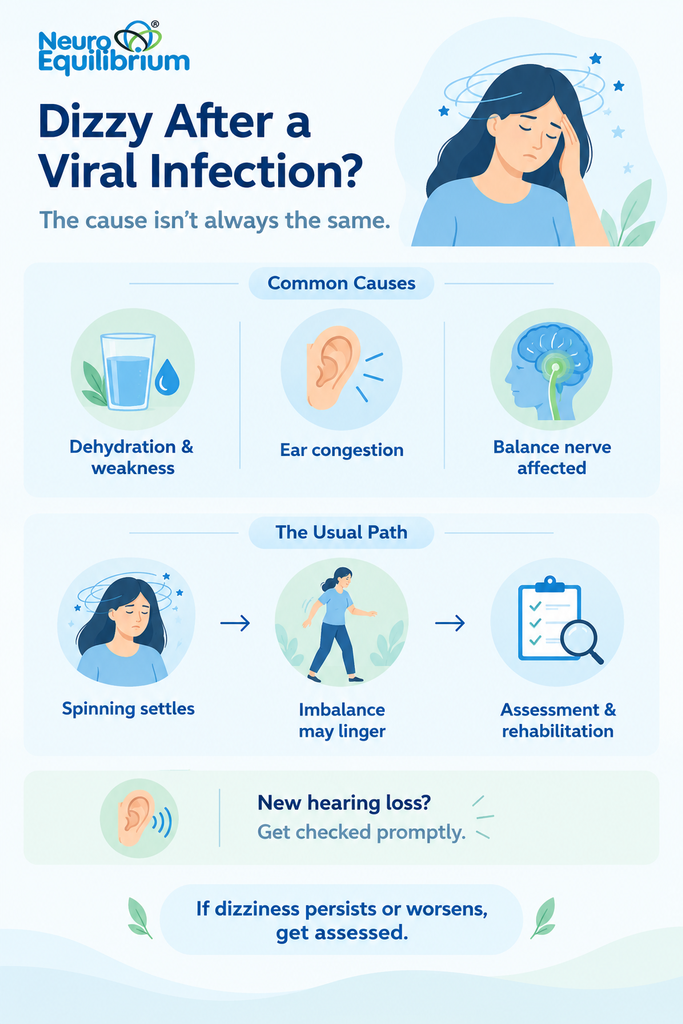
- Fever, poor eating and vomiting leave you dehydrated and weak. That usually feels like light-headedness, not spinning.
- Congestion and middle-ear inflammation can give you that blocked, slightly off-balance feeling.
- Broken sleep and illness can set off a migraine-related dizziness episode in people who are prone to migraines.
- The balance nerve itself can be affected – and that is where vestibular neuritis comes in.
What is vestibular neuritis?
The nerve that carries balance information from your inner ear up to your brain has a vestibular portion. In vestibular neuritis, that portion becomes inflamed or stops working properly, usually on one side. The balance signals from that ear fall away.
What follows is a sudden mismatch. One ear is still reporting normally. The other has gone quiet. Your brain reads the gap between them as violent movement – which is why vestibular neuritis rarely creeps up on anyone. It announces itself: intense, continuous vertigo, often with severe nausea and vomiting, real difficulty standing or walking, and involuntary jerking eye movements called nystagmus that a clinician can see on examination.
Vestibular neuritis may occur after a viral illness and is thought to involve inflammation or dysfunction affecting the vestibular nerve. That wording is careful on purpose. Not every viral infection leads to it. And not every case can be traced back to a virus anyone confirmed. What we can say is that the link is well recognised, and the timing – a few days to a couple of weeks after an illness – is often exactly what brings someone into a balance clinic.
One thing clearly separates it from the most common cause of vertigo. In BPPV, the spinning lasts under a minute and is set off by specific positions, like rolling over in bed or tipping your head back at the salon. A repositioning maneuver treats it. Vestibular neuritis does not work that way: the vertigo is continuous rather than momentary, and repositioning maneuver are not its treatment. Two different problems, two different plans.
Is it vestibular neuritis or labyrinthitis?
These two names get swapped around casually, but there is a practical difference – and it comes down to your hearing.
Vestibular neuritis affects balance without affecting hearing. When the inflammation also involves the hearing part of the inner ear, so that vertigo arrives together with hearing loss or significant new ringing, labyrinthitis is the more accurate word.
This is not a technicality for textbooks. New hearing loss alongside vertigo changes what needs to happen next, and how soon – so it should be checked promptly rather than written off as part of the infection. Separately, if vertigo keeps returning in episodes along with fluctuating hearing, ear fullness and ringing, a clinician may consider other conditions such as Ménière’s disease. That is a different diagnosis altogether, and it is not something a viral infection causes.
Symptoms people actually report
These symptoms vary a great deal from person to person, and nobody gets all of them. But the ones patients describe most often are:
- a spinning sensation, or the feeling that the room is moving
- unsteadiness while walking, or drifting towards one side
- reaching for a wall, a railing or someone’s arm without meaning to
- nausea, and sometimes vomiting
- feeling worse with movement – in an auto, a bus, a lift
- discomfort in crowded shops, on escalators, in bright busy places
- eye strain or queasiness while scrolling on the phone
- a clear jolt of dizziness with quick head turns
That last one is what people describe most vividly. Turning your head to check traffic before crossing. Looking up at the top shelf in the kitchen. Things that never required a second thought suddenly need concentration.
How long does dizziness after a viral infection last?
It helps to split this into two phases, because they behave quite differently.
The acute phase is when things are at their worst. With vestibular neuritis, this is the stretch of severe continuous vertigo, nausea and difficulty standing. It usually improves over a matter of days to a couple of weeks.
The recovery phase is longer and far less dramatic. The spinning has stopped, but something is left behind – unsteadiness, especially in the dark or on uneven ground, sensitivity to motion, discomfort in visually busy places, and mild dizziness when you move your head quickly. This phase is your brain adjusting to a balance organ that is now weaker on one side.
How long that second phase runs varies quite a lot. It depends on the underlying cause, how much vestibular function was affected, your age and general health, other medical conditions, and how actively you get back to moving. Anyone who hands you a guaranteed number of weeks is guessing.
What is fair to say is this: you should be able to see steady improvement over time. A long plateau, where nothing has changed in weeks, is a reason to get reassessed – not a reason to wait longer.
When dizziness after an infection should be checked
It is worth getting assessed when:
- the dizziness came on suddenly or is severe
- it has continued well past the original illness
- it is getting worse instead of better
- your balance is affecting walking, working or daily routine
- episodes keep coming back
- your hearing has changed
- nobody has been able to tell you why it is happening
None of these means something dangerous is going on. They simply mean the pattern deserves a proper look instead of more waiting.
Symptoms that need urgent care
Get emergency help if dizziness or vertigo comes along with any of these: weakness or drooping on one side of the face, new weakness or numbness in an arm or leg, trouble speaking or understanding speech, new double vision, severe difficulty walking or inability to stand, a sudden severe headache unlike any you have had, or loss of consciousness.
Some neurological conditions can look like an inner-ear problem in the first few hours. That is exactly why these particular symptoms should never be filed away as “probably just the infection.”
How is vestibular neuritis diagnosed?
There is no single test that confirms vestibular neuritis in every case. The diagnosis is built from the whole picture, and honestly, your history does most of the work.
A specialist will want to know how the symptoms started and how suddenly, whether the vertigo was constant or came in short bursts tied to certain positions, what illness came before it, whether your hearing has changed, and what you can and cannot do right now. Small details help – whether you could stand at all on day one, whether it was worse lying on one side, whether anyone at home noticed your eyes flickering.
Then comes the examination: watching your eye movements, including any nystagmus and how it behaves; a head impulse test, where the clinician turns your head quickly to one side and watches whether your eyes stay locked on a target; and a look at how you stand and walk.
Where the history and examination point that way, vestibular testing adds objective detail.
Videonystagmography (VNG) uses goggles fitted with small cameras to record your eye movements while you follow visual targets and while your head and body are placed in different positions. Because the inner ear and the eyes are wired together, those recordings help show which side is affected and how the balance system is responding.
The Video Head Impulse Test (vHIT) measures the vestibulo-ocular reflex – the automatic mechanism that keeps your vision steady while your head moves. Lightweight goggles track both eye and head movement during small, quick, unpredictable turns, giving a measure of how well each ear is responding.
A hearing assessment may be added where hearing symptoms are present, or where a clinician wants to separate vestibular neuritis from conditions that affect hearing as well as balance.
Not every patient needs every test. What gets done depends on your symptoms, your examination, and the specific question the clinician is trying to answer.
Treatment and recovery
Treatment depends on the phase you are in, and on what is actually causing the symptoms.
In the acute phase, the priorities are practical ones: staying safe, not falling, and keeping up fluids – prolonged vomiting causes problems of its own. Doctors sometimes prescribe short-term medication to bring down severe vertigo and nausea. These are used briefly and under supervision, because leaning on vestibular suppressants for weeks can actually slow your brain’s natural adaptation. Please do not start, stop or continue any medicine on your own reading of an article. That call belongs with your doctor.
As the worst of it settles, the focus shifts from resting to moving again – carefully, and in stages. This is the point where rehabilitation becomes the main part of your care.
Vestibular Rehabilitation Therapy for vestibular neuritis
Vestibular Rehabilitation Therapy (VRT) is the cornerstone of recovery for vestibular neuritis. Because vestibular neuritis involves inflammation of the balance nerve, it disrupts the signals sent from your inner ear to your brain. VRT works through a process called central compensation, essentially retraining your brain to rely on alternative signals (from your eyes and other muscles) to restore your balance.
A comprehensive vestibular rehabilitation protocol typically spans 6 to 8 weeks and is broken down into specific targeted exercise categories:
- Gaze Stabilization (VOR Exercises) – these work on your ability to keep your vision clear and steady while your head is moving. It is usually the function people notice most after vestibular neuritis, because it is what makes turning your head feel unsafe.
- Postural exercises – these build postural control and steadiness, training your body to hold and correct its position under different conditions.
- Tandem standing – this challenges balance by placing one foot directly in front of the other, narrowing your base of support. It should be done safely and under professional guidance.
A few honest notes to go with that. Rehabilitation protocols vary, and the 6 to 8 week figure describes a typical comprehensive programme – not a promise about how any one person will feel at the end of it. Some people need longer follow-up or further rehabilitation depending on their symptoms and vestibular function. Progress is rarely a straight line either. A temporary increase in dizziness during exercises can be part of how adaptation works, rather than a sign that something has gone wrong. What matters most is that the programme is built around your findings and properly supervised – not copied off a video.
What central compensation actually means
This one idea explains a lot, including why moving helps and why weeks of bed rest usually do not.
When one balance organ stops sending reliable information, the nerve is not necessarily being repaired. Instead, your brain recalibrates around the loss. It learns to weigh the remaining vestibular signals differently, to use vision more fully, and to lean harder on what your muscles and joints are reporting about position and ground contact. Gradually, the mismatch that was causing the spinning stops being read as movement at all.
Here is the important part: that adjustment is driven by exposure. Your brain updates its calibration only when it experiences the movements it currently finds difficult, in a controlled, graded way. Lying still in a dark room for weeks gives it nothing to work with – which is why long stretches of inactivity tend to stretch out the symptoms rather than protect you from them.
What recovery usually looks like
Recovery comes in stages, not all at once. The severe spinning settles first, and that change is usually obvious. Nausea eases next. Walking becomes possible, then becomes comfortable. What hangs around longest is the quieter layer: a wobble when you turn quickly, unsteadiness in a dark corridor, discomfort on a moving bus, and everything feeling worse on days when you are tired.
Many people measure themselves only against the spinning, decide they are “still not better,” and lose heart – when the symptom that remains is a different one, from a later stage of the same recovery. Noticing that shift is genuinely good news, and it is useful information for whoever is planning your rehabilitation.
The Bottom Line
Dizziness after a viral infection sits in an awkward space. It feels like a leftover, so people wait it out – and it is often only after weeks of unsteadiness, cancelled plans and holding on to furniture that anyone thinks to get it assessed.
Waiting a few days is reasonable. Waiting months, while your balance quietly shrinks what you are willing to do, is not. The point of an evaluation is not to find something frightening. It is to work out which part of the balance system is involved, so the right rehabilitation can be planned instead of guessed at.
NeuroEquilibrium’s clinics assess dizziness and balance problems through specialist consultation, vestibular testing where it is indicated, and rehabilitation designed around what those findings show. If your balance has not come back to normal since an infection, that is a sensible place to start.
What triggers visual vertigo?
Visual vertigo can be triggered by scrolling on screens, crowded places, traffic, busy patterns, supermarkets, escalators, and other situations with a lot of visual movement.
Can vertigo be triggered by screens?
Yes. Scrolling, fast-moving videos, gaming, and prolonged screen use can trigger or worsen dizziness in people with visual vertigo.
Why do I feel dizzy in crowded areas?
Crowded places have constant movement and changing visual information, which can make it harder for the brain to process balance signals and may trigger dizziness.
How long can visual vertigo last?
It depends on the underlying cause. Visual vertigo may improve within weeks, but symptoms can last longer if the underlying vestibular problem is not treated.
Is visual vertigo the same as PPPD?
No. Visual vertigo describes dizziness triggered by visual movement, while PPPD is a chronic vestibular disorder that can include visual vertigo along with other symptoms.