







Scrolling through your phone starts to feel unsteady. Driving in traffic makes your head swim. Walking through a busy market or mall leaves you gripping a wall for support. If moving visuals – not moving yourself – seem to be what sets off your dizziness, you may be dealing with visual vertigo, a real and well-recognized form of visually induced dizziness.
It’s an unsettling experience, especially because everyday environments most people don’t think twice about – a phone screen, a supermarket aisle, a busy road – become genuine triggers. The good news: visual vertigo is a recognized, explainable condition, and for most people it improves with the right evaluation and rehabilitation approach.
What Is Visual Vertigo?
Visual vertigo (also called visually induced dizziness or visual motion sensitivity) is a form of dizziness triggered specifically by what you see rather than by how you’re actually moving. Instead of a true spinning sensation, most people describe it as a sense of unsteadiness, disorientation, or “swimming” vision that appears – or gets noticeably worse – in visually busy or moving environments.
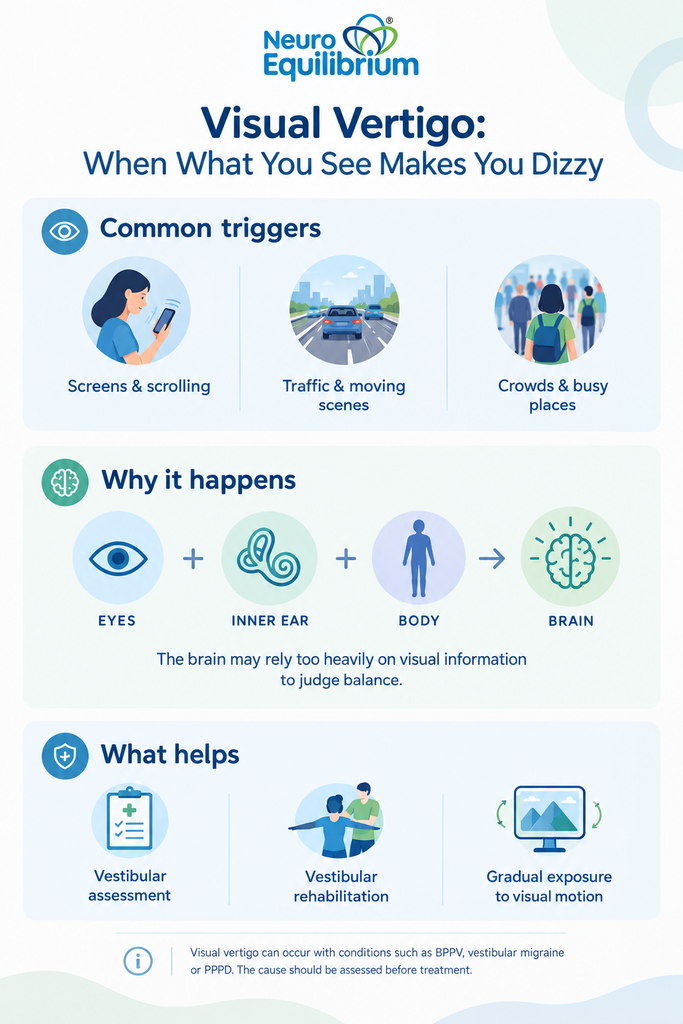
It happens because your brain relies on three systems working together to keep you balanced: your eyes, your inner ear (vestibular system), and receptors in your muscles and joints (proprioception). Normally, these three sources of information agree with each other. In visual vertigo, the brain starts giving disproportionate weight to visual input, so busy or moving scenes overwhelm the balance system even when the inner ear itself is working normally.
Importantly, visual vertigo is not “in your head” in the dismissive sense – it reflects a genuine, measurable change in how the brain processes balance information, and it’s a recognized feature seen alongside several vestibular conditions.
Common Symptoms of Visual Vertigo
Visual vertigo symptoms typically include:
- Dizziness or unsteadiness triggered by scrolling, busy patterns, or flickering screens
- A “swimming” or floating sensation in visually crowded spaces (malls, supermarkets, traffic)
- Disorientation when watching moving objects – traffic, escalators, crowds, or even fans/ceiling patterns
- Symptoms that ease when you close your eyes or focus on something still
- Fatigue, mental “fogginess,” or headache after visually demanding tasks
- Anxiety or avoidance of situations that reliably trigger symptoms
Unlike classic vertigo (BPPV or Ménière’s disease, for example), visual vertigo rarely causes a true spinning sensation. It’s more often described as unsteadiness, “wooziness,” or a feeling of being slightly out of sync with your surroundings.
What Causes Visual Vertigo?
Visual vertigo causes generally fall into two categories:
1. Following a vestibular event. Many people first notice visual vertigo after an episode of vestibular neuritis, labyrinthitis, BPPV, or a vestibular migraine attack. While the original trigger resolves, the brain can get “stuck” over-relying on vision to compensate – a pattern that persists even after the inner ear has recovered or been treated.
2. As part of a broader visual-vestibular mismatch pattern, most commonly seen in Persistent Postural-Perceptual Dizziness (PPPD), a chronic functional balance disorder in which the brain becomes hypersensitive to motion and visual stimulation. Visual vertigo is one of PPPD’s hallmark features, alongside a general sensitivity to upright posture and self-motion.
This is why an accurate diagnosis matters: the same symptom – dizziness triggered by visual busyness – can point to a resolving inner-ear issue, an underlying vestibular migraine, or PPPD, and each needs a different treatment approach.
Why Screens Trigger Dizziness
Can vertigo be triggered by screens? Yes – this is one of the most common patient-reported triggers today. Scrolling feeds, video content, and flickering or fast-refreshing screens all create continuous visual motion in a small, close field of view. For a brain that’s already over-relying on visual input to judge balance, this concentrated stream of movement is a strong trigger, often producing dizziness, eye strain, or a “foggy” feeling within minutes of screen use.
Why Traffic Triggers Dizziness
Dizziness in traffic – whether you’re driving or a passenger – happens for a similar reason. Passing vehicles, changing scenery at speed, and the visual “flow” of the road all provide large amounts of motion information. If your brain is misjudging how much of that motion to factor into your sense of balance, the mismatch between what your eyes see and what your inner ear and body report can bring on dizziness, disorientation, or a feeling of being slightly delayed relative to your surroundings.
Why Crowded Places Trigger Dizziness
“Why do I feel dizzy in crowded areas?” is one of the most frequent questions patients ask. Malls, markets, train stations, and busy streets combine several triggers at once: multiple moving objects (people, trolleys, vehicles), repetitive visual patterns (shelving, tiled floors, escalators), and a lack of a single fixed point to focus on. This sensory overload is a classic trigger for visual vertigo and is often one of the first symptoms patients notice when they start avoiding certain outings.
How Visual Vertigo Relates to the Vestibular System
Visual vertigo isn’t a separate, unrelated condition – it’s best understood as a pattern of imbalance within your existing vestibular system. Your brain constantly weighs input from your eyes, inner ear, and body to construct your sense of balance. When one of these systems is compromised or recovering, the brain can over-compensate by leaning too heavily on vision – which works fine in a still, quiet room, but breaks down the moment the visual environment starts moving.
This is precisely the mechanism seen in PPPD, and it’s also why visual vertigo often lingers as a “residual” symptom even after an original vestibular problem (like vestibular neuritis or BPPV) has technically resolved.
How Is Visual Vertigo Diagnosed?
Because visual vertigo can accompany several different underlying conditions, an accurate diagnosis starts with identifying whether there’s an active or resolved vestibular issue, and how the visual, vestibular, and postural systems are interacting. A structured vestibular evaluation may include:
- Videonystagmography (VNG) – assesses eye movement control and inner-ear function
- Computerized posturography – measures how much you rely on vision versus vestibular and proprioceptive input to stay balanced, which is particularly useful in visual vertigo
- Dynamic Visual Acuity (DVA) testing – checks how well your gaze stays stable during head movement
- A detailed symptom history to distinguish visual vertigo from other causes of dizziness, including checking for underlying PPPD, vestibular migraine, or unresolved peripheral vestibular weakness
This step matters because treating the symptom without understanding its cause rarely gives lasting relief.
Visual Vertigo Treatment: What Actually Helps
There’s no need for alarm – visual vertigo is a well-recognized, treatable pattern, and most patients see meaningful improvement with the right approach. Visual vertigo treatment typically centers on vestibular rehabilitation, not medication, since the goal is to retrain how the brain processes and weighs visual information, not to suppress a symptom.
Vestibular Rehabilitation for Visual Vertigo
Vestibular rehabilitation therapy (VRT) uses graded, structured exposure to the very triggers that cause symptoms – busy visual scenes, optokinetic (moving pattern) exercises, and gaze stabilization drills – to help the brain recalibrate and reduce its over-reliance on vision. This typically includes:
- Habituation exercises that gradually and safely reintroduce visual motion, building tolerance over time
- Gaze stabilization exercises to strengthen the connection between eye movement and head movement
- Balance retraining to rebuild confidence in the vestibular and proprioceptive systems, reducing dependence on vision alone
- In select cases, VR-based rehabilitation, which can simulate controlled visual-motion environments (like a busy street or scrolling pattern) in a safe, monitored setting
Recovery is usually gradual rather than immediate, and progress is often measured in weeks, not days. Avoiding triggers altogether tends to make visual vertigo worse over time, since the brain never gets the chance to relearn how to tolerate them – supervised, gradual exposure is the more evidence-supported path forward.
When Should You See a Specialist?
If dizziness from screens, traffic, or crowded places is becoming a regular part of your life – especially if you’ve started avoiding places or activities because of it – it’s worth getting a proper vestibular evaluation rather than assuming it will resolve on its own or relying only on symptom-suppressing medication. A structured assessment can identify whether there’s an underlying trigger (such as unresolved BPPV, vestibular migraine, or PPPD) and guide you toward a rehabilitation plan built for your specific pattern of symptoms.
What triggers visual vertigo?
Visual vertigo can be triggered by scrolling on screens, crowded places, traffic, busy patterns, supermarkets, escalators, and other situations with a lot of visual movement.
Can vertigo be triggered by screens?
Yes. Scrolling, fast-moving videos, gaming, and prolonged screen use can trigger or worsen dizziness in people with visual vertigo.
Why do I feel dizzy in crowded areas?
Crowded places have constant movement and changing visual information, which can make it harder for the brain to process balance signals and may trigger dizziness.
How long can visual vertigo last?
It depends on the underlying cause. Visual vertigo may improve within weeks, but symptoms can last longer if the underlying vestibular problem is not treated.
Is visual vertigo the same as PPPD?
No. Visual vertigo describes dizziness triggered by visual movement, while PPPD is a chronic vestibular disorder that can include visual vertigo along with other symptoms.