







Every year, millions of people seek medical care for dizziness, vertigo and balance disorders. Yet for many, reaching the correct diagnosis takes longer than it should.
At NeuroEquilibrium, we have treated more than 2 lakh patients with dizziness and balance disorders. Our data of these 2L patients shows that, on average, a patient consults 3.7 doctors before receiving the correct diagnosis. Many undergo repeated investigations or try different medications along the way.
As a neurotologist who has spent more than three decades caring for patients with vestibular disorders, this has been one of the most consistent challenges I have observed.
It raises an important question: how can we improve vestibular care not only for patients who reach specialised centres, but also for those seeking treatment in hospitals and clinics across the country?
I believe a large part of the answer lies in strengthening clinical education.
Vestibular Medicine Has Evolved. Training Needs to Keep Pace.
Vestibular medicine has changed dramatically over the last two decades. Advances in research, diagnostics and rehabilitation have given clinicians a much deeper understanding of balance disorders.
Today, technologies such as VNG, SVV, DVA and vHIT allow us to assess different components of the vestibular system with far greater precision.
But technology alone does not lead to better patient outcomes.
A test result must still be interpreted in the context of the patient’s history, symptoms and clinical examination. Clinicians need to recognise patterns of nystagmus, differentiate peripheral from central causes of vertigo, select appropriate investigations and understand what the findings mean for the individual patient.
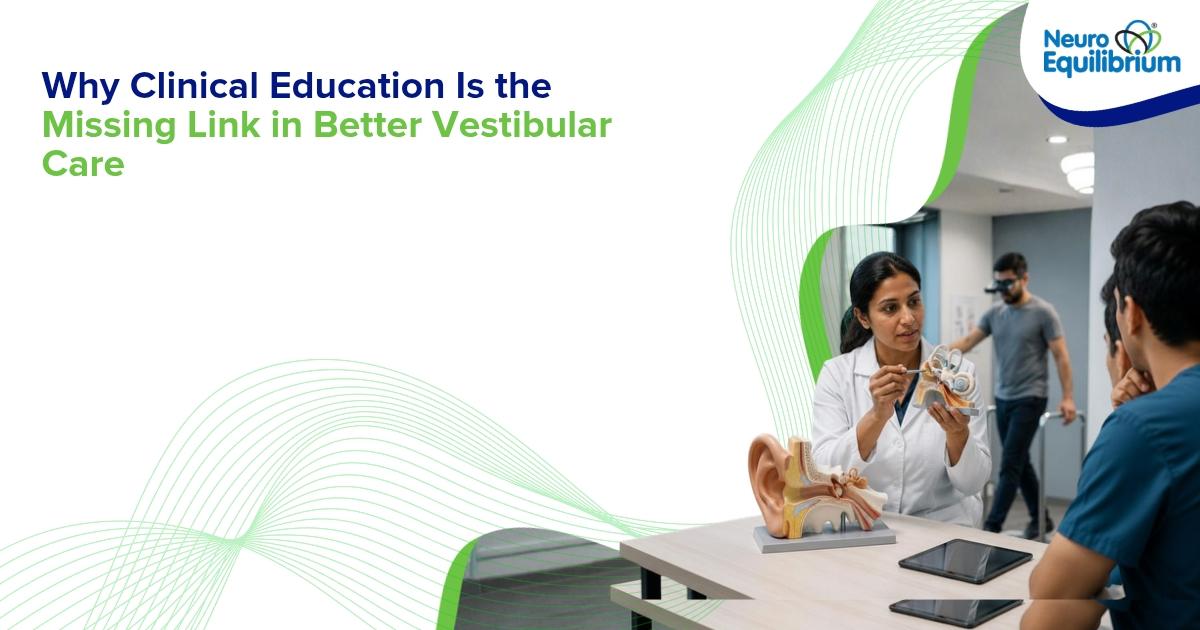
These are skills that cannot be developed through textbooks alone. They require repeated exposure to patients, observation, clinical reasoning and mentorship.
That is where structured clinical education becomes important.
What More Than 2 Lakh Patients Have Taught Us
Some of the most important lessons in vestibular medicine come from patients themselves.
Over the years, we have encountered patients whose symptoms did not fit neatly into textbook descriptions. Some presented with common disorders in uncommon ways. Others had complex conditions that challenged conventional thinking. In many cases, a carefully taken history helped explain what the investigations were showing.
The question then became how we could share that experience with more clinicians.
Turning Clinical Experience Into Education
When we built NeuroEquilibrium, our vision extended beyond creating specialised clinics. We wanted to contribute to the advancement of vestibular medicine through clinical care, technology, research and education.
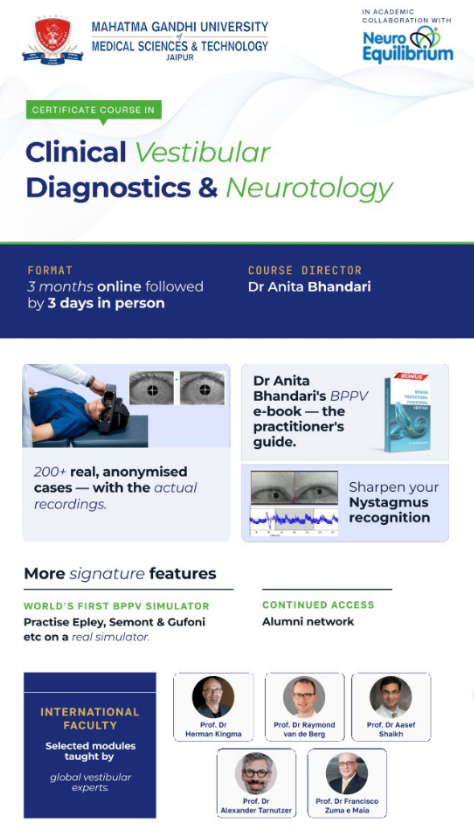
This philosophy eventually led NeuroEquilibrium, in academic collaboration with Mahatma Gandhi University of Medical Sciences & Technology (MGUMST), to develop the Certification Programme in Clinical Vestibular Diagnostics and Neurotology.
The objective is to bridge the gap between theoretical knowledge and practical clinical application.
Participants learn through more than 200 anonymised patient cases and actual vestibular recordings. The programme combines structured learning with case discussions, simulation-based training and hands-on workshops.
Rather than studying vestibular disorders only as concepts, clinicians can observe how conditions present in real patients, interpret diagnostic findings and understand how those findings influence clinical decisions.
The programme also provides opportunities to learn from nationally and internationally recognised faculty, bringing together different clinical perspectives and experiences in vestibular medicine.
Ultimately, the objective is not simply to provide another qualification. It is to help clinicians return to their practices with greater confidence in evaluating and managing patients with dizziness and balance disorders.
Better Education Can Shorten the Patient’s Journey
For me, the impact of clinical education ultimately comes back to the patient.
If a clinician recognises BPPV earlier, a patient may avoid months of unnecessary treatment.
If subtle signs of a central vestibular disorder are identified sooner, it can change the course of further investigation and management.
And if clinicians become more confident in selecting and interpreting vestibular investigations, patients can reach the correct diagnosis faster.
The impact of training one clinician can therefore extend far beyond the classroom. Over the course of a career, that knowledge can influence the care of hundreds or even thousands of patients.
That is what makes education such an important part of improving vestibular care at scale.
The Future of Vestibular Care
Vestibular medicine will continue to evolve. Artificial intelligence, digital diagnostics, simulations and new technologies will create opportunities to diagnose and manage balance disorders with increasing precision.
But technology should complement, not replace, clinical judgement.
Patients will continue to need clinicians who listen carefully, recognise clinical signs, interpret investigations in context and continue learning throughout their careers.
That is the future we want to help build at NeuroEquilibrium.