







If you experience vertigo, spinning, imbalance, motion sensitivity, or blurred vision during movement, vestibular physiotherapy may be more appropriate than general physiotherapy when these symptoms are related to the vestibular system and its role in balance. General physiotherapy may be helpful when weakness, stiffness, posture, joint problems, or reduced mobility contribute to unsteadiness. However, vertigo is a symptom rather than a diagnosis, and treatment depends on its underlying cause. A vestibular assessment can help determine whether you may benefit from vestibular rehabilitation, a repositioning maneuvers, general physiotherapy, or a combination of approaches.
What Is the Difference Between Vestibular and General Physiotherapy?
People experiencing spinning, chakkar, feeling off balance, unsteadiness, or dizziness may wonder whether they need general physiotherapy or a more specialised form of rehabilitation.
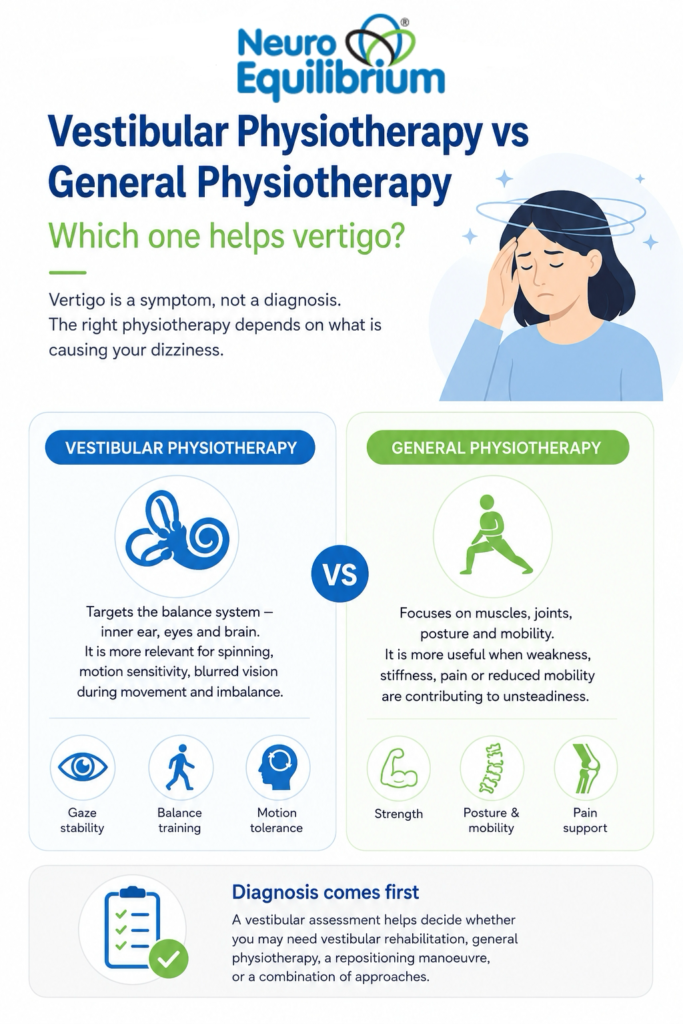
General physiotherapy can be beneficial when muscle weakness, joint stiffness, posture problems, or reduced mobility contribute to unsteadiness. Vestibular physiotherapy, on the other hand, focuses specifically on disorders of the vestibular and balance systems and how they interact with vision and movement.
For many people with vertigo, the first step is therefore not simply starting exercises. The cause of the symptoms needs to be understood so that treatment can be matched to the specific problem rather than relying on general exercises for vertigo.
| Vestibular physiotherapy | General physiotherapy | |
| Main focus | Vestibular system, balance, gaze stability, and motion tolerance | Muscles, joints, strength, posture, mobility, and flexibility |
| May be considered when | Spinning, head-movement dizziness, motion sensitivity, blurred vision during movement, or imbalance | Weakness, stiffness, posture problems, joint problems, or reduced mobility |
| Treatment may include | Gaze stabilisation, habituation, balance and walking exercises, visual-motion training | Strengthening, mobility, posture, flexibility, and walking training |
| Does everyone with vertigo need it? | No. Treatment depends on the cause | No. It may help when musculoskeletal or physical limitations contribute to instability |
| Is assessment useful first? | The cause of vertigo should be evaluated before selecting treatment | Assessment helps determine whether physical weakness or musculoskeletal problems are contributing |
Vertigo is a specific type of dizziness in which a person may feel that they or their surroundings are spinning or moving. Dizziness is a broader term and may also describe light-headedness, floating, unsteadiness, or feeling off balance. This distinction matters because not every form of dizziness is caused by a vestibular disorder or treated with vestibular physiotherapy.
Know More About
- Vestibular Neuritis Symptoms: Early Warning Signs You Shouldn’t Ignore
- Top 5 Vestibular Rehabilitation Exercises for Vertigo Relief
- How Neuro Rehabilitation Helps Patients Recover
What Does Vestibular Physiotherapy Treat in People With Vertigo?
The vestibular system is an important part of the body’s balance system. It is located in the inner ear and works together with vision and information from the muscles and joints to help the brain detect head movement and maintain balance.
If these signals do not work together properly, a person may feel spinning, floating, swaying, unsteady, or find it difficult to keep their vision stable while walking.
Vestibular physiotherapy, also known as Vestibular Rehabilitation Therapy (VRT), is a specialised form of rehabilitation that uses targeted exercises to help the brain adapt to and better process information involved in balance and movement. Depending on the individual’s symptoms and assessment findings, it may include gaze stabilisation, head and eye movements, balance and walking exercises, and activities designed to improve tolerance to movements that trigger dizziness.
The aim of vestibular rehabilitation is not simply to improve physical strength. It is to help the brain effectively use information from the vestibular system, vision, and the body to improve balance, movement, and function during everyday activities.
When Can General Physiotherapy Help Someone With Dizziness or Imbalance?
General physiotherapy may be useful when musculoskeletal or physical factors contribute to dizziness-related unsteadiness or difficulty with movement. It may include treatment for back or neck problems, joint injuries, muscle weakness, poor posture, reduced flexibility, or difficulty walking after surgery or illness.
For example, someone who is unstable because of weak legs may benefit from strength and fall-prevention training. A person with neck stiffness may require mobility and posture work.
However, improving muscle strength does not necessarily correct a problem with the inner-ear balance system. If the main symptoms include spinning, dizziness with head movement, blurred vision while walking, or repeated imbalance, a vestibular assessment may be more useful before exercises are selected.
Sometimes both approaches are useful. Physiotherapy for vertigo can address the vestibular problem, while general physiotherapy may help improve strength, postural stability, mobility, and confidence while walking.
Does Physiotherapy Help Every Type of Vertigo?
Vertigo is a symptom rather than a diagnosis. Different causes of vertigo can produce similar symptoms, so the same exercise programme may not be appropriate for every patient.
Vertigo or imbalance may be associated with BPPV, vestibular neuritis, labyrinthitis, vestibular migraine, Persistent Postural-Perceptual Dizziness (PPPD), or reduced vestibular function.
Dizziness can also have non-vestibular causes, including changes in blood pressure, medicines, or other medical conditions.
The pattern of symptoms can help guide evaluation. A specialist may ask whether spinning occurs when rolling in bed or changing head position, whether vision becomes shaky or blurred during walking, whether busy environments such as malls, crowds, or traffic trigger dizziness or unsteadiness, and whether symptoms occur in episodes or persist over longer periods.
These patterns can help determine whether physiotherapy management for vertigo may involve a repositioning manoeuvre, gaze training, habituation, balance exercises, or another approach.
No single physiotherapy approach is appropriate for every cause of vertigo. Management depends on the underlying diagnosis.
Does BPPV Need Physiotherapy or a Repositioning Maneuver?
Short episodes of spinning triggered by changes in head position are commonly associated with BPPV. BPPV occurs when tiny calcium carbonate crystals, known as otoconia, become displaced into one of the semicircular canals of the inner ear, where they can interfere with normal balance signals.
For appropriately diagnosed BPPV, a canalith repositioning maneuvre, such as the Epley maneuver, may be recommended according to the affected ear and semicircular canal. These movements are intended to help return the crystals to the appropriate location.
The correct repositioning manoeuvre depends on the affected ear and canal. It should therefore be selected and performed or advised under appropriate specialist supervision rather than attempted independently without a confirmed diagnosis.
If imbalance or sensitivity to movement persists after the intense positional spinning has resolved, vestibular rehabilitation may then be considered.
Vestibular exercises should be selected according to the diagnosis, symptoms, and assessment findings rather than using the same exercise programme for every type of vertigo.
What Exercises May Be Used in Vestibular Physiotherapy for Vertigo?
Depending on the individual’s symptoms, diagnosis, and assessment findings, different types of exercises may form part of a vestibular rehabilitation programme.
Gaze Stabilisation Exercises
Gaze stabilisation exercises are used to help the eyes remain stable during head movements. They may be useful when objects appear to blur or shimmer while walking or moving the head.
Habituation Exercises
Habituation exercises involve repeated exposure to movements that provoke dizziness to help reduce sensitivity to those movements over time.
Balance and Walking Training
Balance and walking exercises may include standing on different surfaces, walking while moving the head, changing direction, or performing tasks that challenge balance in different situations.
Visual-Motion Training
If symptoms become worse in traffic, while scrolling, in malls, or in supermarket aisles, visual-motion training may be included as part of rehabilitation.
These are not one-size-fits-all exercises. Not every patient requires each type of exercise. The exercise selected, its difficulty, and the speed of progression depend on the underlying vestibular problem, symptoms, balance ability, and response to rehabilitation.
Assessment helps determine whether vestibular rehabilitation is appropriate and which exercises may be relevant for dizziness, gaze stability, balance, and day-to-day function.
How Do Specialists Decide Which Physiotherapy Is Needed for Vertigo?
Evaluation generally begins with the patient’s symptoms, medical history, and clinical examination. The pattern of vertigo such as whether it is triggered by head position, movement, or visually busy environments can help guide the next step.
A person with a vestibular disorder may have normal muscle strength while still experiencing dizziness, blurred vision with movement, or imbalance. A strength assessment alone may therefore not explain vestibular symptoms.
Vestibular testing may be considered when clinically indicated to assess different aspects of vestibular and balance function. The tests selected depend on the patient’s symptoms, clinical findings, and suspected cause. No single vestibular test can identify every cause of vertigo, so test results should be interpreted alongside the patient’s history and clinical examination.
DVA assesses visual acuity during head movement. A vHIT is used to assess the vestibulo-ocular reflex (VOR), which helps maintain stable vision during rapid head movements.
Each test examines a particular aspect of balance or vestibular function, so the results need to be interpreted alongside the patient’s symptoms and clinical examination. A single test does not determine the cause of every case of vertigo.
The findings can help determine whether treatment may involve a repositioning maneuvre, gaze stabilisation, balance retraining, general physiotherapy, vestibular rehabilitation, or another management approach.
When May Virtual-Reality Rehabilitation Be Used for Vertigo?
Some people may feel comfortable in a quiet room but become dizzy in a crowded market, on an escalator, near moving traffic, or while watching a large screen.
VR-based rehabilitation can simulate visually challenging situations in a controlled and graded setting. The difficulty can be progressed gradually while the patient practises gaze control, balance, and movement tasks, according to their symptoms and rehabilitation goals.
When clinically appropriate, VR-based rehabilitation may be combined with gaze stabilisation, sensory retraining, and balance exercises for people whose symptoms are triggered by movement or visually busy settings.
It may also be useful for people who experience dizziness or blurred vision while moving or who are concerned about walking in busy areas because they worry that dizziness may return.
Can Vestibular and General Physiotherapy Be Used Together?
Vertigo can affect how a person walks and moves. Someone concerned about another episode of spinning may walk more slowly, avoid turning their head, reduce physical activity, or move more cautiously. Over time, these changes may contribute to reduced strength, mobility, or confidence with movement.
Over time, this may contribute to weakness or reduced confidence with movement.
In these situations, vestibular physiotherapy may help address balance processing and dizziness, while general physiotherapy may help improve strength, mobility, and safer movement.
The two approaches can complement each other when a patient has both vestibular symptoms and physical problems such as weakness or reduced mobility.
The more useful question is not which type of physiotherapy is universally better, but which system is contributing to the patient’s symptoms.
How Long Does Physiotherapy for Vertigo Take to Work?
There is no fixed number of physiotherapy sessions that is appropriate for everyone with vertigo.
Some people with appropriately diagnosed BPPV may improve relatively quickly after the correct repositioning maneuvre, while vestibular weakness, persistent motion sensitivity, or chronic imbalance may require a longer rehabilitation programme.
As balance improves, exercises may be made more challenging. A therapist can adjust head speed, walking tasks, visual backgrounds, and the amount of assistance required for balance.
The duration and progression of physiotherapy for vertigo therefore depend on the diagnosis, symptoms, and individual response rather than a standard programme for everyone.
When Does Vertigo Need Urgent Medical Assessment?
New, sudden, severe, or unexplained dizziness should not automatically be assumed to be a problem that requires physiotherapy exercises. Some causes of dizziness may require prompt medical assessment.
Urgent medical evaluation is recommended for new or worsening vertigo accompanied by symptoms such as:
- weakness or numbness on one side
- slurred speech or confusion
- double vision
- a severe new headache
- fainting
- chest pain or shortness of breath
- sudden hearing loss
- significant new difficulty standing or walking
These warning signs require medical assessment rather than assuming that the symptoms should be managed with physiotherapy exercises.
What May Vertigo Assessment and Rehabilitation Involve?
If vertigo persists, a list of general exercises may not be enough. A diagnosis-first approach can help determine which part of the balance system may be affected before rehabilitation begins.
Depending on the diagnosis and clinical findings, care may involve vestibular evaluation and selected vestibular tests, BPPV repositioning, customised vestibular physiotherapy, gaze and head-movement training, balance and walking exercises, posturography, hearing assessment, or VR-based rehabilitation where clinically appropriate. Not every patient requires every assessment or treatment; the approach is tailored to the individual’s symptoms and functional needs.
For example, someone with BPPV may require an appropriate repositioning maneuvre, while a person with vestibular weakness may require gaze-stabilisation and balance training. Someone whose symptoms are mainly triggered by busy visual environments may need a different rehabilitation approach.
The combination of assessment and rehabilitation therefore depends on the patient’s symptoms and findings.
NeuroEquilibrium follows a diagnosis-first approach to help determine which form of vestibular or physical rehabilitation may be appropriate.
What Should You Do Next if You Have Vertigo or Repeated Imbalance?
If you are experiencing repeated spinning, dizziness with head movement, motion sensitivity, blurred vision during movement, or unexplained imbalance, consider getting your symptoms assessed before starting a general exercise programme. Identifying the likely cause can help determine the most appropriate treatment approach.
A clinical and vestibular assessment can help determine whether the problem may require a repositioning maneuvre, vestibular rehabilitation, general physiotherapy, or another form of medical evaluation.
If weakness, stiffness, posture, or mobility problems are also present, general physiotherapy may form part of the rehabilitation plan alongside vestibular treatment.
NeuroEquilibrium provides specialised assessment and rehabilitation for vertigo and balance disorders, with treatment tailored to the patient’s symptoms, clinical findings, diagnosis, and functional needs. The goal is to help patients improve balance, manage dizziness, and return to walking, working, and everyday activities with greater confidence.
Frequently Asked Questions
Is vestibular physiotherapy better than general physiotherapy for vertigo?
Vestibular physiotherapy may be more appropriate when vertigo or imbalance is related to the vestibular and balance systems. General physiotherapy primarily focuses on muscle strength, joints, posture, mobility, and other physical or musculoskeletal factors. The appropriate treatment depends on the underlying cause of the symptoms
What does vestibular physiotherapy do for vertigo?
Vestibular physiotherapy may use targeted exercises to improve gaze stability, balance, walking, and tolerance to movements or visual situations that trigger dizziness. The rehabilitation program is individualized according to the patient’s symptoms, diagnosis, and assessment findings.
Can general physiotherapy cure vertigo?
General physiotherapy primarily focuses on strength, mobility, posture and musculoskeletal issues. Vestibular examination and treatment for vestibular conditions may be more appropriate if vertigo is associated with a vestibular condition.
Does BPPV need vestibular physiotherapy?
BPPV may be treated with an appropriate canalith repositioning manoeuvre based on the affected ear and semicircular canal. If imbalance, motion sensitivity, or unsteadiness persists after the positional vertigo has resolved, vestibular rehabilitation (VRT) may be considered.
How do specialists decide which physiotherapy is needed for vertigo?
The symptom pattern, medical history, and a clinical examination are all considered first by specialists. Vestibular tests (VNG, vHIT or DVA) may be performed when clinically warranted. The results from the tests do not necessarily identify the cause of every case of vertigo, but can guide treatment options such as repositioning, gaze stabilisation, balance retraining or other treatment.
How long does vestibular physiotherapy take to work?
There is no fixed treatment duration for vestibular physiotherapy. Some people with appropriately diagnosed BPPV may improve relatively quickly after repositioning, while vestibular weakness, persistent motion sensitivity, or chronic imbalance may require a longer rehabilitation programme. Progress depends on the underlying condition, symptoms, functional goals, and individual response to treatment.