








You woke up in the morning, and the room began to spin as soon as you rolled over. It lasted only 20 seconds, but those 20 seconds were very frightening. And now you are asking yourself: Will this go away on its own? And how long will this last? Is it safe to wait?
These are the right questions. We will walk through everything you need to know in simple, straightforward terms.
What Is BPPV and Why Does It Cause That Sudden Spinning Feeling?
BPPV stands for Benign Paroxysmal Positional Vertigo. It is one of the most common causes of vertigo, and although it can feel frightening, it usually has a clear and treatable cause.
Inside your inner ear are tiny calcium crystals, almost like fine grains of sand, that help your brain sense balance. They normally stay in the correct place. Sometimes, however, these crystals become displaced and move into the wrong part of the inner ear.
When that happens, certain head movements send confusing signals to your brain. Your brain thinks you are spinning even though you are not. The result is a sudden, sharp spinning sensation that usually lasts no more than 30 seconds to 1 minute when you turn over in bed, look up, or bend down.
The spinning episodes are short. But the condition itself can last much longer.
Know More About BPPV
- Just Diagnosed with BPPV? Here’s what to do next?
- How the Epley Maneuver Can Help Relieve BPPV Symptoms Fast
- How Do I Know If My Vertigo Is BPPV or Something Else?
How Long Does BPPV Last If You Don’t Get Treatment?
This is often the first question patients search for, and the honest answer is: it depends. In some cases, it may last for weeks or even months.
BPPV can sometimes go away on its own. The loose crystals can sometimes drift back into place over time. But “over time” may mean weeks of dizziness, disturbed sleep, and fear of turning your head the wrong way every day.
A rough, untreated timeline may look like this:
- Days 1–7: Dizzy spells are common, often with multiple episodes a day. Mornings can be especially difficult.
- Weeks 2–4: Episodes may become unpredictable. Many people begin avoiding movements that trigger spinning, which can slow the natural recovery process.
- Months 1–3: Some cases begin to settle. Others remain active and disruptive.
- Beyond 3 months: Some cases of untreated BPPV may still continue without clear signs of resolving naturally.
The most important point to note is that although each dizzy attack may last only a few seconds, the condition may persist for a frustratingly long time without proper BPPV treatment. And the longer it lasts, the more it can affect your daily life and safety.
A 2019 PMC report confirms that: Only 18% resolve spontaneously after 1 month, 42% after 6 months, 51% after 1 year, 40%+ persist beyond 12 months untreated.
What Are the Real Risks of Leaving BPPV Untreated?
This is the part many people do not take seriously enough. Because the attacks are brief, BPPV may seem mild. But leaving it untreated is not safe. The risks look like this:
1. Dangerous Falls, Especially for Older Adults
Falling is the greatest risk of untreated BPPV. Even a 20-second spinning episode can make someone lose balance and fall. A fall can lead to a broken hip, spinal fracture, or serious head injury, especially in older adults.
Falls are one of the leading causes of serious injury and injury-related death in older adults. One preventable cause of those falls is BPPV. This alone is a strong reason to seek BPPV treatment as soon as possible rather than delay it.
2. Disruption of Daily Life
Even very basic tasks get tiresome when you experience untreated vertigo. Waking up, picking something up from the floor, glancing up at a shelf, or turning your head while driving can all become anxiety-inducing moments.
Daily activities, such as reaching for an item on a high shelf or bending down to tie a shoelace, often become significant hurdles that cause people to limit their natural range of motion.
3. Anxiety, Fear of Falling, and Social Isolation
Because you do not know when the next dizzy spell will strike, your brain stays in a constant state of caution. You are frightened to move about. You may start avoiding places, people, and activities.
Over time, this anxiety can become a problem in itself and may contribute to long-term chronic dizziness even after the original BPPV has been treated. That is why it is so important to start BPPV treatment as soon as possible. The longer the problem continues, the more complicated it can become.
4. Higher Risk of BPPV Coming Back
BPPV is known to recur. Treatment not only helps resolve the current episode but also helps identify possible contributing factors and reduce the risk of future recurrences. Doing nothing and hoping it improves will not help prevent future episodes.
“Untreated BPPV spontaneous recovery takes weeks to months as crystals may settle naturally, but carries high risks: falls (leading cause of injury/death in older adults), psychological distress (fear of falling → anxiety/depression/social isolation), and loss of independence (restricted mobility, reliance on caregivers). With treatment, repositioning maneuvers resolve symptoms. Same-day patients enter dizzy, exit confident.”
Dr. Anita Bhandari, Co-founder, NeuroEquilibrium Vertigo Clinics
What Does Proper BPPV Treatment Actually Involve?
The good news is this: BPPV treatment is one of the quickest and most effective treatments in medicine.
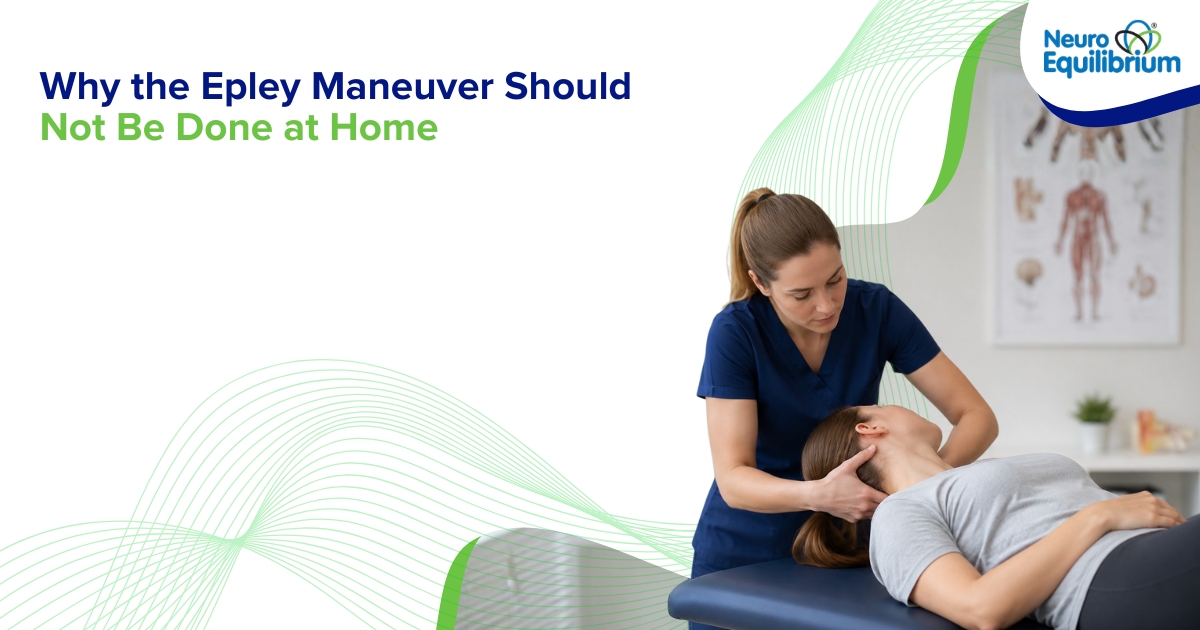
A Canalith Repositioning Maneuver is a series of guided head and body movements performed by a trained specialist, such as the Epley maneuver, Semont maneuver, or Zuma maneuver. Each movement helps guide the loose inner ear crystals back to their proper place.
The result? Most patients experience significant relief after just one or two sessions. No surgery. No long-term medication. No weeks of waiting. But these maneuvers need to be performed correctly.
Using the wrong maneuver or performing the right one incorrectly can worsen symptoms. That is why a proper diagnosis should come first.
Why BPPV Test Matters Before Treatment Begins
BPPV is not the only cause of dizziness. Conditions such as Meniere’s disease, vestibular migraine, or vestibular neuritis can look similar but require completely different treatment. Starting the wrong treatment or skipping proper diagnosis can delay real recovery.
A proper BPPV evaluation examines eye movements during specific changes in head position. The Dix-Hallpike test is the most common BPPV test and helps a specialist determine which ear is affected and which canal the crystals have moved into. This knowledge will directly influence the repositioning maneuver that will be effective.
Advanced balance clinics may also use tools such as:
- Videonystagmography (VNG), which monitors eye movements linked to inner ear signals
- Video Head Impulse Test (vHIT), which evaluates inner ear function during quick head movements
- Computerized Posturography, which assesses whole-body balance
Getting the right BPPV test is not a minor detail. It is what makes treatment quick, accurate, and effective rather than a guessing game.

Can BPPV Come Back Even After Successful Treatment?
Yes, BPPV does recur in some people. Some studies suggest that nearly half of patients may experience recurrence within five years. Recurrence may be more common in people with certain medical conditions, vitamin D deficiency, or a history of head trauma.
That is why the advice of a specialist is important not just during the initial visit. All of this is part of a long-term approach to BPPV management, including understanding your personal risk factors, knowing which symptoms to watch for, and having a plan in place if symptoms recur.
Why Choose NeuroEquilibrium for Your BPPV Diagnosis and Treatment?
If you are experiencing spinning spells and wondering whether to wait or seek medical help, this section is for you.
NeuroEquilibrium is the largest network of clinics in India that specializes in vertigo and balance disorders. The entire setup is built around one goal: identifying the exact cause of your dizziness and ensuring it is properly treated for the first time.
The following is what is unique about the approach:
- Proper BPPV testing: A special BPPV Maneuver Guidance System helps ensure the correct canal is identified, and the right maneuver is performed each time.
- State-of-the-art diagnostic tools: VNG, SVV and DVA testing are all available in one place.
- Condition-specific repositioning treatment: Whether it is the Epley, Semont, or another maneuver depends on your precise diagnosis.
- Online rehabilitation: Vestibular rehabilitation can also be provided online for patients who cannot easily access a clinic.
- Whole person care: Since BPPV can sometimes occur alongside anxiety or other balance disorders, treatment considers the full picture, not just the inner ear.
You do not have to keep waking up afraid to move. Spinning is not something you have to live with.
The Bottom Line: Waiting for BPPV to Resolve on Its Own Is a Risk Not Worth Taking
BPPV may resolve on its own, but it can take months, and each passing day brings real risks: falls, fear, disturbed sleep, and increasing anxiety. The longer it goes untreated, the more difficult recovery can become.
With the right BPPV test and proper treatment, you may get your life back in just one or two sessions. It may seem simple, but it can make a huge difference.
Do not wait if spinning spells are affecting your mornings, your sleep, or your confidence. Thousands of patients in India have found relief and returned to normal life with NeuroEquilibrium.
Find a NeuroEquilibrium clinic near you and take the first step in living a spin-free life.
Frequently Asked Questions
What is the main cause of BPPV?
Benign Paroxysmal Positional Vertigo is primarily caused by tiny crystals (otoconia) moving into the wrong part of the inner ear. These crystals migrate into the semicircular canals, which disturbs normal balance signals to the brain, causing short bursts of spinning dizziness, particularly during head movements.
What are the risks of leaving BPPV untreated?
BPPV can lead to falls, particularly among the elderly. It may also cause anxiety, limited mobility, sleep disturbance, and fear of falling. Eventually, it can even cause chronic dizziness.
How do you get tested for BPPV?
Benign Paroxysmal Positional Vertigo is usually diagnosed through the Dix-Hallpike Test used by doctors. In this test, the patient is moved into specific positions to provoke vertigo and monitor eye movements (nystagmus), which is used to verify the condition.
What are the 5 D’s of BPPV?
The 5 D’s are often used as red-flag neurological symptoms in the assessment of dizziness, including dizziness, diplopia (double vision), dysarthria (slurred speech), dysphagia (difficulty swallowing), and dysmetria (lack of coordination). These are not typical BPPV symptoms; rather, they are warning signs that may point to a more serious neurological condition.
What are BPPV red flags?
Red flags are symptoms that suggest the dizziness may not be simple BPPV, but something more serious. These include severe headache, double vision, difficulty speaking, feeling weak or numb on one side of the body, difficulty walking, or losing consciousness. These indicators can be signs of conditions such as stroke and require urgent medical treatment.