







You’ve had an MRI. It came back normal. You’ve had blood tests. Also normal. And yet you cannot get through a grocery aisle without thinking the floor is moving under you. You are not imagining it, and the scans are not wrong.
The fact is, standard tests do not assess how your balance system functions. Posturography comes in at that point. If you have been searching for answers for weeks or months, this test may provide the clarity you need.
What Is Posturography and How Is It Different from an MRI or CT Scan
Most patients who experience chronic dizziness have at some point been referred for an MRI or CT scan. These are significant tests that identify structural issues such as tumors, strokes, or lesions. However, the key point is that they capture images of your brain and inner ear. They actually do not measure the actual performance of your balance system in real time.
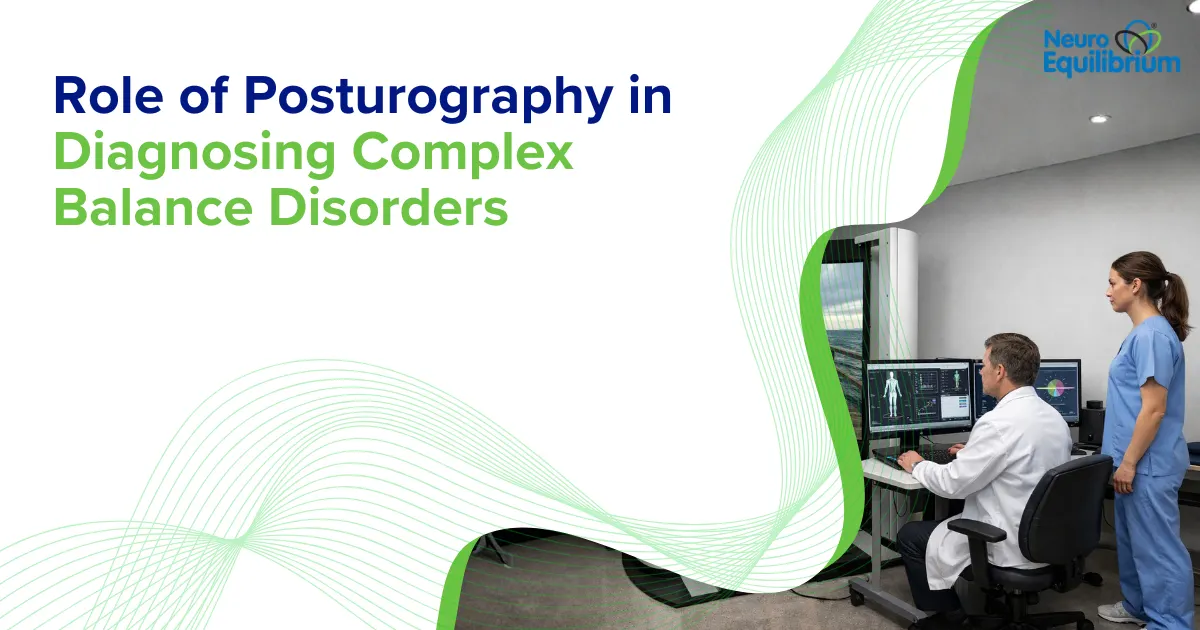
Posturography is an entirely different type of test. Rather than imaging, it quantitatively assesses your body’s functional stability and its ability to actually stand, respond, and stabilize in various circumstances. You stand on a specialized platform, and the platform moves gently or tilts as sensors capture the precise response of your body.
Think of it this way: an MRI examines whether or not the engine parts are physically intact. Posturography checks whether the engine is functioning correctly.
It is this difference that makes posturography so important in patients with complicated or chronic balance problems that are inexplicable by scans.
Know More About
- How to Cure Motion Sickness Permanently: Doctor Insights
- What Is Cerebellar Ataxia? Meaning, Symptoms, and Treatment Explained
- Electrolyte Imbalance & Dizziness: How Hydration Affects Your Balance
Understanding How Your Balance System Works – and What Goes Wrong
To see what posturography detects, it is a bit easier first to understand how balance functions. Three systems work together to maintain your balance:
- Your inner ear (vestibular system): sense of motion and gravity.
- Your eyes (vision): help confirm what your body senses.
- Your muscles and joints (proprioception): inform the brain about your body’s position in space.
And when the three are transmitting proper, compatible signals, you remain on your feet without even having to think about it. However, when one of these systems transmits incorrect or contradictory information due to injury to the vestibular system or inner ear damage, or a neurological problem, your brain becomes confused. The effect is dizziness, unsteadiness, and the impression that the ground is not where it ought to be.
This is where a VNG test becomes important. The VNG test (Videonystagmography) measures involuntary eye movements to assess the communication between the inner ear and the brain. While the VNG test directly evaluates the inner ear, posturography looks at the entire system of the inner ear, vision, and proprioception as a team.
The Relevance of Posturography for Older Adults at Risk of Falls
Balance disorders are a frequently underdiagnosed cause of falls in both adults over 65 and falls overall, as falls are the most common cause of serious injury in adults over 65. Older adults are often dismissed as simply being a little unsteady on their feet. But unsteadiness has causes, and the causes can be determined and treated.
Posturography is a quantified and objective measure of fall risk. It does not depend on what the patient reports in their description of their symptoms or what the doctor observes during their gait. It generates precise data on sway, weight distribution, and sensory compensation that can help specialists determine which patients are at risk and develop specific rehabilitation to enhance their strength, posture, and balance prior to a fall.
In older adults who have already fallen, posturography can be used to determine the cause of the fall and what requires modification to avoid the next one.
Why Do You Need to Request a Posturography Assessment
You may wish to ask your physician to order a posturography evaluation in case:
- You have felt dizzy or unsteady over more than a few weeks.
- Your CT scan or MRI was normal and you still have symptoms.
- Your VNG test results did not fully indicate your balance problems in your day-to-day life.
- You feel significantly worse in crowded or visually stimulating environments.
- You have had a fall or are in danger of one.
- You have a diagnosed vestibular condition and are interested in the way your rehabilitation is going.
- You are wobbly when not in motion, particularly when you have your eyes shut.
No one of these situations is to live with. They all can be researched, diagnosed, and treated.

Why Use NeuroEquilibrium to assess and diagnose balance
When you were told that your tests were normal, yet you continue to struggle on a daily basis, you require a team that specializes in balance disorders rather than a team that treats this as an incidental part of treatment.
NeuroEquilibrium is a specialty clinic for vertigo and balance disorders in India, Posturography is one of several methods used in vestibular assessment more broadly. It is not part of NeuroEquilibrium’s standard test battery, which includes VNG, SVV, DVA and Caloric Testing, selected according to the patient’s symptoms and clinical findings.. The VNG test, the Computerized Dynamic Posturography, and the Video Head Impulse Testing (vHIT) is offered, along with the Rotary Chair assessment, Vestibular Evoked Myogenic Potential (VEMP) testing, and VR-based rehabilitation, all in a single building.
What sets this apart from a typical clinic is that the diagnostic method is comprehensive and objective. Instead of just relying on symptoms, all tests provide specific, measurable data on exactly how your vestibular system is performing. That information leads to the diagnosis. And diagnosis leads to a treatment regimen designed specifically for you, not a standardized regimen.
You may be having your first bout of dizziness or have long-standing chronic unsteadiness, but a posturography test with a VNG test will provide you with answers that no MRI will ever provide.
Last Consideration: Normal Scan Does Not imply normal balances
Granted that your brain scan is clear and you still feel that you are walking on a ship, you are not imagining that. You just have not had an appropriate test.
Posturography assesses the performance of your balance system in reality. When used in conjunction with a VNG test and a complete vestibular examination, it may offer the best possible representation of what is going wrong and how to make it right.
Frequently Asked Questions
What does a VNG test diagnose?
A Videonystagmography identifies issues of the inner ear and the balance system through eye movements in response to visual and positional change. It can be used to detect diseases like Benign Paroxysmal Positional Vertigo, vestibular neuritis, and other ear (vestibular) diseases, and also can be used to determine whether the cause of dizziness is the ear or the brain.
Is VNG testing worth it?
Yes, it is worth Videonystagmography when you experience frequent, unexplained or severe dizziness. It gives you specific details on how your balance system is operating and it aids the doctor to diagnose the cause of vertigo with a higher degree of accuracy, resulting in more precise and effective treatment.
How do I prepare for a VNG test?
You might be asked to take a break of 24-48 hrs before a Videonystagmography because some medications such as sedatives or dizziness medications may interfere with measurements of the type of eye movement (Tiemann, 2010). During the day of the test, it is better to avoid alcohol, caffeine, and heavy meals. You are also supposed to be in good rest and dress in comfortable clothes because the test will require you to move the head and the eyes.
What is called the red flag in vertigo?
In vertigo, the red flags are the alert signs that can be used to indicate that it is something serious, not just an inner ear problem. They consist of intense headache, blurred vision, speech problems, and weakness in one side of the body, lack of coordination, or chest pains, which may indicate such conditions as stroke. These symptoms with persistent/progressive vertigo demand urgent medical intervention.
How will I feel after a VNG test?
Some individuals might experience brief and mild dizziness, nausea or imbalance after a Videonystagmography as the test causes the inner ear to be triggered. These symptoms normally disappear in a matter of minutes or a few hours. It is advisable to rest after the test and not to drive right after you feel dizzy.