







For most people in India, driving is not optional. It is how you get to work, drop the children at school, reach the hospital for a follow-up. So when vertigo shows up, one of the first questions patients ask, often before they ask about treatment, is: “Doctor, can I still drive?” The honest answer is that it depends, and the rest of this guide explains on what, so you can make a safer decision and know when to ask for help.
Is It Safe to Drive With Vertigo?
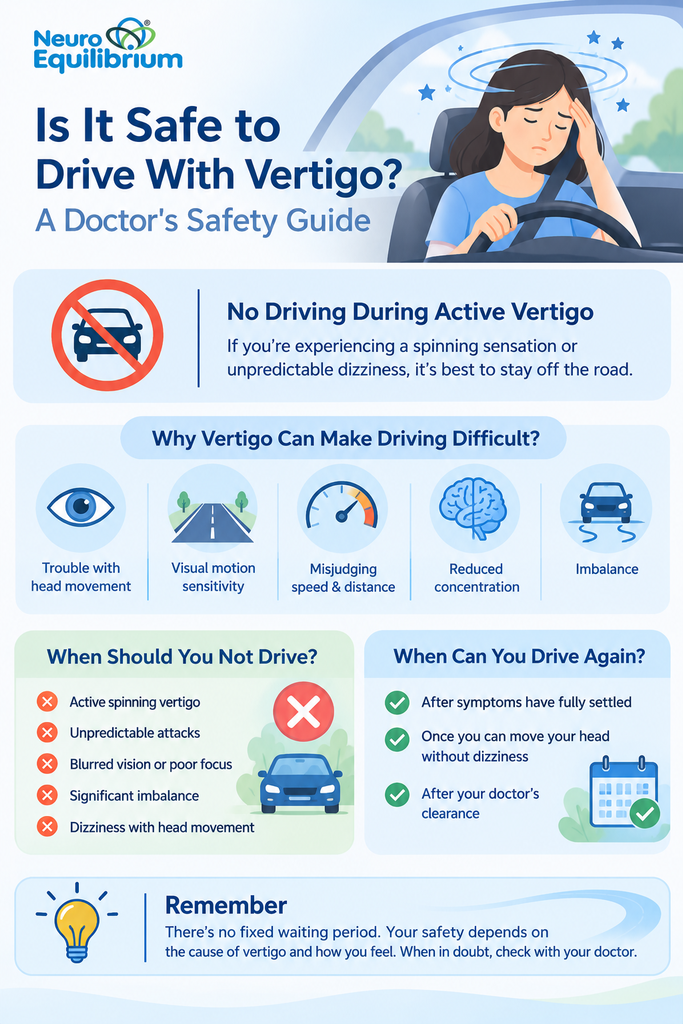
Driving with vertigo is not safe while symptoms are active, unpredictable, or triggered by ordinary driving movements such as turning your head to check a mirror. When you can return to driving depends on the underlying cause, how well your symptoms are controlled, and an assessment of your individual situation. There is no fixed waiting period that applies to everyone.
That last line matters. A ten-second spin from loose crystals in the inner ear and an hour-long Ménière’s attack that arrives without warning are not the same problem, and they do not carry the same risk behind the wheel.
Why Can Vertigo Make Driving More Difficult?
Safe driving depends on three systems working together: your eyes, your inner-ear balance organs, and the sense of position from your muscles and joints. Your brain blends these signals constantly. Am I moving, or is the car next to me moving? How fast is that truck approaching? Where is my lane?
Vertigo disrupts this blending. Depending on the cause, a person may notice:
- Trouble with head movement. Checking mirrors, glancing over a shoulder at a two-wheeler, or looking up at a signboard can trigger a spin.
- Visual motion sensitivity. Busy traffic, headlights at night, or flyover railings flashing past can feel overwhelming. Patients often describe it as the road moving more than it should.
- Misjudging speed and distance. When the inner ear is not sending reliable information, the brain can misread how fast you or other vehicles are moving.
- Slowed reactions and poor concentration. Fighting nausea or a spinning sensation uses up attention that should be on the road.
- Imbalance getting in and out of the car or when the vehicle stops suddenly.
Patients are not imagining this. When researchers writing in the Journal of Safety Research interviewed people with vestibular disorders about driving, the situations they struggled with most were quick head turns, poor visibility, and anything that required judging where they were in space. Which is a long way of saying: “I feel mostly fine” is not the same as “I am safe to drive.”
When Should You Not Drive With Vertigo?
You should avoid driving if you currently have:
- active spinning vertigo
- vertigo attacks that come without warning
- significant imbalance or unsteadiness while walking, sitting or standing
- blurred or jumping vision, or difficulty focusing on moving objects
- trouble concentrating or feeling “foggy”
- dizziness triggered by turning your head, looking up, or looking over your shoulder
Each of these gets in the way of something driving requires. An active spin removes your ability to control the vehicle at all. Unpredictable attacks cannot be planned around. Head-movement triggers are the most underestimated: if you cannot check your right mirror without a lurch of dizziness, you will either stop checking it or be caught mid-spin when you do. Neither is acceptable in Indian traffic.
One more point. Please do not “test” whether you are safe by taking the car out in traffic to see how it feels. If you are unsure, that uncertainty is the answer for now.
When Can I Drive After Vertigo?
This is the question everyone wants a number for, and it is the one a responsible doctor will not give a number to. What we do instead is talk it through, and the conversation usually comes down to a handful of things.
The first is whether the episode has completely settled. Not “mostly better.” Settled. The second is whether it is a one-off or part of a pattern; a single resolved episode is a very different situation from attacks that keep returning or arrive without warning. Then comes the diagnosis itself, because BPPV, vestibular migraine, Ménière’s disease and vestibular neuritis each carry different driving considerations, which the next sections cover.
After that, we look at where you are in treatment and, just as importantly, what is left over. Many people are free of spinning but still have residual dizziness, a wobble on quick turns, or a flicker of unease when they look over their shoulder. If head movement still triggers anything, if your vision jumps or blurs when you move, or if concentration is not back to normal, the answer is “not yet,” whatever the calendar says. Finally, there is the question of medicines and alertness, covered below, and your own doctor’s advice for your specific condition, which outweighs anything in a general article like this one.
If you can honestly say the spinning is gone, your symptoms are predictable, you can turn your head fully in both directions and check mirrors and blind spots without dizziness, your balance holds when you stop or change direction, and your doctor sees no reason to hold off, you are probably close. If any of that gives you pause, that is fine. Most people get there.
A note on medicines
Some medicines prescribed for dizziness, nausea, migraine prevention or anxiety can cause drowsiness, slowed reactions, reduced alertness or blurred vision. Not all of them do, and not in everyone. Read the label, and if a medicine makes you feel sleepy or slow, do not drive while taking it. If you are unsure, ask your doctor or pharmacist whether your prescription affects driving. Do not stop a prescribed medicine on your own because of driving concerns; ask about alternatives instead.
Do licensing rules apply?
They may. In India, the standard driving licence declaration (Form 1 under the Central Motor Vehicles Rules, 1989) asks whether the applicant suffers from “sudden attacks of loss of consciousness or giddiness from any cause.” Some countries go further; in the UK, drivers must notify the licensing authority about dizziness that is sudden, disabling or recurrent. The principle is the same everywhere: recurrent or unpredictable vertigo is a genuine road-safety concern, not a minor inconvenience.
Is It Safe to Drive After BPPV Treatment?
Benign paroxysmal positional vertigo, or BPPV, is one of the most common causes of vertigo. Tiny calcium crystals in the inner ear drift into the wrong canal, and specific head positions, such as rolling over in bed, looking up, or bending down, set off a brief but intense spin.
You can probably already see the problem. The movements that trigger positional vertigo are the same movements driving keeps asking for. Turning to check a blind spot, looking up at an overhead sign, or reversing with your head turned can all provoke an episode. Some people with BPPV are barely affected by horizontal head turns; others are very sensitive to them. That difference matters more than the diagnosis itself.
BPPV treatment usually involves a repositioning maneuver, performed by a trained clinician once the affected canal has been identified. When the right maneuver is used for the right canal, it often resolves the positional spinning. That is good news, but it is not a green light to drive home the same afternoon.
Even after a maneuver that works, many patients notice residual dizziness for a few days, sometimes longer. It is not the spinning; it is more of a lightheaded, slightly unsteady, “I don’t quite trust my head yet” feeling while the brain recalibrates. And BPPV can come back, so a good result today is not a promise that the crystals will stay where they belong.
Before driving after BPPV treatment, check for any remaining positional symptoms, residual dizziness or imbalance, hesitation when turning your head, or visual discomfort. Ideally, a follow-up review should confirm the positional vertigo has actually cleared.
What About Other Vestibular Conditions and Driving?
Not all vertigo is BPPV, and the driving risk changes with the cause.
Vestibular migraine
Dizziness, visual motion sensitivity and disorientation can occur with or without a headache. Someone with vestibular migraine may feel fine on a quiet road and struggle badly in dense evening traffic or under flickering streetlights. Attacks can last hours. If episodes are frequent or hard to predict, driving during a symptomatic phase is not advisable, and trigger management is worth discussing with your doctor.
Ménière’s disease
Here the concern is different from BPPV. Ménière’s attacks tend to be prolonged, and in some people they arrive with little warning. That unpredictability, more than the severity of any single attack, is what makes driving decisions harder. People with frequent or unheralded attacks are usually advised not to drive until the condition is controlled, and to be cautious about long solo journeys.
Vestibular neuritis and other inner-ear injuries
Nobody should drive during the first days of severe vertigo. The trap comes later. As the spinning fades, a person may be left with imbalance, a sense that the world “bounces” when they move their head, or difficulty with quick head turns. These are exactly the abilities driving depends on, and they can persist for weeks or months while the brain compensates.
Persistent or residual dizziness
Across all of these, be honest about the difference between “my vertigo is gone” and “I still feel off.” An active spinning attack, lingering lightheadedness, chronic imbalance, visual motion sensitivity and difficulty with head movement are different symptoms. Only the first is what most people call “vertigo,” but every one of them can affect driving.
Can Vestibular Rehabilitation Help With Driving?
For some vestibular conditions, yes. In fact, “I want to be able to drive again” is one of the most common goals patients bring to their first rehabilitation session, and it is a good one, because it is specific.
Vestibular rehabilitation therapy is a structured programme of exercises that helps the brain adapt to a change in inner-ear balance signals. Depending on the condition and what the assessment shows, it may target gaze stability (keeping vision clear while the head moves), motion tolerance (reducing the sensitivity that makes busy traffic overwhelming), balance, and confidence in movement. Those map directly onto driving: checking mirrors is a gaze-stability task, a crowded junction is a motion-tolerance challenge, and confidence is what lets you turn your head without bracing for a spin.
Two cautions. Vestibular rehabilitation is not a requirement for everyone before driving; someone whose BPPV has fully resolved may not need it at all. And it does not automatically make driving safe. The exercises need to be selected and progressed for the individual, based on what vestibular testing shows, and progress reviewed rather than assumed.
What Should You Do If Vertigo Starts While Driving?
Even careful people can be caught out. If dizziness or vertigo begins while you are already on the road:
- Stay calm. Panic makes the sensation worse and your reactions poorer.
- Ease off the accelerator and reduce speed gradually. Do not brake hard.
- Avoid sudden steering or lane changes. Keep the car straight and steady.
- Signal and pull over at the first safe opportunity, such as the road shoulder, a service lane or a petrol pump, and switch on your hazard lights.
- Do not restart until the symptoms have fully passed. If they linger, do not talk yourself back into driving.
- If symptoms are severe or unusual, call someone. Ask a family member to collect you, or take a cab. If you are worried about your health, call for emergency help rather than driving yourself to hospital.
On a two-wheeler the same principles apply, but the margin for error is far smaller. Slow down, move to the left, and stop as soon as you safely can.
When Should You See a Doctor About Vertigo and Driving?
Most vertigo is not dangerous in itself, but some symptoms need urgent medical attention regardless of any driving decision. Seek emergency care immediately if dizziness occurs together with:
- sudden weakness or numbness, especially on one side of the body
- drooping of the face
- difficulty speaking or understanding speech
- a sudden, severe headache unlike any you have had before
- fainting or near-fainting
- chest pain or breathlessness
- severe difficulty walking or standing
- new double vision
- sudden hearing loss in one ear
These symptoms do not tell you what is wrong, but they do tell you that you need to be assessed quickly. Do not drive yourself to the hospital. Call for emergency help or have someone take you.
Outside of emergencies, see a vertigo specialist if your vertigo keeps coming back, has not settled despite treatment, has never been clearly explained, or leaves you unsure whether driving is safe. Vertigo is a symptom, not a diagnosis. A proper vestibular evaluation, which may include tests such as VNG to record eye movements alongside other measures of inner-ear and balance function, can usually clarify which part of the balance system is involved. That is what allows treatment and any rehabilitation to be planned around your actual condition rather than guessed at.
Driving Again, With Confidence
The goal of vertigo treatment is not just to stop the spinning. It is to give you back the ordinary things: sleeping on either side, walking through a market, and driving to work without a knot in your stomach.
If driving with vertigo is still a worry because your symptoms are recurring, unexplained, or affecting your confidence on the road, a detailed evaluation with a vestibular specialist can help identify the underlying cause and whether targeted treatment or vestibular rehabilitation may be appropriate for you. NeuroEquilibrium’s vertigo and balance clinics across India offer this kind of assessment. Until then, drive only when you are sure, and let someone else take the wheel when you are not.
Frequently Asked Questions
Can I still drive if diagnosed with vertigo?
Possibly, but not while symptoms are active or unpredictable. It depends on whether your episodes are controlled, whether head movement still triggers symptoms, and your doctor’s judgment for your specific condition. Many people return to driving once the cause is identified and treated.
Does vertigo get worse when driving?
It can. Frequent head turns, fast-moving visuals, and sudden speed changes can all provoke or worsen dizziness – busy traffic, night driving, and highway speeds are common triggers. If driving reliably brings on symptoms, that’s a sign your balance system hasn’t fully recovered.
How long should you wait to drive after vertigo?
There’s no standard waiting period – it depends on the cause, whether attacks are recurring, any residual dizziness, and whether medication affects your alertness. Your doctor can help you judge this. If you wouldn’t feel comfortable reacting to a sudden hazard, you’re not ready yet.
Is it safe to drive after BPPV treatment?
Not automatically. Residual dizziness is common for a few days after a repositioning maneuver, and BPPV can recur. Before driving, confirm head movements no longer trigger symptoms, your balance feels stable, and ideally that a follow-up has confirmed the vertigo has cleared.
What should I do if vertigo starts while I am driving?
Stay calm, ease off the accelerator, and pull over safely with your hazards on as soon as you can. Wait until symptoms fully pass before driving again – if they persist, get someone else to take you home, and call for emergency help if you notice weakness, slurred speech, or a sudden severe headache.