







Dizziness or imbalance can be alarming, especially when you cannot pinpoint the cause. Although most vertigo originates from the inner ear or brain, problems in the cervical spine can also affect balance and may lead to cervicogenic vertigo. Because of this overlap, many people search online asking whether can cervical neck problems cause vertigo or whether can neck problems cause vertigo when their symptoms appear together.
Because these symptoms overlap with other conditions, it often goes undiagnosed, leaving people confused and searching for answers. We will try to explain what cervicogenic vertigo is, how neck issues contribute to dizziness, what mechanisms are involved, and why a thorough evaluation with specific vertigo tests is essential for finding the real cause and choosing the right treatment.
What Is Cervicogenic Vertigo?
Cervicogenic vertigo is a type of dizziness caused by dysfunction in the cervical spine (neck). The condition occurs when abnormal signals from neck muscles, joints, or nerves interfere with the brain’s balance-processing systems.
Unlike inner-ear vertigo, cervicogenic dizziness is commonly associated with:
- Neck pain and stiffness
- Poor posture
- Whiplash injuries
- Limited neck movement
- Headaches and imbalance
Many people describe the sensation as:
- Floating
- Unsteadiness
- Feeling off-balance
- Light-headedness
- Difficulty focusing while walking
Understanding Cervicogenic Vertigo
Cervicogenic vertigo (also known as cervicogenic dizziness) is a condition in which the brain’s balance mechanisms receive incorrect signals from the neck. The human balance mechanism depends on the synchronized input of:
- The inner ear (vestibular system)
- The eyes
- Position and motion sensory nerves in the neck.
The brain becomes confused when the neck sends distorted or conflicting signals due to pain, stiffness, damage, or other structural problems. A person might become light-headed, unsteady or even feel the ground moving under him/her instead of undergoing severe spinning. Specific movements of the head or neck usually trigger these sensations.This explains why people experiencing both neck discomfort and imbalance frequently ask: can neck pain cause vertigo or can neck problems cause vertigo.
Studies suggest that chronic neck dysfunction and poor cervical proprioception may significantly contribute to persistent dizziness and balance disorders.
Common Symptoms of Cervicogenic Dizziness
Symptoms commonly reported include:
- Neck pain and dizziness occur together
- Feeling unsteady while walking
- Light-headedness
- Head pressure or headaches
- Neck stiffness
- Reduced neck mobility
- Shoulder tightness
- Difficulty concentrating
- Dizziness triggered by head movement
- Symptoms worsening after prolonged screen time
Emergency Symptoms That Need Immediate Medical Attention
Seek urgent care if dizziness occurs with:
- Slurred speech
- Sudden weakness
- Chest pain
- Double vision
- Facial drooping
- Severe headache
- Loss of consciousness
These symptoms may indicate a stroke or neurological emergency rather than cervicogenic vertigo.
Know More About Vertigo
- Positional Vertigo Treatment: Causes, Diagnosis, and Treatments
- Vertigo vs Dizziness: Understanding the Key Differences and When to Seek Medical Help
- Why Some Vertigo Treatments Don’t Work the First Time
Who Is Cervical Physiotherapy Most Appropriate For?
Neck-focused rehabilitation may be considered when several findings occur together:
- Dizziness and neck pain or stiffness have a clear temporal relationship
- Neck movement is restricted or uncomfortable
- Symptoms worsen with sustained neck posture or specific cervical movements
- There is a relevant history such as whiplash or neck injury
- The physical examination identifies cervical movement, strength, endurance or proprioception deficits
- BPPV, vestibular migraine and other more common causes have been appropriately considered
- There are no emergency neurological or vascular warning signs
- Symptoms improve as measurable neck impairments improve
The diagnosis becomes less convincing when dizziness occurs independently of neck symptoms, when true spinning follows classic BPPV triggers, when hearing symptoms dominate or when another vestibular or neurological diagnosis better explains the episodes.
Supervised Physiotherapy vs Home Care
| Supervised care is preferable when | Home care may be appropriate when |
| The diagnosis remains uncertain | A clinician has assessed the patient and provided a specific programme |
| Symptoms began after whiplash or another significant injury | Symptoms are stable and there are no warning signs |
| Neck movement causes substantial pain or dizziness | The patient can perform the prescribed movements safely and correctly |
| There is restricted neck movement, weakness or significant balance impairment | Exercises are being used to maintain progress between appointments |
| The patient has fallen or is at significant fall risk | Standing and walking are safe without assistance |
| Symptoms worsen rather than settle with exercises | The clinician has explained what level of symptom response is acceptable |
| Neurological symptoms or unexplained visual symptoms occur | Progress and symptoms are being monitored and reviewed |
How Neck Problems Disrupt Balance
Several cervical spine conditions may influence balance. The most frequent contributors include:
1. Muscular Tension and Postural Strain
Such unhealthy postures that are sustained during a long duration can cause a lot of tension in the neck muscles, which can be as a result of bending forward to the screens or prolonged hours of studying. This strain interferes with the proprioceptors and causes the instability or mild dizziness which may be accompanied by cervicogenic vertigo. A stiff neck does not appear to be that serious however in the long run, it may impair the quality of signal transferred to the brain in relation to balance.Persistent posture-related strain can sometimes lead to symptoms described as neck pain and dizziness, which may require targeted neck pain and dizziness treatment through physiotherapy and posture correction.
2. Trauma and Whiplash Injuries
It is through this disruption of the neural tracts that deal with balance, either temporarily or permanently, due to the injuries that can be caused by the neck whiplash. Whereas the acute pain has subsided, people can report chronic dizziness, lack of concentration or balance which can be a sign of cervicogenic vertigo.
3. Structural Changes in the Cervical Spine
The degeneration of the age, disc problems, or arthritic changes may aggravate the harmonious working of cervical joints. This may disrupt proprioception, make the eyes, ears and neck perceive something that seems like, causing the lack of balance or being lightheaded, which occasionally causes cervicogenic vertigo.This is why patients frequently ask whether cervical spondylosis can cause vertigo or whether their dizziness is actually dizziness due to cervical spondylosis. While not all cases of spondylosis cause vertigo, degenerative cervical changes may contribute to balance disturbances in some individuals.
4. Reduced Blood Flow (Rare but Important)
In a disorder known as vertebrobasilar insufficiency, some of the movements of the neck may limit the supply of blood to the parts of the brain that regulate the sense of balance. Though this is rare, it may cause dizziness, blurred vision, or instability, and in some cases may be confused with cervicogenic vertigo.
What Causes Neck Pain and Dizziness Together?
Several conditions can cause simultaneous neck pain and dizziness:
| Condition | How It Causes Dizziness |
| Poor posture | Alters neck muscle tension and balance signals |
| Cervical spondylosis | Degenerative changes affect cervical nerves |
| Whiplash injury | Disturbs cervical proprioception |
| Vestibular migraine | Neck tightness accompanies migraine episodes |
| Herniated cervical disc | Irritates nearby nerves |
| Muscle spasms | Restrict neck movement and sensory feedback |
| Anxiety and stress | Increase neck tension and dizziness perception |
Neck Pain Is Often Misinterpreted as True Vertigo
A common misunderstanding is that degenerative neck disorders directly cause true spinning vertigo, i.e., spinning sensations. Cervical problems are rarely spinning causing bad balance. This misconception usually causes people to relate the neck pain with the vertigo and resort to unnecessary imaging tests such as MRI.
True spinning vertigo is most commonly associated with:
- Benign Paroxysmal Positional Vertigo (BPPV)
- Vestibular migraines
- Inner ear infections
- Neurological conditions
Understanding this difference helps avoid misdiagnosis and unnecessary testing.This is also why understanding the difference between vertigo and spondylitis-related dizziness is important. While cervical spondylitis mainly causes neck pain and stiffness, vertigo is more commonly linked to inner-ear or neurological conditions.
Neck Dizziness vs Other Common Patterns
| Pattern | What it may suggest |
| Dizziness or imbalance closely linked with neck pain, stiffness and restricted neck motion | A cervical contribution may be considered after competing causes are assessed. |
| Brief spinning when rolling over, lying back or looking upward | BPPV is more typical than cervicogenic dizziness. |
| Vertigo with migraine, light sensitivity, sound sensitivity or visual motion intolerance | Vestibular migraine may need evaluation. |
| Vertigo with fluctuating hearing, tinnitus or ear fullness | An inner-ear disorder requires hearing and vestibular assessment. |
| Persistent rocking in supermarkets, crowds or while scrolling | PPPD, vestibular migraine or visual-motion sensitivity may be contributing. |
| Lightheadedness after standing | Blood pressure, dehydration or medicine effects may be more relevant. |
| Sudden severe vertigo with neurological symptoms | A central or vascular emergency must be excluded. |
When Neck Pain Is Actually a Symptom, Not the Cause
In some cases, dizziness does not start in the neck at all. Instead, it originates from the brain or the inner ear, and neck pain appears only as a secondary symptom. A good example is vestibular migraine.
In vestibular migraine, dizziness or vertigo is the primary symptom, and it may occur with or without a headache. Many people also notice neck pain before or during a migraine episode. This often happens because stress, a common migraine trigger, causes increased tension in the neck muscles. In such situations, treating the neck alone will not relieve the dizziness, because the underlying issue is neurological rather than cervical, and therefore not related to cervicogenic vertigo.
Cervicogenic Vertigo vs BPPV: What’s the Difference?
| Feature | Cervicogenic Vertigo | BPPV |
| Main Cause | Neck dysfunction | Inner ear crystals |
| Dizziness Type | Imbalance or floating sensation | Severe spinning sensation |
| Neck Pain | Usually present | Usually absent |
| Trigger | Neck movement or posture | Rolling in bed or head position |
| Hearing Symptoms | Rare | Rare |
| Treatment | Physiotherapy and posture correction | Epley maneuver |
Difference Between Cervicogenic Vertigo and Other Types of Vertigo
| Feature | Cervicogenic Vertigo (Neck-Related) | Other Types of Vertigo (Inner Ear or Neurologic) |
| Primary Cause | Dysfunction in the cervical spine, muscle tension, nerve irritation, whiplash, arthritis | Inner ear problems such as BPPV, Ménière’s disease, vestibular neuritis, or neurological disorders |
| Type of Sensation | Unsteadiness, imbalance, light dizziness; true spinning is less common | Spinning sensation (true vertigo) is typical and often intense |
| Triggering Movements | Neck movements, poor posture, prolonged screen use, sudden neck rotation | Turning in bed, looking up or down, rapid head movements, loud noises (depending on condition) |
| Associated Symptoms | Neck pain, stiffness, headaches, reduced neck mobility, shoulder tightness | Ear ringing, hearing loss, ear pressure, nausea, prolonged spinning episodes |
| Neck Pain Presence | Almost always present and often worsens with cervical movements | Usually absent unless the vertigo stems from trauma |
| Balance Problems | Mild to moderate imbalance that correlates with neck discomfort | May cause significant imbalance, nausea, vomiting, and difficulty standing still |
| Duration of Episodes | Minutes to hours, often fluctuating with neck strain | Seconds (BPPV), hours (Ménière’s), or days (vestibular neuritis) depending on cause |
| Effect of Neck Position | Symptoms worsen when holding the neck in one position too long or during certain neck motions | Symptoms relate more to head movement or inner ear fluid changes rather than neck posture |
| Improvement With Neck Treatment | Symptoms improve with physiotherapy, posture correction, gentle neck mobilization, or treating cervical issues | Symptoms improve with vestibular maneuvers, medications, or inner ear treatments |
| Diagnostic Clues | Neck tenderness, restricted neck motion, symptoms reproduced with cervical tests | Positive Dix-Hallpike test, abnormal vestibular tests, hearing changes |
| When It Happens | After neck injuries, whiplash, arthritis flare-ups, chronic postural strain | Can occur after viral infections, stress on inner ear, aging, or without clear cause |
How Cervicogenic Dizziness Is Diagnosed
Cervicogenic vertigo is difficult to diagnose because there is no single test that can confirm it. Doctors must first rule out other, more common causes of dizziness. Only after these other conditions are excluded can cervicogenic dizziness be considered.
Diagnosis usually involves several steps.
1. Detailed Medical History
Some details on neck pain, posture patterns, past injuries, and triggers of dizziness will help determine whether the neck is the cause.
2. Physical Examination
Physicians evaluate the movement of the neck, muscle spasms, and the ability of certain movements of the neck to cause dizziness. They also assess balance, gait, and coordination.
3. Specialized Balance and Vestibular Testing
To distinguish cervicogenic vertigo from ear- or brain-related vertigo, one might perform advanced tests of vertigo, including:
- Videonystagmography (VNG)
- Video Head Impulse Test (vHIT)
- Dynamic Visual Acuity (DVA)
- Computerized posturography
- Additional tests of the vestibular functioning.
Such tests aid in the determination of the causes of dizziness, either inner ear, or the central nervous system and cervical spine.
4. Observation of Improvement
A key part of diagnosing cervicogenic dizziness is seeing whether symptoms improve when the neck problem is treated. If dizziness gets better with neck therapy, it supports the diagnosis. Because no single test can confirm the condition, evaluation by a trained balance or vestibular specialist is very important.
Because cervicogenic vertigo is a diagnosis of exclusion, expert vestibular evaluation is essential for accurate diagnosis.
Step-by-Step Cervical Vertigo Treatment
Step 1: Confirm the Correct Diagnosis
Doctors first rule out:
- Stroke
- Inner-ear disorders
- Neurological conditions
- Vestibular migraine
Step 2: Reduce Neck Pain and Stiffness
Treatment may include:
- Gentle cervical physiotherapy
- Heat therapy
- Stretching exercises
- Muscle relaxation techniques
Step 3: Improve Balance Function
Vestibular rehabilitation exercises help retrain the brain’s balance pathways.
Step 4: Correct Posture and Ergonomics
Patients are advised to:
- Raise screen height
- Avoid prolonged neck bending
- Take movement breaks every 30–45 minutes
Step 5: Prevent Recurrence
Long-term recovery includes:
- Neck-strengthening exercises
- Stress management
- Better sleeping posture
- Regular physical activity
Treatment Approaches for Cervicogenic Vertigo
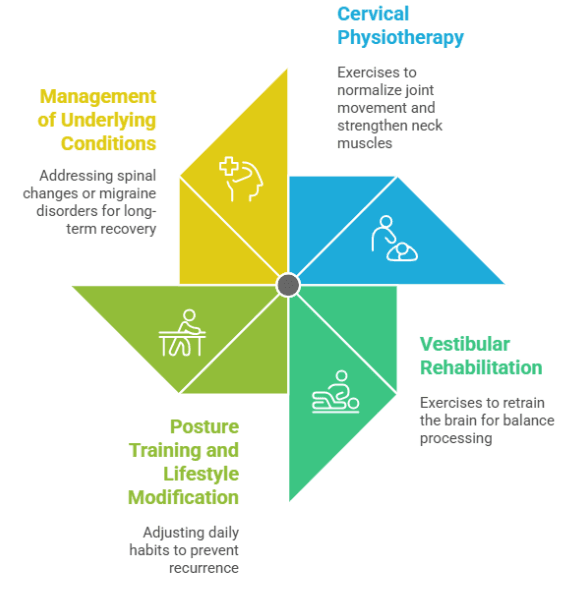
Most individuals experience significant improvement with a combination of appropriate therapeutic strategies. Treatment commonly includes:
1. Cervical Physiotherapy
Specific exercises can be used to normalize the movement of the joints, loosen the muscles and strengthen the neck. Improved neck mechanics enhance proprioceptive signals.
2. Vestibular Rehabilitation
Special exercises are a method of retraining the brain to process the balance information in the proper way. They enhance postural stability, coordination and gaze stability.
3. Posture Training and Lifestyle Modification
To prevent recurrence, correcting daily habits such as adjusting screen height, taking movement breaks, and avoiding awkward neck postures helps prevent recurrence.
4. Management of Structural or Neurological Conditions
In case there are some underlying spinal changes or migraine disorders, the correct treatment plans are incorporated to ensure long-term recovery.

Who Is at Higher Risk of Cervicogenic Dizziness?
You may be at higher risk if you:
- Work long hours on computers
- Have poor posture
- Experienced whiplash or neck trauma
- Have cervical arthritis
- Suffer from chronic migraines
- Frequently use mobile phones with forward-head posture
Who Should and Should Not Try Neck Exercises at Home?
People Who May Benefit
- Individuals with mild posture-related neck stiffness
- Patients already diagnosed with cervicogenic dizziness
- People recovering under physiotherapy guidance
People Who Should Avoid Self-Treatment Until Evaluated
- Individuals with sudden, severe dizziness
- People with stroke symptoms
- Patients with recent trauma
- Individuals with severe neurological symptoms
- Those with unexplained fainting
Treatment Decision: What Should Physiotherapy Address?
A physiotherapy programme should be based on identified impairments rather than a standard “cervical vertigo exercise” list. Treatment may address:
Neck mobility
Gentle, graded movement may be used when range of motion is restricted and medically safe. The goal is comfortable functional movement rather than forcing the neck through dizziness or pain.
Neck muscle control and endurance
Exercise may target deep cervical control, upper-quarter strength and endurance when weakness or fatigue contributes to symptoms or neck pain.
Cervical proprioception
Selected exercises may retrain awareness of head and neck position when examination suggests impaired cervical position sense.
Posture and movement habits
Treatment may include workstation changes, screen positioning, movement breaks and reducing prolonged static positions. The aim is to reduce symptom-provoking load rather than enforce one rigid posture all day.
Balance and gaze rehabilitation
When assessment identifies concurrent imbalance, visual instability or vestibular deficits, vestibular rehabilitation may be added. NeuroEquilibrium describes VRT as a personalised programme that can include gaze stabilisation, habituation and balance work after assessment.
Treatment Approaches for Cervicogenic Vertigo
Most individuals experience significant improvement with a combination of appropriate therapeutic strategies. Treatment commonly includes:
1. Cervical Physiotherapy
Specific exercises can be used to normalize the movement of the joints, loosen the muscles and strengthen the neck. Improved neck mechanics enhance proprioceptive signals.
Treatment should begin within a comfortable range and progress according to symptoms, strength and function. The goal is not to repeatedly provoke severe dizziness.
2. Vestibular Rehabilitation
Special exercises are a method of retraining the brain to process the balance information in the proper way. They enhance postural stability, coordination and gaze stability.
Vestibular rehabilitation is particularly relevant when a vestibular or balance impairment has also been identified. It should not automatically be added solely because the patient has neck pain.
3. Posture Training and Lifestyle Modification
To prevent recurrence, correcting daily habits such as adjusting screen height, taking movement breaks, and avoiding awkward neck postures helps prevent recurrence.
These changes may reduce neck-related symptom aggravation, but recurrence can still occur if an underlying vestibular, migraine, neurological or musculoskeletal condition remains active.
4. Management of Structural or Neurological Conditions
In case there are some underlying spinal changes or migraine disorders, the correct treatment plans are incorporated to ensure long-term recovery.
What Symptoms During Physiotherapy Are Acceptable?
A rehabilitation programme may sometimes produce a mild, familiar increase in discomfort or dizziness, particularly when balance rehabilitation is included. The response should remain controlled and should settle according to the therapist’s plan.
Seek urgent or emergency care rather than continuing therapy when:
- There is sudden double vision
- Speech becomes slurred or difficult
- One side of the face or body becomes weak or numb
- You cannot stand or walk
- You faint or lose consciousness
- A sudden severe headache occurs
- There is chest pain or severe breathlessness
How Long Does Cervicogenic Dizziness Treatment Take?
There is no reliable universal recovery timeline because diagnostic criteria, causes and treatment protocols vary across studies.
Some people may notice early changes in neck pain, mobility or dizziness during the first phase of rehabilitation, while longstanding symptoms, whiplash-associated problems or combined vestibular and cervical impairments may require a longer programme.
Published trials of manual therapy and exercise use different treatment schedules and follow-up periods, so a fixed promise such as “cured in two weeks” is not supported. Reviews show that manual therapy can improve dizziness and neck symptoms, but treatment response varies.
Progress should be measured by:
- Reduced dizziness intensity or frequency
- Improved neck range of motion
- Reduced neck pain
- Improved tolerance of work and screen use
- Better walking and balance
- Improved confidence with head movement
- Fewer activity restrictions
- Ability to complete the prescribed exercises without prolonged symptom flare
What If Physiotherapy Does Not Work?
Failure of neck treatment should trigger diagnostic review rather than progressively more forceful treatment. Possible reasons include:
- The original dizziness was not primarily cervicogenic
- BPPV is present
- Vestibular migraine is contributing
- A peripheral vestibular weakness needs targeted rehabilitation
- PPPD or visual-motion sensitivity has developed
- A medicine or blood-pressure problem is contributing
- The exercise programme does not match the ideal physiotherapy, add vestibular rehabilitation or investigate a different cause.
What to Do if You Suspect Cervicogenic Vertigo
If you notice dizziness along with neck discomfort, poor posture, or symptoms triggered by head movement, the following steps are advisable:
- Assess your posture and daily habits.
- Note when symptoms worsen and whether neck movement plays a role.
- Seek evaluation from a balance-specialized medical professional.
- Undergo appropriate vertigo tests to determine the root cause.
- Follow the recommended combination of neck therapy and vestibular rehabilitation.
Early diagnosis significantly improves outcomes and prevents chronic imbalance.
How NeuroEquilibrium Can Help
Cervicogenic vertigo is a complex but manageable condition that develops when the neck interferes with the brain’s balance-processing systems. Because its symptoms closely resemble those of inner-ear disorders, a detailed evaluation using specialized vertigo tests is essential for finding the true cause. With an accurate diagnosis and a personalized treatment plan, most people recover well, regain confidence, and return to their normal activities.
Choosing a center that specializes in dizziness and balance disorders can make all the difference in identifying what is really behind your symptoms. At NeuroEquilibrium, our network integrates advanced diagnostic technology with an individualized approach to assessment and rehabilitation. Our expertise in both vestibular and cervical causes of dizziness ensures that patients receive precise, targeted care rather than temporary symptom relief, especially in complex cases of cervicogenic vertigo.If you are experiencing neck-related dizziness or suspect cervicogenic vertigo, visiting NeuroEquilibrium may be a significant step toward lasting recovery. Our holistic approach provides clarity, confidence, and a clear path to better balance and well-being. Book an appointment here.
Final Thoughts
Cervicogenic dizziness is often overlooked because its symptoms overlap with migraine, BPPV, and inner-ear disorders. However, recognizing the connection between neck pain and dizziness is essential for proper diagnosis and recovery.
A combination of:
- Accurate vestibular testing
- Cervical physiotherapy
- Posture correction
- Vestibular rehabilitation
can significantly improve symptoms and restore confidence in daily activities.
Frequently Asked Questions
What causes cervical vertigo?
Cervical vertigo is usually caused by dysfunction in the cervical spine such as poor posture, neck injuries, degenerative disc disease, arthritis, or muscle tension. These conditions may disrupt the normal balance signals sent from the neck to the brain.
What symptoms are associated with cervical vertigo?
Common symptoms include neck pain, dizziness, light-headedness, imbalance, headaches, and symptoms that worsen when moving or holding the neck in certain positions.
How is cervical vertigo diagnosed and treated?
Doctors usually diagnose cervicogenic vertigo after ruling out inner-ear and neurological causes. Treatment may include physiotherapy, posture correction, vestibular rehabilitation therapy, medication for underlying conditions, and targeted neck therapy.
How do you treat cervicogenic vertigo?
Treatment typically focuses on improving neck mobility and correcting posture. Physiotherapy, vestibular exercises, and ergonomic adjustments are commonly used approaches for effective neck pain and dizziness treatment.
How to cure vertigo permanently?
The possibility of long-term relief depends on identifying the correct cause of vertigo. Once the underlying condition is treated whether it is an inner ear disorder, migraine, or cervical issue many patients experience lasting improvement.