









That distinction is the whole point of this article. Many people are told, or tell themselves, that chakkar is “just the sugar.” Sometimes it is. But diabetes and dizziness are connected in at least five different ways, and only one of them is blood glucose. The sections below walk through each, explain how the sensations differ, and describe what a doctor looks at when the usual explanation does not fit.
Can diabetes cause dizziness?
Yes. Diabetes can contribute to dizziness through low blood sugar, very high blood sugar and the dehydration that comes with it, blood-pressure changes when standing, and nerve damage that affects balance. Some medicines can add to this. But dizziness in a person with diabetes can also come from an unrelated cause, such as an inner-ear (vestibular) disorder, which needs its own evaluation.
So if you have diabetes and experience chakkar, the first question is not simply “Is my sugar low?” The more useful question is “What kind of chakkar is this, and when does it happen?”
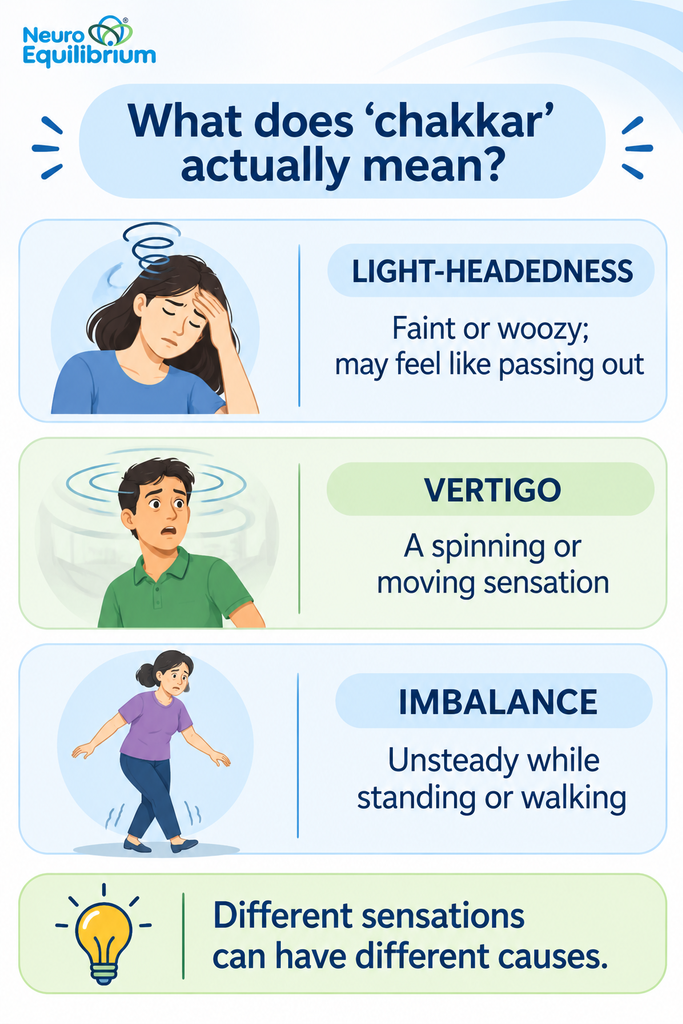
What does “chakkar” actually mean?
In everyday Indian usage, chakkar covers a lot of ground. One person means they felt faint and had to sit down. Another means the room spun so hard they held the wall. A third means they drift sideways when walking and the ground feels unreliable. All of these are real and none should be brushed off, but they are not the same symptom, and they do not come from the same place.
Broadly, doctors sort these sensations into three groups:
- Light-headedness: a faint, woozy, “about to pass out” feeling. Often linked to blood sugar, blood pressure, dehydration or a fast heartbeat.
- Vertigo: a false sense of movement. The room spins, tilts or rocks, or you feel as if you are moving when you are still. This almost always points to the balance system in the inner ear or brain.
- Imbalance: unsteadiness on your feet without the head feeling odd. You veer, you reach for support, you feel worse in the dark or on uneven ground. This can involve nerves, muscles, vision or the inner ear.
Why do diabetics feel dizzy?
Diabetes can contribute to dizziness because of:
Low blood sugar
This is the cause most people with diabetes already know. When glucose drops too low, the brain runs short of fuel and the body responds with a stress reaction. The result is typically light-headedness together with shakiness, sweating, sudden hunger, a pounding or racing heartbeat, weakness, irritability or difficulty concentrating. Some people notice blurred vision or trouble finding words.
The key feature is the company the dizziness keeps. It rarely arrives alone, and it usually eases once glucose is brought back up according to the plan your doctor has given you. It also tends to have a context: a missed or delayed meal, more exercise than usual, or a change in medication timing.
Severe hypoglycaemia, with confusion, inability to swallow safely, a seizure or loss of consciousness, is an emergency and needs immediate help. If low readings are happening often, or you are having episodes you cannot explain, that is a conversation to have with your diabetes doctor . Do not adjust insulin or tablets on your own just on the basis of an article.
High blood sugar and dehydration
Very high glucose behaves differently. The body tries to flush excess sugar through the kidneys, so you pass more urine, feel thirsty, and gradually lose fluid. Over hours or days this can leave you tired, weak, heavy-headed and, in some people, light-headed or faint, especially on standing or in hot weather.
This is not spinning vertigo. It is more of a drained, woozy, “not right” feeling, and it usually comes with the other signs of high sugar: thirst, frequent urination, blurred vision, fatigue. When high glucose is accompanied by vomiting, abdominal pain, rapid breathing, a fruity smell on the breath or confusion, it can signal a dangerous metabolic state and needs urgent medical care.
Blood-pressure changes when standing
Some people with diabetes notice chakkar specifically when they get up from bed or rise from a chair. Blood pools briefly in the legs, the pressure to the brain dips, and there is a moment of light-headedness or greying of vision before it settles.
This can happen to anyone who is dehydrated or on certain blood-pressure medicines. In diabetes there is an additional possible reason: long-standing high sugar can affect the autonomic nerves that adjust blood pressure automatically when you change position. When those nerves respond slowly, standing up produces a bigger dip. This is called autonomic neuropathy, and it affects some people with diabetes, not all. If your dizziness is clearly tied to standing, mention it; it is straightforward to check by measuring blood pressure lying and standing.
Nerve damage and balance
Diabetic neuropathy usually shows up first in the feet as numbness, tingling, burning or a “walking on cotton” feeling. What is less often explained is what it does to balance.
Your brain keeps you upright by combining three streams of information: what your eyes see, what your inner ear senses about head movement, and what the nerves in your feet and joints report about where the ground is and how your weight is distributed. When the feet go quiet, the brain loses one of its three inputs and leans harder on the other two. In daylight on a flat floor you may not notice. In a dim room at night, on a sandy beach, or on a broken pavement, the missing information suddenly matters, and you feel unsteady.
This is imbalance, not vertigo. There is no spinning; the head feels clear, but the feet do not feel trustworthy. It is one of the main reasons people with long-standing diabetes fall more often, and it is a problem that balance training can help with.
Medicines
Some medicines used for diabetes, blood pressure, heart conditions, nerve pain or sleep can cause dizziness in some people, particularly when a new medicine is started or a dose is changed. This does not mean diabetes medication routinely causes chakkar; most people take it without any such problem. But timing is a useful clue. If dizziness began after starting or changing a medicine, discuss it with your doctor rather than stopping the medicine on your own.
Know More About
- BPPV Treatment: Effective Ways to Manage Vertigo
- What Happens in a Vertigo Physiotherapy Session? Tests, Exercises and Recovery Plan
Can diabetes affect the vestibular system?
The vestibular system is the balance organ inside each inner ear. It senses head movement, tilt and acceleration and tells the brain which way is up. The brain merges this with vision and with sensation from the muscles, joints and feet, so that you can walk, turn your head and keep your vision steady at the same time.
There is a reasonable body of research suggesting that diabetes and vestibular dysfunction are associated. A large United States population study found that vestibular dysfunction was more common in adults with diabetes than without, was more likely with longer diabetes duration and higher HbA1c, and independently raised the odds of falling. Smaller clinical studies using inner-ear tests have reported similar patterns, and the proposed explanations include effects of high glucose on the tiny blood vessels and nerves of the inner ear, and changes in the calcium crystals that the balance organ relies on.
Two cautions matter here. First, association is not the same as cause; these studies show that the two conditions travel together more often than chance would predict, not that diabetes damages every inner ear. Second, “vestibular dysfunction” on a test does not automatically mean a person has vertigo. Many people with a weaker inner-ear response have no spinning at all, only a subtle unsteadiness.
What this research does support is a practical point: if you have diabetes and balance problems, it is reasonable to have the inner ear assessed rather than assuming everything is explained by neuropathy or sugar.
Is diabetes-related dizziness the same as vertigo?
Usually not, and this is the distinction that saves people months of confusion.
Dizziness from low sugar, dehydration or a blood-pressure dip is light-headedness: faint, weak, floaty, usually with the body’s other warning signs, and usually relieved by sitting down, eating or drinking, or bringing glucose back into range. Vertigo is a sensation of movement. The room turns, the bed tilts, the floor rolls. It is provoked by things that move the inner ear, such as turning over in bed or looking up, and it does not respond to a glucose tablet. Imbalance sits between the two: the head feels fine, but walking feels unreliable.
They can overlap. Someone with neuropathy and a blood-pressure dip may feel both weak and unsteady; someone in the middle of a bad inner-ear spin may also feel faint and sick. That is exactly why the precise sensation and its triggers matter more than the word “chakkar” on its own.
When diabetes and a vestibular disorder occur together
Having diabetes does not protect you from the common inner-ear causes of vertigo, and it does not mean every vertigo episode is diabetes-related.
Benign paroxysmal positional vertigo (BPPV) is the most frequent example. Tiny calcium crystals in the inner ear come loose and produce brief, intense spinning with specific head positions, classically turning over in bed. It is common in middle-aged and older adults regardless of diabetes, and some research suggests it may be more frequent, or more likely to recur, in people with diabetes. Either way, BPPV is diagnosed by a positional test and treated with a repositioning maneuver, not by adjusting glucose.
Vestibular migraine, Ménière’s disease and vestibular neuritis can also occur in someone who happens to have diabetes, each with its own pattern of attack length and accompanying symptoms. The details matter less than the principle: a spinning sensation, dizziness triggered by head movement, hearing change or ear fullness, or imbalance that continues despite well-controlled sugar, is a reason to look at the balance system directly.
What should you do if you have diabetes and feel dizzy?
Some general, safe steps:
- Stop what you are doing and sit or lie down until the feeling passes. Do not try to “walk it off.”
- If you have a glucose monitor and your diabetes care plan asks you to check during symptoms, follow that plan. If the reading is low, treat it the way your healthcare team has taught you.
- Have a drink of water if you have not been drinking enough, especially in hot weather or after a high reading.
- Do not drive or ride a two-wheeler or operate machinery while dizzy, and wait until you are fully recovered before doing so.
- Notice what the chakkar felt like and what set it off: faintness after a missed meal, a head-spin on turning in bed, unsteadiness in the dark. Writing this down helps your doctor enormously.
- If episodes are repeated, unexplained, or do not match your sugar readings, discuss them with your doctor.
- If the sensation is spinning, recurrent, or linked to head position, a vestibular assessment may be useful.
When is dizziness in diabetes a warning sign?
Most dizziness in people with diabetes is not dangerous, but a few combinations need urgent attention. Seek emergency help if dizziness comes with:
- severe confusion, a seizure, or loss of consciousness
- very low blood sugar that does not improve with your usual emergency plan
- sudden weakness or numbness on one side of the body, facial drooping, or difficulty speaking
- severe chest pain or severe shortness of breath
- a sudden, severe headache unlike any before
- inability to stand or walk safely
These can signal severe hypoglycaemia, a heart or circulation problem, or a stroke, and none of them should wait for an outpatient appointment.
When should a person with diabetes and dizziness see a doctor?
Talk to your diabetes doctor first if the pattern fits blood sugar or blood pressure: episodes around meals or medication timing, dizziness on standing, symptoms that track with your readings. Blood glucose, blood pressure lying and standing, hydration, kidney function and your medication list are usually the starting points, along with a check for neuropathy.
Consider a vestibular evaluation when the picture does not fit, for example:
- the dizziness is a spinning or moving sensation rather than faintness
- it is triggered by turning in bed, looking up or bending down
- it comes with hearing change, ringing or fullness in one ear
- you feel unsteady walking most days, particularly in the dark or on uneven surfaces
- episodes keep happening even though your sugar and blood pressure are well controlled
A vestibular evaluation typically includes a detailed history, examination of eye movements and positional testing, and, depending on findings, tests such as videonystagmography (VNG), which records eye movements to assess inner-ear function, and balance testing that measures how well you use vision, inner ear and foot sensation together. For people with diabetes this last test is especially informative, because it can show which of the three inputs is weak and therefore what kind of balance training is likely to help.
Treatment then depends entirely on what is found: a repositioning maneuver for BPPV, condition-specific care for other inner-ear disorders, and vestibular rehabilitation, a structured programme of exercises that retrains the brain’s balance responses, where imbalance or motion sensitivity persists. In people whose unsteadiness comes from neuropathy, balance rehabilitation can also help the brain make better use of the inputs it still has.
A short word before you go
The link between diabetes and dizziness has several strands, and pulling the wrong one wastes time. Low sugar, high sugar, a blood-pressure dip, numb feet and a new medicine each produce a slightly different kind of chakkar, and none of them produce true spinning. When the room turns, when head position is the trigger, or when unsteadiness persists despite a well-managed glucose chart, the balance system deserves its own look.
NeuroEquilibrium’s clinics evaluate dizziness and balance problems by identifying which part of the balance system is involved, through specialist consultation, vestibular testing and rehabilitation planned around the actual diagnosis. If your chakkar is not being explained by your sugar, that evaluation may be a sensible next step, alongside your diabetes care rather than instead of it.
Medical Disclaimer
The content on this blog is intended for informational and educational purposes only. The information provided should not be considered a substitute for professional medical advice, diagnosis, or treatment, as vertigo and dizziness can have different underlying causes and symptoms may vary from person to person. Always consult a qualified vertigo specialist for an accurate diagnosis and personalized treatment recommendations. Do not disregard professional medical advice or delay seeking medical care based on information you read on this blog.
Frequently Asked Questions
Can diabetes cause dizziness?
Yes. Common causes include low or high blood sugar, blood pressure drops on standing, nerve damage affecting balance, and certain medications. Since dizziness can also have an unrelated cause, the type and triggers matter for diagnosis.
Why do diabetics feel dizzy?
It depends on the type. Shakiness and sweating point to low glucose; thirst and fatigue suggest high glucose; dizziness on standing suggests a blood pressure dip; unsteadiness in the dark suggests nerve damage in the feet; and true spinning points to the inner ear.
Is dizziness from low blood sugar the same as vertigo?
No. Low blood sugar causes light-headedness with hunger, shakiness, or a racing heart, and improves once glucose rises. Vertigo is a spinning sensation triggered by head movement, not meals – a glucose tablet won’t fix it.
Can diabetes affect balance?
Yes. Nerve damage in the feet reduces ground sensation, blood pressure drops on standing can cause lightheadedness, and inner-ear dysfunction is more common in diabetes. Together, these raise fall risk, making balance assessment important for long-standing diabetes.
When should a person with diabetes and dizziness see a doctor?
Seek urgent care if dizziness comes with confusion, fainting, weakness, facial drooping, slurred speech, chest pain, or a severe headache. Otherwise, see your doctor for repeated or unexplained episodes, especially if dizziness involves spinning, head position, or hearing changes.