


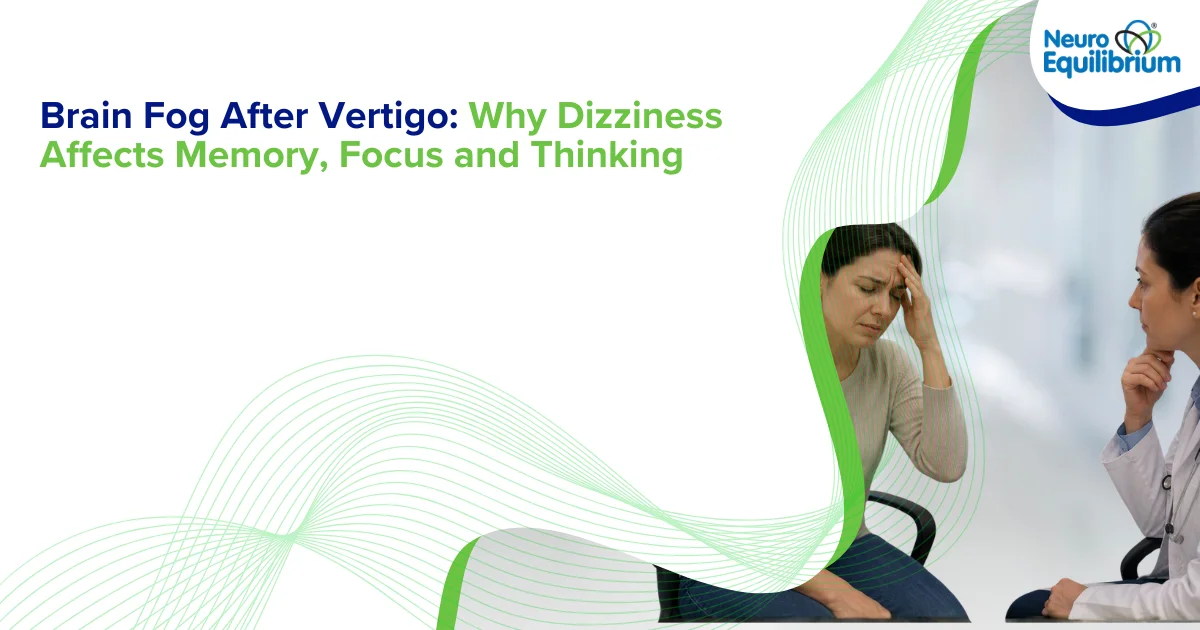





The spinning has stopped, or at least it is not the main problem any more. What is left is harder to explain to anyone. You read the same line three times. You walk into a room and forget why. A conversation in a noisy restaurant leaves you drained. Work that used to take an hour now takes the whole afternoon, and by evening your head feels like it has been running a marathon.
If that sounds like you, you are in good company. A lot of people with vertigo or persistent dizziness describe exactly this, and nearly all of them reach for the same two words: brain fog. Here is what is going on, why, how it differs from a real memory problem, and what tends to help.
Can vertigo cause brain fog?
Yes, in many people it can. Vertigo and persistent dizziness often come with difficulty concentrating, mental fatigue and a sense of thinking more slowly, because the brain has to work harder to keep you balanced and oriented when inner-ear signals are unreliable. Several things feed into it, it is usually temporary, and it should not be taken to mean memory loss or brain damage.
That is the short version. The longer one starts with what people actually mean when they say “brain fog”.
What do patients mean by “brain fog”?
Brain fog is not a medical diagnosis. It is the word patients use for a cluster of experiences that are hard to pin down individually. Someone with dizziness who says they feel foggy usually means some mix of:
- Difficulty concentrating, especially in busy or noisy places
- Forgetting what they were about to say or do
- Needing more time to process information
- Difficulty multitasking
- Mental fatigue that sets in far earlier than it used to
- Trouble reading, following screens or scrolling on a phone
- Feeling distracted, “spaced out” or slightly detached
- Losing words mid-sentence
One way patients often put it: “The room is not spinning any more, but my brain feels tired. I lose my train of thought and I cannot focus at work the way I used to.”
This is not rare. In clinic studies, well over half of people attending for dizziness or vertigo report difficulties of this kind, and the pattern is remarkably consistent: attention and mental speed take the hit, while true memory complaints are less prominent. Hold on to that distinction, because it matters later.
How do the brain and vestibular system work together?
The vestibular system is the balance organ inside each inner ear. It senses how your head is moving, how fast you are accelerating, and which way is up. It sends this information to the brain many times a second.
The brain does not use those signals alone. It combines them with what your eyes see and what your muscles and joints report about the position of your body. From those three streams it builds a continuous, mostly unconscious picture of where you are in space, and uses it to:
- Keep you upright and balanced
- Keep your vision steady while your head moves
- Tell you which way you are facing and how you are moving
- Coordinate movement smoothly without thinking about it
When the three streams agree, all of this runs quietly in the background and you never think about it. When one of them goes wrong, say an inner ear that has been inflamed, is sending distorted signals, or has lost function on one side, the picture stops adding up. That mismatch is what you feel as dizziness, unsteadiness or a strange sense of not knowing quite where you are.
The vestibular system also connects to brain regions involved in spatial memory and navigation, including the hippocampus. Researchers are still working out what those connections mean for thinking in people with vestibular problems, but balance information is clearly not kept in a separate compartment from the rest of the brain’s work.
Why does vertigo make it hard to think clearly?
Think of your attention as a monthly budget. Normally, balance costs almost nothing from it. When the vestibular signals become unreliable, balance suddenly becomes an expensive line item, and it stays expensive for as long as the problem lasts. Several things push the bill up.
Constant sensory processing. The brain has to keep resolving conflicting information from the inner ear, eyes and body, even when you are sitting still, and much more so when you move.
Consciously managing balance. Walking, turning, standing up and looking around stop being automatic and start needing deliberate attention. That attention comes from the same pool you use for reading, planning and conversation.
Visual environments. Supermarket aisles, traffic, crowds, patterned floors, scrolling screens and video calls present a lot of visual movement at once. For someone with motion sensitivity, these settings can leave them exhausted, headachy or foggy within minutes.
Poor sleep and fatigue. Dizziness that disturbs sleep, or a fear of turning in bed, means a tired brain the next day, and a tired brain concentrates poorly whatever the cause.
Vigilance and symptom-related stress. When dizziness is unpredictable, part of the mind stays on watch for the next episode. That vigilance is a real cognitive load and a normal response to an unpredictable physical symptom, not evidence that the dizziness is “just anxiety”.
Medication. Some medicines used for vertigo or nausea, and some used for other conditions, can dull alertness. Raise this with your doctor rather than changing anything on your own.
Put these together and the fog makes sense. The brain is not failing. It is working overtime on a task that should be free.
Can dizziness affect memory and concentration?
Concentration, yes. Memory, in the sense most people are worried about, usually no.
What people with vestibular problems describe most often is attention that keeps slipping: losing the thread of a conversation, forgetting what they walked into the kitchen for, reading a paragraph and realising none of it went in. That feels like memory loss. Mostly, though, it is attention and processing speed. If your mind was only half on something to begin with, there is nothing to recall later. A true memory disorder is different: information that was properly taken in cannot be retrieved.
Research in people with vestibular disorders does show measurable differences on tests of attention, spatial navigation, mental rotation and some short-term memory tasks compared with healthy controls, with larger effects in people who have lost vestibular function on both sides. Researchers are careful to say that cause and effect are not settled. There is no evidence that ordinary vertigo damages the brain, and no basis for assuming that a foggy few months means anything permanent.
The practical point: attention problems that track your dizziness, improve when it improves, and are worse in busy environments fit this pattern. Memory problems that are new, severe, progressive, or present without any dizziness do not, and should be evaluated on their own terms.
Know More About
- Why Do Crowded Places Make Me Dizzy?
- Vestibular Neuritis Symptoms: Early Warning Signs You Shouldn’t Ignore
- How Cognitive Behavioural Therapy (CBT) Can Help People with Vestibular Migraine
Which vestibular conditions are linked to brain fog or mental fatigue?
Different vestibular disorders produce different patterns of dizziness, and some are more closely associated with cognitive complaints than others.
Vestibular migraine is one of the most common. It can cause dizziness, motion sensitivity, sensitivity to light and busy visual scenes, and difficulty concentrating or feeling mentally slowed, with or without a typical headache. In clinic studies, attention complaints are particularly prominent in this group.
Persistent postural-perceptual dizziness (PPPD) is a condition in which the brain stays in a heightened, “on guard” state after a vestibular event. Symptoms are worse when upright, moving or in visually complex environments, and mental fatigue from constant symptom management is common.
Vestibular neuritis is a sudden inflammation of the balance nerve, usually causing days of intense vertigo. The spinning settles, but during the weeks of recovery that follow, imbalance, fatigue and difficulty functioning normally are common while the brain adapts to the changed signal from that ear.
Meniere’s disease brings recurrent episodes of vertigo along with hearing changes, fullness and ringing in the ear. The episodes themselves, the disrupted sleep and the anxiety of waiting for the next one can leave a person drained and mentally flat. Meniere’s is not known to cause memory loss.
Bilateral vestibulopathy, where vestibular function is reduced in both ears, affects balance and the ability to keep vision steady during movement. Because the brain has so little balance information to work with, the effort of moving around is high, and cognitive effects tend to be more noticeable in this group in research studies.
Other vestibular disorders, including residual symptoms after BPPV or labyrinthitis, can also leave people foggy for a period, usually in proportion to how much dizziness is still present.
Brain fog and persistent dizziness: not all ongoing symptoms are the same
It is worth being honest with yourself about what kind of dizziness you are still having, because the reason for the fog, and the right response, are not the same in each case.
- A brief vertigo attack (minutes to hours of spinning) can leave a hangover of tiredness for a day or two.
- Residual dizziness after an episode has been treated is a non-spinning, off-balance feeling while the brain recalibrates. Fog usually fades alongside it.
- Persistent dizziness that lasts weeks or months without a clear pattern suggests the underlying cause has not been fully identified or treated.
- Visual motion sensitivity produces fog specifically in busy visual settings and on screens, even when balance at rest is fine.
- Ongoing imbalance without spinning, especially in the dark or on uneven ground, points to the balance system still compensating or still impaired.
You can be completely free of spinning and still feel mentally wrung out. The useful question is why the dizziness is continuing, not how to live with the fog.
How long does brain fog after vertigo last?
There is no single answer, and anyone who gives you one with confidence is guessing. What it depends on:
- Which vestibular condition is responsible
- Whether that cause has been identified and treated
- Whether dizziness is still occurring
- How quickly your balance system compensates
- Sleep quality and overall fatigue
- Whether migraine or another condition is also involved
- Whether rehabilitation is being done, and how consistently
- Individual differences in recovery
For some people, especially after a single episode that has been treated, the fog lifts within days to a few weeks as the dizziness settles. For people with persistent dizziness, vestibular migraine or PPPD, it tends to hang around for as long as the condition is active and lifts as that condition is brought under control. The fog is a passenger, not the driver.
What can help?
Because the fog is a consequence of the vestibular problem and the load it places on the brain, there is no standalone treatment for brain fog. Management is aimed at the cause and usually involves several things together:
- Identifying the underlying vestibular disorder through history, examination and, when indicated, vestibular testing.
- Treating that disorder appropriately, which looks very different for vestibular migraine than for neuritis recovery.
- Vestibular rehabilitation therapy, for the conditions where it is indicated (see below).
- Managing vestibular migraine when it is part of the picture, through trigger management and, where a doctor advises, preventive treatment.
- Protecting sleep, including addressing night-time dizziness and evening screen exposure if it provokes symptoms.
- A gradual return to normal activity. Avoiding movement and busy environments feels protective, but it delays adaptation and keeps the cognitive load high. Graded, steady exposure works better than avoidance or forcing through.
- Reviewing medication with your doctor if anything you take may be adding to drowsiness or slowed thinking.
None of these is a quick fix on its own. Together, they address why the fog is there.
Can vestibular rehabilitation help?
For the right person, yes. Vestibular rehabilitation therapy is an exercise-based programme, designed by a trained physiotherapist after assessment, that helps the brain adapt to a vestibular deficit. Depending on the findings, it may work on:
- Gaze stability, keeping vision clear while the head moves
- Balance on different surfaces and with eyes open and closed
- Motion tolerance, gradually reintroducing movements that provoke symptoms
- Coordination of head, eye and body movement
- Confidence in walking, turning and everyday tasks
- Adaptation, so that balance becomes automatic again
Rehabilitation does not treat brain fog directly, and it is not appropriate for every cause of dizziness. In the conditions where it is indicated, it reduces the vestibular problem and the effort of managing it. As balance becomes automatic again and movement stops demanding attention, many people find mental fatigue and concentration problems ease too. That is why an assessment comes first.
When should brain fog after vertigo be evaluated?
Not every concentration or memory problem should be pinned on vertigo, and it would be a mistake to let a dizziness diagnosis explain away something else. Get a proper evaluation when thinking problems are:
- New and without an obvious vestibular explanation
- Severe enough to affect work, driving or safety
- Progressively getting worse rather than fluctuating with dizziness
- Present when there is no dizziness at all
- Significantly affecting daily life for weeks
- Accompanied by other neurological symptoms
An evaluation in this situation looks at both the balance system and, where needed, thinking and memory in their own right, so that the right cause is found rather than assumed.
Red flags: symptoms that need urgent attention
Sudden new symptoms should never be attributed to vertigo or brain fog without being checked. Seek urgent medical care if you or someone with you notices:
- Drooping of the face
- Weakness or numbness, particularly on one side
- Difficulty speaking or slurred speech
- A sudden, severe headache unlike previous ones
- New double vision or loss of vision
- Fainting or near-fainting
- Sudden severe difficulty walking or standing
- Sudden confusion or a change in alertness
These do not necessarily mean a stroke or anything else serious, but they are the symptoms that need to be ruled out quickly, and that cannot be done at home.
A final word
Brain fog after vertigo is real, it is common, and it has a mechanism: a brain working overtime to do a job that should be effortless. It is not a diagnosis, it is not a sign of damage, and it generally follows the same course as the dizziness underneath it. The useful question is not “how do I clear the fog?” but “why is my balance system still demanding this much attention?”
If you are living with persistent dizziness, recurrent vertigo, or a fog that has not lifted as your symptoms should have, a proper vestibular evaluation can help identify what is driving it and what the appropriate next step is. NeuroEquilibrium’s vertigo and balance clinics assess the cause first and build treatment and rehabilitation around what is found.
Medical Disclaimer
The content on this blog is intended for informational and educational purposes only. The information provided should not be considered a substitute for professional medical advice, diagnosis, or treatment, as vertigo and dizziness can have different underlying causes and symptoms may vary from person to person. Always consult a qualified vertigo specialist for an accurate diagnosis and personalized treatment recommendations. Do not disregard professional medical advice or delay seeking medical care based on information you read on this blog.
Frequently Asked Questions
Can vertigo mess with your memory?
It can feel that way, but what most people actually have is an attention problem, not a memory one. Things are not remembered because they were never fully taken in while the brain was busy with balance. New, severe or worsening memory problems, or ones without any dizziness, need their own evaluation.
Can dizziness cause difficulty concentrating?
Yes. Staying balanced and oriented uses attention that would normally be free, and busy environments, poor sleep, stress and some medicines add to it. Concentration usually improves as the dizziness does.
How long does brain fog after vertigo last?
There is no fixed timeline. After a single treated episode it often clears in days to a few weeks; with vestibular migraine, PPPD or persistent dizziness it lasts as long as the condition is active and eases as that is treated.
Can vestibular rehabilitation help with brain fog after vertigo?
Indirectly, yes, when the dizziness comes from a condition rehabilitation is suited to. As balance becomes automatic again, the mental effort of moving drops and many people find their focus and energy return. It does not treat the fog directly and is not right for every cause.
When should I see a doctor for brain fog and dizziness?
If dizziness has lasted more than a few weeks, keeps coming back or is affecting daily life, or if thinking problems are new, severe, worsening or present without dizziness. Seek urgent care for sudden facial drooping, weakness, speech trouble, severe headache, vision changes, fainting, difficulty walking or confusion.