







When a child says “the room is spinning,” it is unsettling to hear. Dizziness and balance problems are fairly common in childhood, but vertigo – that specific sense that the child or the room is spinning – deserves attention when it keeps happening, when it is severe, or when other symptoms come with it. The causes range from relatively harmless ones such as migraine-associated vertigo to inner-ear problems or, less commonly, the nervous system. Identifying which is what makes proper treatment possible.
Can Children Have Vertigo?
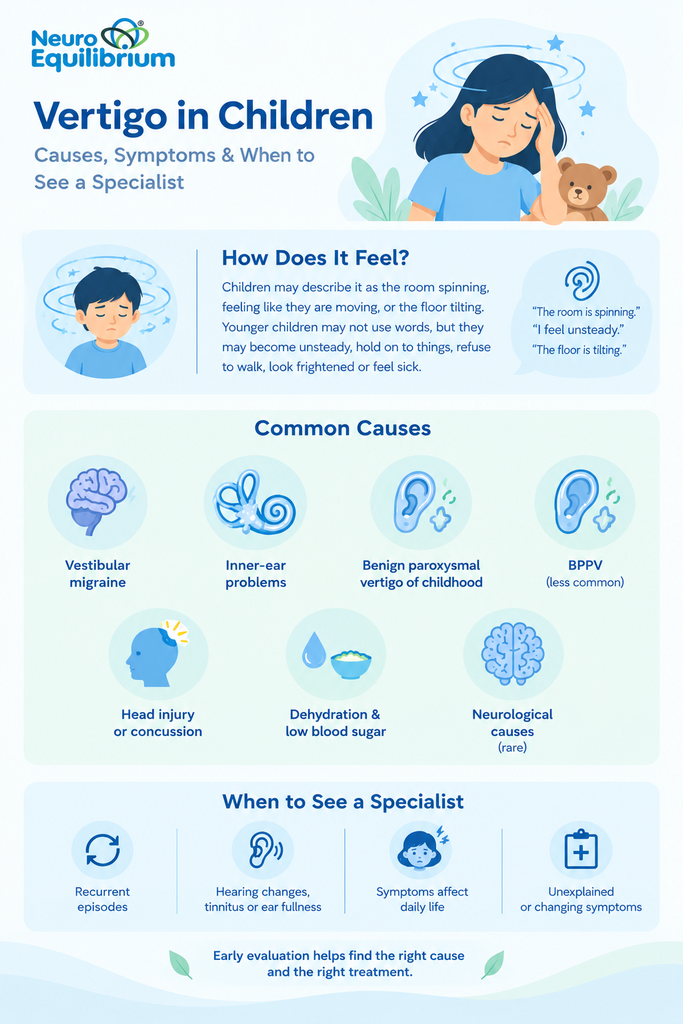
Yes. Children can experience vertigo and other balance-related symptoms, and the causes vary – migraine-related vestibular conditions, certain inner-ear disorders and other vestibular problems among them. Because children often describe dizziness differently from adults, recurring or significant symptoms are best assessed in the context of the child’s overall health and full symptom pattern rather than from one episode alone.
What Does Vertigo Feel Like for a Child?
Vertigo is a false sensation of movement. An older child may put it into words:
- “The room is spinning.”
- “I feel like I’m moving.”
- “The floor is tilting.”
- “Everything is going around me.”
Younger children often cannot explain it at all. What you see instead is behaviour: a child who suddenly becomes unsteady, holds on to furniture, refuses to walk, looks frightened, or says they feel sick.
Vertigo is also different from simply feeling light-headed or faint, which can happen when a child stands up quickly, is dehydrated or has not eaten enough. Vertigo specifically involves that abnormal sense of movement – though children will use the single word “dizzy” for both.
Know More About
- https://www.neuroequilibrium.in/vertigo-and-balance-disorders-in-children/
- https://www.neuroequilibrium.in/top-5-vestibular-exercises-for-vertigo-relief/
Common Causes of Vertigo in Children
Several things can be responsible, and they vary widely in how common they are.
Vestibular migraine
Migraine is an important cause of recurrent dizziness and vertigo in children, and episodes can happen with or without a headache – which surprises many parents. A child may also have sensitivity to light or sound, nausea or vomiting, motion sensitivity or visual disturbances, and a family history of migraine is often part of the picture. Episodes vary in length and frequency.
Inner-ear problems
The inner ear houses the vestibular system, which helps control balance and spatial orientation, so conditions affecting it can cause vertigo. An ear infection or inflammation involving the balance organs may lead to dizziness or vertigo, and some children also notice hearing changes, ringing in the ear, or a feeling of fullness.
Epilepsy-related vertigo
Rarely, focal seizures can present mainly with a sensation of spinning.
Benign paroxysmal vertigo of childhood
Here, otherwise healthy children have sudden episodes of vertigo. They can be frightening to watch, but they typically settle on their own. Some of these children may go on to develop migraine later in life, and doctors weigh the child’s symptoms and medical history together when making the diagnosis.
Benign paroxysmal positional vertigo (BPPV)
Despite the similar name, this is a different condition. BPPV occurs when tiny calcium crystals in the inner ear become displaced, so changes in head position – turning over in bed, looking up, bending down – set off brief episodes of vertigo. It is less common in children than adults, but can occur, particularly after a head injury or certain ear conditions.
Head injury or concussion
A concussion or other head injury can affect the vestibular system and lead to dizziness, imbalance or vertigo. A child who develops vertigo after a head injury should be medically evaluated, particularly if symptoms persist or come with other concerning signs.
Dehydration and low blood sugar
Dehydration, a long stretch of physical activity, vomiting, diarrhoea or simply not eating enough can all leave a child dizzy. These situations more often produce light-headedness than true vertigo – but again, children reach for the same word either way.
Neurological causes
Less commonly, vertigo may be associated with neurological conditions such as cerebellar disorders. Because the possible causes range from minor to serious, recurrent or unexplained vertigo should be assessed by a healthcare professional.
Symptoms That May Occur With Vertigo
Depending on the cause, a child with vertigo may have spinning or moving sensations, loss of balance, difficulty walking, nausea or vomiting, headache, blurred or abnormal vision, sensitivity to light or sound, hearing loss or ringing in the ears, abnormal eye movements, or visible fear during an episode.
Keep track of when the symptoms happen. Patterns that are invisible episode by episode often become obvious once they are written down.
How Is Vertigo in Children Diagnosed?
The doctor will usually start with a detailed history and a physical examination. Expect to be asked:
- When did the episodes begin?
- How often do they occur?
- How long does each episode last?
- What was your child doing when the symptoms started?
- Are certain head movements triggering them?
- Is there a headache?
- Does your child have any hearing problems?
- Has there been a recent ear infection?
- Has your child had a head injury?
- Is there a family history of migraine or balance disorders?
Those answers usually point the way. From there, a child may have hearing and balance assessments. A vestibular examination is adapted to the child’s age and how well they can cooperate – it is not a smaller version of the adult test battery. In selected cases, additional investigations such as blood tests or brain imaging may be recommended.
Treatment for Vertigo in Children
Treatment depends entirely on the underlying cause.
For some children, reassurance, hydration, enough sleep and monitoring are all that is needed. If migraine is suspected, the doctor may recommend lifestyle measures and, where necessary, medication. If an inner-ear condition is responsible, the treating clinician may suggest specific medicines – antihistamines or motion-sickness medication in some situations, or antibiotics where an infection calls for them. Children with persistent balance problems may benefit from vestibular rehabilitation, a specialised therapy that helps improve balance and the brain’s ability to process signals from the vestibular system.
One thing to hold firmly, though: never give a child medication for dizziness or vertigo without medical advice. What is safe and useful depends on their age, symptoms, diagnosis and overall health.
When Should Parents Seek Urgent Medical Care?
Some symptoms alongside vertigo need looking at straight away. Seek immediate medical attention if your child’s dizziness comes with:
- a severe or sudden headache
- loss of consciousness
- new weakness or numbness
- difficulty speaking
- significant difficulty walking
- persistent or severe vomiting
- seizures
- major changes in vision
- confusion or unusual behaviour
- symptoms following a significant head injury
None of these necessarily means something serious is happening. They do mean this is not one to watch and wait on.
What Can Parents Do During an Episode?
If your child suddenly develops vertigo:
- Help them sit or lie down somewhere safe.
- Avoid activities that could lead to a fall.
- Encourage fluids if they are able to drink.
- Observe how long the episode lasts.
- Note anything that comes with it – headache, vomiting, hearing changes, unusual eye movements.
- Arrange medical evaluation if episodes are recurrent, severe or unexplained.
A symptom diary is worth keeping. Note the date, how long it lasted, possible triggers, what came with it, food and fluid intake, sleep, and any recent illness or injury. Parents who do this often walk into a consultation with a clearer picture than they realise they have.
Can Vertigo in Children Be Prevented?
That depends on the cause, so not always. But healthy routines do help, particularly for children whose dizziness is tied to migraine or lifestyle triggers: enough water through the day, regular balanced meals, a consistent sleep schedule, breaks from long stretches of screen time, and managing stress where you can. And after a concussion or other head injury, following the advice given at the time genuinely matters.
Getting the Right Answer for Your Child
Vertigo is unsettling for the child going through it and for the parent watching it happen. Many causes are manageable – but episodes that keep returning, or that no one has explained, deserve evaluation rather than being filed away as “just dizziness.”
A careful history, a physical examination and, where appropriate, hearing or balance testing can usually identify what is going on. With the right diagnosis, most children with vertigo can be managed and supported well. If your child is having repeated episodes of spinning, imbalance, vomiting, hearing changes, headaches or anything else that does not seem right, a consultation with a vertigo specialist or neurotologist is a sensible next step.
Medical Disclaimer
The content on this blog is intended for informational and educational purposes only. The information provided should not be considered a substitute for professional medical advice, diagnosis, or treatment, as vertigo and dizziness can have different underlying causes and symptoms may vary from person to person. Always consult a qualified vertigo specialist for an accurate diagnosis and personalized treatment recommendations. Do not disregard professional medical advice or delay seeking medical care based on information you read on this blog.
FAQs
Can children really have vertigo?
Yes. It is not only an adult problem. Children just describe it differently – a young child may never say “spinning,” and instead go unsteady, cling to furniture or look frightened.
What causes vertigo in children?
Most often migraine-related vertigo or an inner-ear problem such as infection or inflammation. Benign paroxysmal vertigo of childhood, head injury and, less commonly, neurological causes can also be responsible.
How do I know if my child’s dizziness is serious?
One brief episode in an otherwise well child usually is not. Get urgent help if it comes with a severe headache, fainting, weakness, trouble speaking or walking, seizures, vision changes or follows a head injury.
Can vestibular migraine cause vertigo in children?
Yes, and it is a leading cause at this age. The part that confuses parents: there need not be a headache. Look instead for light or sound sensitivity, nausea, and a family history of migraine.
When should my child see a specialist for dizziness?
When episodes keep returning, affect school or balance, come with headaches or hearing changes, or have no clear explanation. A pattern that worries you is reason enough.