


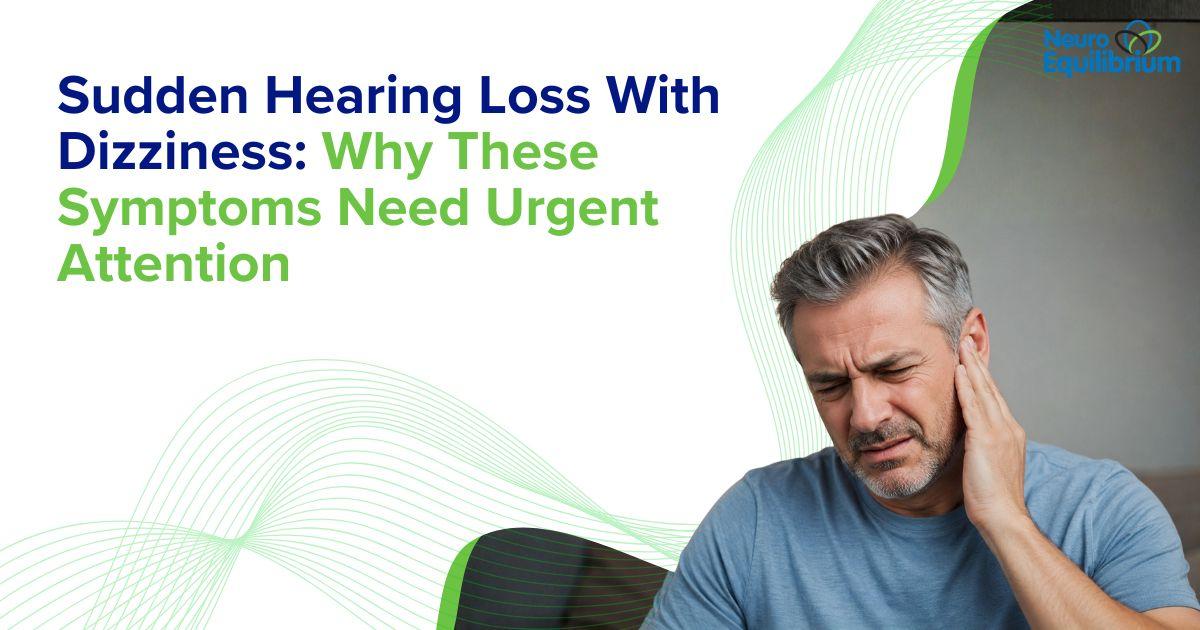





If hearing suddenly becomes weaker in one ear and you also feel dizzy, experience spinning, or become unsteady, medical assessment should be sought promptly.
A blocked or full feeling in the ear can sometimes come from earwax or another conductive problem, but the same sensation may also occur with sudden sensorineural hearing loss, which affects the inner ear or hearing nerve.
Because it is difficult to tell the difference without an examination and hearing test, sudden hearing loss should not simply be assumed to be wax or congestion, especially when dizziness or vertigo is present.
What is sudden sensorineural hearing loss and why does it need prompt attention?
Sudden sensorineural hearing loss is a rapid loss of hearing caused by a problem involving the inner ear or hearing nerve.
It commonly affects one ear and can develop over hours or days.
Some people notice it when they wake up. Others first notice that one ear sounds much softer when using the phone or when listening to someone speak.
Symptoms may include:
- Ringing or buzzing in the ear
- A feeling of fullness or pressure
- Dizziness
- Vertigo
- Unsteadiness
The original source content states that sudden hearing loss should be evaluated by a physician as soon as possible because treatment can be time-sensitive.
Prompt assessment is important because the type of hearing loss first needs to be established.
Related Reading
- Sudden Hearing Loss: Why “Ear Stroke” Is a Medical Emergency You Should Never Ignore
- Is Your Dizziness Labyrinthitis or Something Else?
- What Happens When Dizziness and Blurry Vision Come Together?
Why can sudden hearing loss and dizziness happen at the same time?
Hearing and balance are both linked to structures within the inner ear.
The cochlea is responsible for hearing. Nearby vestibular organs help the brain understand head movement, position, and balance.
Because these structures are located close together and are connected through nearby nerves and fluid-filled structures, some inner-ear disorders can affect both hearing and balance.
Sudden sensorineural hearing loss may therefore sometimes occur with:
- Vertigo
- Nausea
- Imbalance
- Difficulty walking
When hearing changes and balance symptoms occur together, the clinical assessment needs to consider more than an obstruction in the external ear.
Can labyrinthitis cause sudden hearing loss with vertigo?
Yes. Labyrinthitis can affect both hearing and balance.
The labyrinth forms part of the inner ear and contains structures involved in these functions. When it becomes inflamed, symptoms may include:
- Sudden spinning
- Nausea or vomiting
- Difficulty walking
- Hearing loss
- Tinnitus
- Imbalance
Labyrinthitis differs from vestibular neuritis because hearing is usually affected in labyrinthitis, while vestibular neuritis mainly affects the balance system.
However, sudden hearing loss should not automatically be attributed to labyrinthitis or a common ear infection.
An ENT specialist should determine whether the hearing loss is conductive, sensorineural, or due to another cause.
Can Ménière’s disease cause hearing loss, dizziness, and ear pressure?
Yes. Ménière’s disease is an inner-ear disorder that can cause recurring episodes of vertigo together with hearing changes.
Symptoms may include:
- Strong spinning vertigo
- Hearing loss in one ear
- Tinnitus
- Fullness or pressure in the ear
Symptoms may improve between attacks, particularly earlier in the condition, while repeated episodes may be associated with progressive hearing loss over time.
Sudden sensorineural hearing loss and Ménière’s disease can both involve hearing changes, tinnitus, and dizziness.
An abrupt first episode should therefore not automatically be labelled as Ménière’s disease without appropriate evaluation.
Can sudden hearing loss and dizziness be a sign of stroke?
In some cases, yes.
Most dizziness is not caused by stroke. However, a stroke involving the brainstem or cerebellum can cause sudden severe dizziness, loss of balance, or difficulty walking.
The original source also notes that sudden hearing changes may sometimes occur alongside problems affecting blood supply to the inner ear or nearby parts of the brain.
Seek emergency medical care if sudden hearing loss or severe dizziness occurs with:
- Slurred speech
- Facial weakness
- Arm or leg weakness or numbness
- Double vision
- Severe difficulty walking
- Loss of coordination
- Sudden severe headache
- Fainting or loss of consciousness
These neurological warning signs require emergency assessment rather than a routine vertigo appointment.
How can you tell whether my hearing loss is sensorineural or just caused by earwax or a blocked ear?
It can be difficult to tell without an examination.
Earwax, middle-ear fluid, or an ear infection can cause conductive hearing loss. In conductive hearing loss, sound is not being transmitted properly into the inner ear.
Sudden sensorineural hearing loss involves the inner ear or hearing nerve.
Both may make an ear feel blocked or full, which is one reason some people delay assessment because they assume the problem is wax.
Seek prompt medical evaluation when there is:
- A rapid change in hearing in one ear
- Hearing loss developing over hours or days
- New tinnitus
- Unexplained ear fullness
- Dizziness or vertigo
- Difficulty understanding speech
An ear examination and hearing test can help distinguish conductive hearing loss from sensorineural hearing loss.
How is sudden hearing loss with dizziness evaluated?
Evaluation should begin with the hearing change, symptom history, and clinical examination.
A clinician may first assess:
- When the hearing loss began
- Whether one or both ears are affected
- Whether tinnitus or ear fullness is present
- Whether the dizziness feels like spinning or imbalance
- Whether walking has become difficult
- Whether any neurological symptoms are present
An ear examination can help identify obvious conductive causes such as wax or middle-ear problems.
Hearing testing is then important for establishing whether the loss is sensorineural or conductive and how severe it is.
If dizziness, vertigo, or imbalance is also present, vestibular assessment may be considered depending on the clinical findings.
Not every person requires every vestibular or imaging test.
What hearing and balance tests may be considered?
Videonystagmography (VNG)
VNG records eye movements and may help assess how the vestibular system is functioning and interacting with the brain.
It may be considered when dizziness or imbalance suggests involvement of the balance system.
Video Head Impulse Test (vHIT)
vHIT assesses the vestibulo-ocular reflex, which helps keep vision stable during rapid head movement.
It can provide information about the function of different semicircular canals when clinically indicated.
VEMP testing
Vestibular Evoked Myogenic Potential testing assesses specific parts of the vestibular system involved in sensing gravity and movement.
VEMP is a specialised investigation and should not be presented as a routine first-line test for every person with sudden hearing loss and dizziness. It may be used when the clinical picture makes it relevant.
How quickly should sudden sensorineural hearing loss be treated?
Sudden sensorineural hearing loss should be medically evaluated promptly rather than waiting several days to see whether hearing returns. Treatment may involve oral corticosteroids or, in some cases, steroid treatment delivered through the eardrum.
These medicines should only be used under medical supervision because the appropriate treatment depends on the diagnosis, medical history, and individual patient factors.
What should you do immediately if hearing drops suddenly and you feel dizzy?
Treat a sudden change in hearing seriously.
If the room is spinning or you are very unsteady, first sit or lie down somewhere safe to reduce the risk of falling.
Then:
- Seek urgent ENT or appropriate medical evaluation.
- Note when the hearing change began.
- Record whether one ear or both ears are affected.
- Tell the doctor about tinnitus or ear pressure.
- Report any neurological symptoms immediately.
- Do not drive if you are dizzy or unable to walk steadily.
- Do not rely only on repeated use of medicines that suppress dizziness.
- Do not assume that the ear simply needs cleaning.
Medicines used to reduce vertigo may sometimes make nausea or spinning more tolerable, but they do not establish why the hearing changed.
The sudden hearing change itself still needs to be assessed.
Why should medicines for dizziness not replace a proper diagnosis?
Medicines prescribed for dizziness may help reduce nausea or spinning in some patients.
However, symptom relief does not determine:
- Why the hearing changed
- Which part of the balance system may be affected
- Whether the problem involves the inner ear, hearing nerve, or central nervous system
Repeatedly treating only the dizziness can delay investigation of the underlying cause.
The appropriate assessment depends on both the hearing symptoms and the balance symptoms.
What happens after the urgent hearing problem has been assessed and treated?
Some people continue to experience spinning or unsteadiness even after the urgent hearing issue has been addressed.
When the vestibular system has been affected, the brain may need time to adapt to altered balance signals.
Depending on the diagnosis, vestibular rehabilitation may be considered.
A personalised vestibular rehabilitation programme may work on:
- Balance
- Tolerance to head movements
- Walking stability
- Eye and head coordination
- Confidence during everyday activities
Vestibular rehabilitation is not automatically required for every patient with sudden hearing loss. It is considered when persistent balance symptoms and clinical findings suggest that rehabilitation may be useful.
Further vestibular tests may also be selected according to the symptom pattern. Specialised investigations such as VEMP or posturography should only be used when clinically relevant rather than as routine tests for every patient.
Why Choose NeuroEquilibrium for Hearing-Related Vertigo and Balance Problems?
Sudden hearing loss with dizziness can involve both the hearing and balance systems.
The first priority when hearing drops suddenly is prompt ENT or emergency medical assessment, particularly when symptoms are severe or accompanied by neurological warning signs.
Once urgent causes have been assessed and the hearing problem is being managed, persistent vertigo or imbalance may require further vestibular evaluation.
At NeuroEquilibrium, the evaluation may include relevant balance tests such as VNG or vHIT, with additional specialised investigations selected according to the patient’s symptoms and clinical findings.
When appropriate, vestibular rehabilitation can then be personalised according to the diagnosis and the part of the balance system affected.
What should you do next if sudden hearing loss occurs with dizziness?
Do not assume that a suddenly blocked or muffled ear is simply caused by wax, particularly if the change affects one ear and occurs with dizziness, vertigo, tinnitus, or unsteadiness.
Seek prompt medical assessment so that the type of hearing loss can be identified.
If severe dizziness occurs together with weakness, speech difficulty, double vision, loss of coordination, severe difficulty walking, a sudden severe headache, or loss of consciousness, seek emergency medical care.
Once urgent causes have been assessed and the hearing problem is under medical care, persistent vertigo or balance difficulty can be evaluated further to determine whether the vestibular system has also been affected.
NeuroEquilibrium can provide specialised vestibular assessment and rehabilitation when this is clinically appropriate after the urgent hearing problem has been addressed.
What is the most common cause of sudden sensorineural hearing loss?
The exact cause of sudden sensorineural hearing loss is often not identified and may be described as idiopathic.
The source content lists possible causes such as viral infections, reduced blood supply to the inner ear, autoimmune disorders, and some neurological conditions.
Sudden sensorineural hearing loss usually develops rapidly and should be medically evaluated promptly.
How is sudden sensorineural hearing loss treated?
The source content states that corticosteroids are commonly used in the treatment of sudden sensorineural hearing loss and may be given orally or through the eardrum.
The exact treatment depends on the clinical assessment, medical history, and suspected cause.
Treatment should be directed by the concerned doctor rather than started without medical supervision.
Can hearing recover after sudden sensorineural hearing loss?
Recovery varies between patients.
The source content states that some people may recover completely, while others may have persistent hearing loss, and that improvement may occur over weeks or months.
The degree of hearing loss and timing of treatment may influence the outcome.
Is sudden sensorineural hearing loss permanent?
Not always, Some people experience partial or complete hearing recovery, while others may continue to have hearing loss.
Because the outcome varies and treatment can be time-sensitive, sudden hearing loss should be evaluated promptly by an ENT specialist.