







Understanding the VNG Test: A Complete Guide
When dizziness or vertigo strikes, even simple activities like walking or turning your head can feel overwhelming. One of the most advanced diagnostic tools used by specialists to identify the root cause of these symptoms is the Videonystagmography (VNG) test.
At NeuroEquilibrium clinics, with over 300+ specialized vertigo and dizziness centers across India and in more than 17 countries, the VNG test is a standard and highly effective diagnostic procedure. Many patients often ask what is VNG test and how it helps in diagnosing balance disorders. This guide covers exactly that, along with insights on VNG test cost in India and VNG test cost in Delhi.
What is a VNG Test?
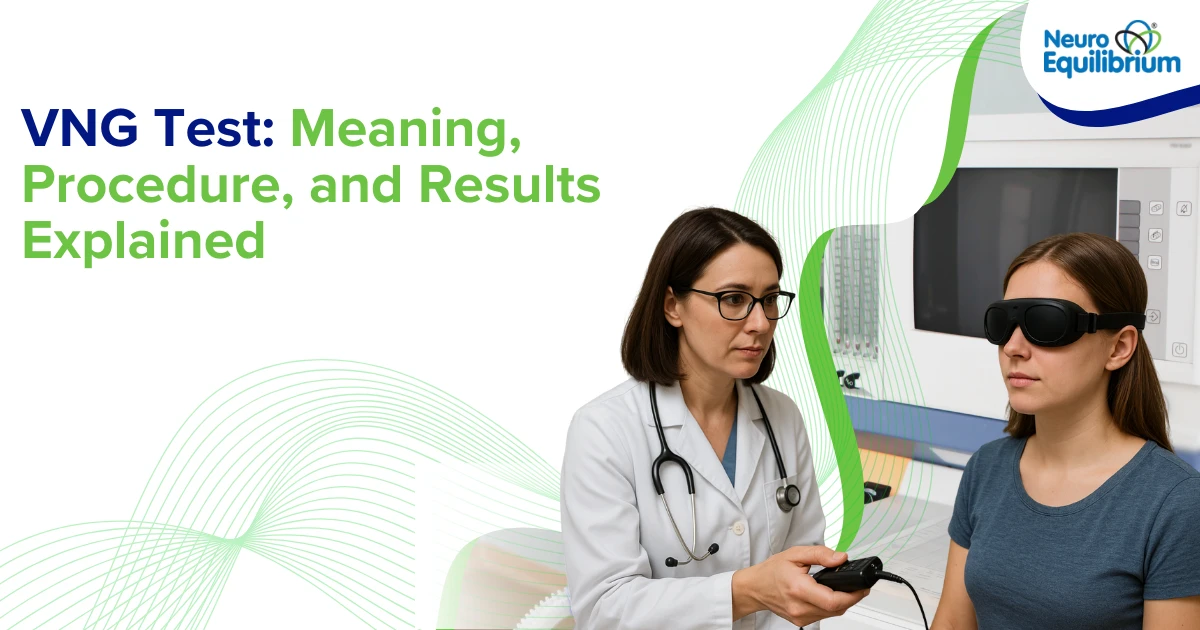
The Videonystagmography (VNG) test is a modern diagnostic procedure that evaluates how well your inner ear balance system and the connections between your eyes and brain are functioning. It records involuntary eye movements (nystagmus) using infrared video cameras placed in lightweight goggles.
Since the inner ear and eye movement pathways are closely linked, abnormal eye movements can indicate whether dizziness or balance problems stem from issues in the vestibular (inner ear) system or the central nervous system (brain).
If you’ve been wondering what is VNG test and whether you might need it, it’s typically advised when patients report persistent vertigo, dizziness, or imbalance.
Know More About Vertigo
- Why Do You Feel Unsteady on Your Feet?
- What Happens When Dizziness and Blurry Vision Come Together?
- What Is Ear Balance Treatment and When Do You Need It?
Why is the VNG Test Done?
Doctors recommend a VNG test when a patient experiences:
- Frequent dizziness or vertigo
- Unexplained imbalance or unsteady gait
- Sudden episodes of spinning sensation
- Nausea and motion sensitivity
- Difficulty focusing or blurred vision with movement
For patients in India and globally, the test helps distinguish between ear-related vertigo (like BPPV, vestibular neuritis, or Ménière’s disease) and neurological causes such as migraine or brainstem disorders. This accurate diagnosis allows doctors to design the right treatment plan early.
If you’re searching online for VNG test cost in India, it’s important to know that prices can vary based on the city and clinic. However, at NeuroEquilibrium, the test is performed using advanced diagnostic systems by trained specialists at affordable rates. Patients specifically looking for VNG test cost in Delhi can expect detailed assessments with transparent pricing and precise analysis.
How is the VNG Test Performed?
The procedure is simple, painless, and usually takes around 60–90 minutes. At a NeuroEquilibrium clinic, it is conducted in four main stages:
- Oculomotor Testing – You follow moving lights on a screen to check how your eyes and brain coordinate.
- Positional Testing – Your head and body are moved into different positions to see if posture changes trigger abnormal eye movements.
- Caloric Testing – Warm and cool air or water are gently introduced into each ear canal to test inner ear function.
- Specialized Vestibular Tests – These include head-shaking, Valsalva-induced, and hyperventilation-induced nystagmus tests for deeper insights.
Throughout the process, your eye movements are precisely recorded through infrared goggles, and the results are analyzed by a vestibular specialist.

Understanding VNG Test Results
Normal Results: Indicate that your inner ear and brain coordination are functioning properly.
Abnormal Results: May point to conditions such as:
- Benign Paroxysmal Positional Vertigo (BPPV)
- Vestibular neuritis
- Labyrinthitis
- Ménière’s disease
- Vestibular migraine
- Central nervous system disorders
At NeuroEquilibrium, these findings are often combined with other diagnostic tools such as Dynamic Visual Acuity (DVA) and Subjective Visual Vertical (SVV) for a comprehensive evaluation.
Advantages of the VNG Test
- Non-invasive and safe procedure
- Provides objective, video-recorded data
- Detects subtle abnormalities often missed in routine exams
- Helps in customizing vertigo rehabilitation programs
VNG-COMPONENTS-FINDINGS, INTERPRETATIONS AND LIMITATIONS
| Result or finding | What it may mean | Important limitation |
| Expected oculomotor responses | The measured eye movements during the visual tasks were within the laboratory’s expected range. | This does not exclude every neurological or visual cause of dizziness. |
| Expected positional responses | No diagnostic positional nystagmus was recorded during the positions tested. | Intermittent BPPV or a canal not adequately provoked may still require clinical consideration. |
| Symmetrical caloric responses | The low-frequency responses measured from the two ears were sufficiently similar. | This does not test every canal at natural head-movement frequencies and may miss bilateral symmetrical dysfunction. |
| Unilateral caloric weakness | One ear produced a weaker low-frequency vestibular response than the other. | The finding must be interpreted with symptoms, examination and other vestibular tests. |
| Positional nystagmus | A head or body position produced a characteristic eye-movement response. | The direction and timing of nystagmus are needed to determine whether the pattern supports BPPV or another cause. |
| Abnormal saccade or pursuit pattern | The visual eye-movement response differed from the laboratory’s reference range. | Attention, vision, age, fatigue and medicines may affect these measurements. A neurological diagnosis cannot be made from one result alone. |
| Directional preponderance | Nystagmus was stronger in one direction during caloric testing. | This finding is not always specific to one disease and requires clinical interpretation. |
| Absent or reduced caloric responses on both sides | The measured low-frequency vestibular responses were reduced. | Technical, ear-related and patient factors must be considered, and other tests may be required. |
A normal VNG means that the responses measured during that particular test session were within the expected limits. It does not prove that every part of the inner ear, brain, cardiovascular system and sensory balance network is functioning normally.
An abnormal VNG supports a pattern of dysfunction. It is not a complete diagnosis without the patient’s history, examination and other relevant assessments.
What Can VNG Help Identify?
Depending on the components performed and the result pattern, VNG may provide evidence relevant to:
- BPPV
- Unilateral vestibular weakness
- Vestibular neuritis
- Labyrinthitis
- Some Ménière’s disease patterns
- Abnormal central eye-movement control
- Unexplained positional or spontaneous nystagmus
- Incomplete vestibular compensation
What VNG Cannot Diagnose or Rule Out by Itself
VNG cannot independently:
- Confirm or exclude every cause of dizziness
- Provide a complete stroke assessment
- Diagnose an acoustic neuroma or brain tumour
- Replace MRI or CT when imaging is clinically required
- Assess hearing loss
- Measure every semicircular canal at natural high-frequency head movements
- Fully assess the saccule and utricle
- Confirm vestibular migraine in every patient
- Exclude PPPD
- Identify blood-pressure, cardiac, metabolic or medication-related causes
- Guarantee that symptoms are coming only from the inner ear
- Predict exactly how quickly a patient will recover
Caloric testing assesses a low-frequency response and can be normal even when a high-frequency canal deficit is present. Bilateral symmetrical vestibular injury may also be difficult to identify through asymmetry-based testing alone.
VNG vs ENG vs vHIT vs VEMP
| Test | How it works | What it mainly evaluates | When it may add information |
| VNG | Infrared cameras record eye movements during visual, positional and caloric tasks. | Oculomotor responses, positional nystagmus and mainly low-frequency vestibular responses during caloric testing | Recurring vertigo, positional symptoms, unexplained imbalance and suspected peripheral or central vestibular patterns |
| ENG | Electrodes placed near the eyes record electrical changes produced by eye movement. | Many of the same nystagmus and eye-movement responses measured by VNG | Selected patients whose eyelids obscure the pupils or who cannot tolerate goggles |
| vHIT | High-speed cameras record the eyes during small, rapid head impulses. | High-frequency vestibulo-ocular reflex function of individual semicircular canals | When rapid-head-movement function needs assessment or VNG/caloric findings do not explain the symptoms |
| VEMP | Electrodes record reflex muscle responses to sound or vibration. | Selected otolith organs and vestibular nerve pathways | When saccular, utricular or related vestibular-nerve dysfunction is suspected |
VNG and ENG measure similar categories of eye movement using different recording technologies. VNG uses video, while ENG uses electrodes.
vHIT focuses on rapid, higher-frequency head movements, while the caloric portion of VNG mainly examines a much slower vestibular response. The two tests can therefore provide different but complementary information.
Which Test May Be Recommended Next?
| Clinical question after VNG | Possible next assessment |
| Does rapid head movement reveal a canal deficit that caloric testing did not show? | vHIT |
| Could the otolith organs or their nerve pathways be involved? | VEMP or SVV |
| Does the patient have hearing loss, tinnitus or ear pressure? | Audiometry and ENT assessment |
| Is visual clarity reduced while the head moves? | DVA |
| Is standing balance or fall risk the main concern? | Posturography or gait assessment |
| Are there neurological signs or central eye-movement findings? | Neurological assessment and imaging where clinically indicated |
| Could blood pressure, medicine or a metabolic problem be involved? | General medical assessment and selected laboratory or cardiovascular tests |
Conclusion
If you or your loved ones suffer from recurrent dizziness, imbalance, or vertigo, the VNG test is one of the most effective ways to uncover the underlying cause. With state-of-the-art NeuroEquilibrium clinics spread across India and 17 countries, patients can access world-class diagnostic care close to home.If you’re looking for reliable information about VNG test cost in India or specifically want to know about VNG test cost in Delhi, reach out to your nearest NeuroEquilibrium clinic. Early diagnosis through VNG testing not only reduces anxiety but also accelerates recovery with targeted treatment.
Sources
- “Videonystagmography (VNG).” MedlinePlus. https://medlineplus.gov/lab-tests/videonystagmography-vng/ (MedlinePlus)
- Mekki S., et al. (2014). The role of videonystagmography (VNG) in assessment of dizzy patient. Egyptian Journal of Otolaryngology, 30:69–72. https://ejo.springeropen.com/counter/pdf/10.4103/1012-5574.133167.pdf (SpringerLink)
- “Videonystagmography (VNG) Testing.” Advocate Health Care. https://www.advocatehealth.com/health-services/rehabilitation-services/audiology/videonystagmography (Advocate Health)
- “What Is Videonystagmography (VNG)?” Interacoustics (Introduction to Balance Testing). https://www.interacoustics.com/academy/balance-testing-training/videonystagmography/videonystagmography-introduction (Interacoustics)
- “VNG Testing — What it means & what to expect.” Phelps Health Audiology Department. https://phelpshealth.org/conditions-treatments/audiology/videonystagmography (Phelps Health)
- “Videonystagmography: Purpose, Results, Normal Range …” Apollo Hospitals Diagnostics. https://www.apollohospitals.com/diagnostics-investigations/videonystagmography (Apollo Hospitals)
- Noreikaite G., Winters R., Shermetaro C. (2024). VNG/ENG Testing. StatPearls Publishing. https://www.ncbi.nlm.nih.gov/books/NBK599515/ (NCBI)
- Meniere disease—deciphering vestibular tests https://pubmed.ncbi.nlm.nih.gov/38223348
Frequently Asked Questions
Is the VNG test painful?
No, the VNG test is completely safe and non-invasive. While some people may feel mild dizziness during certain parts of the procedure, it does not cause pain.
How long does a VNG test take?
The test usually takes between 60 to 90 minutes, depending on the number of assessments required for accurate diagnosis.
Do I need to prepare before the VNG test
Yes, your doctor may ask you to avoid caffeine, alcohol, certain medications, or heavy meals before the test to ensure accurate results. Specific instructions will be provided in advance.
Who should undergo a VNG test?
Anyone experiencing frequent dizziness, vertigo, imbalance, motion sensitivity, or unexplained vision issues during movement may be advised to take a VNG test.
What happens after the VNG test?
Once the test is complete, a specialist will analyze your results and discuss whether your symptoms are linked to an inner ear condition or a neurological issue. This helps create a personalized treatment plan.