







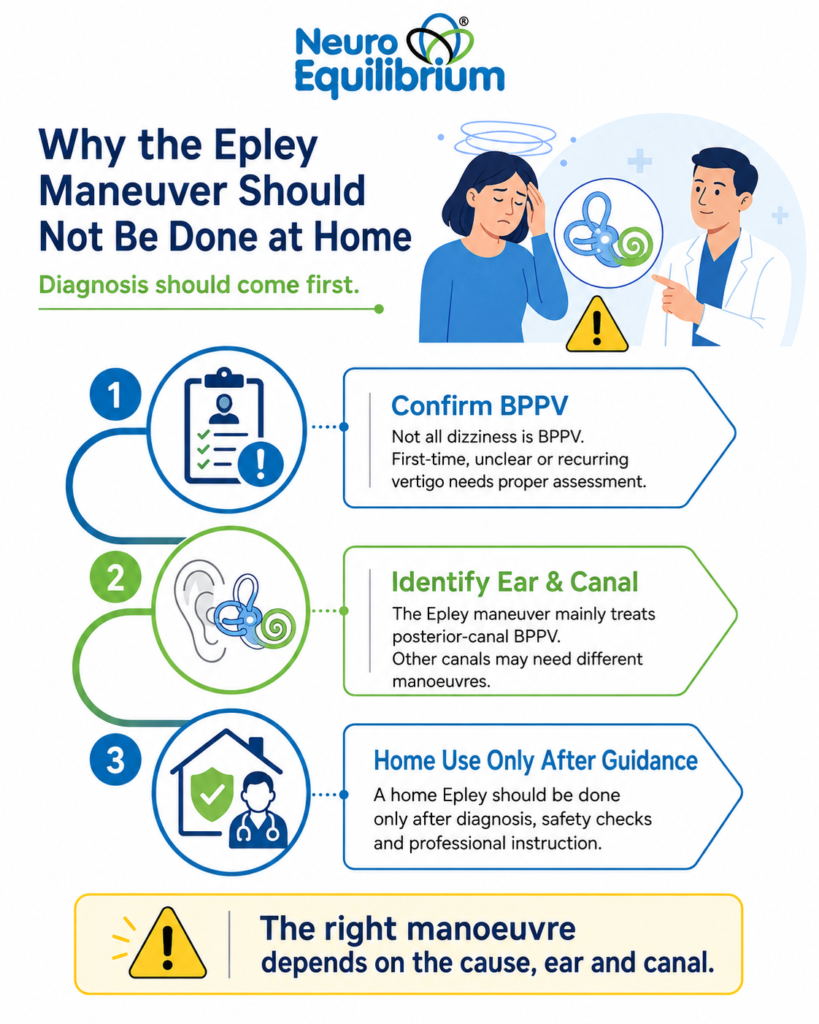
The Epley maneuver should not be the first treatment attempted at home for unexplained, first-time, recurring, or unclear vertigo. Not all dizziness is caused by Benign Paroxysmal Positional Vertigo (BPPV), and even when BPPV is present, the correct repositioning maneuver depends on the affected ear and semicircular canal. The Epley maneuver is mainly used for posterior-canal BPPV and may not be appropriate for other types. Diagnosis should therefore come first. Selected patients with confirmed BPPV may later be taught a home Epley maneuver after the affected side has been identified, safety risks assessed, and the correct technique demonstrated by a healthcare professional.
If vertigo occurs when lying down, rolling over in bed, getting up, looking upwards, bending, or changing head position, it can be tempting to look for an exercise that provides a quick solution. The Epley maneuver is one of the most commonly used treatments for BPPV and is frequently demonstrated online.
However, not all dizziness or chakkar is BPPV, and BPPV does not always require the Epley maneuver. Identifying the cause, affected ear, and semicircular canal involved is an important part of Epley maneuver safety.
If the cause of vertigo has not been confirmed, or episodes are first-time, recurring, or unclear, an assessment at an A specialised vestibular or vertigo clinic can help determine whether repositioning treatment is appropriate.
If BPPV has already been diagnosed and the correct technique has been taught by a healthcare professional, selected patients may be advised to perform a home Epley maneuver. The important point is not simply knowing how to perform the movement; it is knowing whether the manoeuvre is appropriate for the diagnosed condition.
Why Should BPPV Be Confirmed Before the Epley maneuver?
Epley maneuver safety starts with confirming that the dizziness is actually caused by BPPV.
BPPV occurs when small calcium carbonate crystals called otoconia become displaced from the utricle and enter a semicircular canal in the inner ear. When the head changes position, movement of these crystals can create abnormal balance signals and trigger brief episodes of spinning.
Symptoms may occur when rolling over in bed, getting up, looking upwards, or bending.
However, vertigo can also occur with other vestibular or neurological conditions, including vestibular migraine and other inner-ear disorders.
Vertigo is also different from dizziness more broadly. Vertigo usually describes a sensation that the person or surroundings are spinning or moving, while dizziness can also mean light-headedness, swaying, or feeling off balance.
For this reason, the first step should be understanding the symptom pattern and performing an appropriate clinical assessment rather than assuming that every positional episode requires the Epley maneuver.
Know More About
- How the Epley maneuver Can Help Relieve BPPV Symptoms Fast
- BPPV Treatment: Effective Ways to Manage Vertigo
- Just Diagnosed with BPPV? Here’s what to do Next?
How Does an A specialised vestibular or vertigo clinic Identify the Affected Ear and Canal?
There are three semicircular canals in each inner ear. BPPV can involve different canals, and the same repositioning maneuver is not appropriate for every type.
The Epley maneuver is mainly used for posterior-canal BPPV. Horizontal-canal BPPV may require other canal-specific repositioning techniques, such as the Barbecue roll, Zuma maneuver, or Gufoni maneuver.
A specialised vestibular or vertigo clinic can assess which side and canal may be involved using the symptom history and positional testing.
The Dix-Hallpike test is commonly used when posterior-canal BPPV is suspected. The Supine Roll test may be used when horizontal-canal BPPV is suspected.
During positional testing, the clinician observes involuntary eye movements called nystagmus. The pattern and direction of these eye movements can help identify whether the findings are consistent with BPPV and which canal or side may be involved.
Treating the wrong side or using a maneuver intended for a different canal may not resolve the problem. Correct diagnosis therefore helps match the repositioning maneuver to the specific type of BPPV.
Is the Epley maneuver appropriate for every type of BPPV?
No. The Epley maneuver is primarily used for posterior-canal BPPV.
Different BPPV patterns may require different canal-specific repositioning maneuvers.
| Situation | What may be considered |
| Posterior-canal BPPV confirmed | Epley or another appropriate posterior-canal repositioning maneuver |
| Horizontal-canal BPPV confirmed | A canal-specific technique such as the Barbecue roll, Gufoni, Zuma, or another appropriate maneuver |
| Cause of dizziness is unclear | Further clinical assessment before repositioning |
| Symptoms do not match typical BPPV | Evaluation for another vestibular or medical cause |
| BPPV has resolved but imbalance remains | Vestibular rehabilitation may be considered when appropriate |
The maneuver chosen depends on the diagnosis rather than on vertigo symptoms alone.
When Is Vestibular Testing Needed Before an Epley maneuver?
Diagnosis generally begins with the patient’s symptoms, medical history, clinical examination, and positional testing.
Not every person with suspected BPPV requires a full battery of vestibular tests.
When the diagnosis is unclear, symptoms do not follow a typical BPPV pattern, or further evaluation is clinically indicated, additional vestibular testing may be considered.
VNG, or videonystagmography, uses specialised equipment to record eye movements. In appropriate cases, recording nystagmus can help a clinician assess patterns of eye movement alongside positional findings.
Depending on the patient’s symptoms, a broader vestibular assessment may also involve vHIT, hearing assessment, or other balance tests when clinically relevant.
No single vestibular test diagnoses every cause of vertigo. Results need to be interpreted together with the symptom pattern, physical examination, and positional testing.
This supports Epley maneuver safety because treatment is selected from examination findings rather than assuming that every episode of chakkar is caused by displaced inner-ear crystals.
Can Neck, Back, Eye, or Vascular Problems Affect Epley Maneuver Safety?
The Epley maneuver involves a sequence of head and body positions. Although the maneuver is suitable for many people with appropriately diagnosed BPPV, the standard movements may not be appropriate for everyone.
Certain neck or spinal conditions, significant mobility limitations, recent injuries, or specific vascular or ocular conditions may affect whether and how the maneuver can be performed safely.
A clinician can review medical history and movement limitations before performing or recommending an Epley maneuver.
This is another reason a generic online video cannot determine whether the same movements are appropriate for every patient.
For selected patients, the maneuver may need to be modified or an alternative approach may be considered based on the medical assessment.
Shortcode to be added
What Happens if the Epley maneuver Does Not Resolve the Vertigo?
Some patients may improve after repositioning, while others may require reassessment or another repositioning session.
Mild unsteadiness can sometimes remain after the intense positional spinning has improved.*
However, persistent dizziness does not mean that the same Epley maneuver should automatically be repeated.
BPPV may still be present, a different canal may be involved, or another vestibular problem may be contributing to the symptoms.
A specialised vestibular or vertigo clinic can reassess the symptom pattern and positional eye movements to determine whether another repositioning maneuver or another form of management is appropriate.
If BPPV has resolved but imbalance remains, Vestibular Rehabilitation Therapy may be considered. Rehabilitation can include gaze-stability exercises, balance retraining, and appropriately selected movement exercises according to the patient’s findings.
When Can the Epley Maneuver Be Done at Home?
Some people with an established diagnosis of BPPV may be advised to use a home Epley maneuver.
This should follow an assessment that confirms the relevant BPPV pattern and affected side, considers medical or movement-related safety factors, and includes professional instruction on the correct technique.
The home Epley maneuver should not be used as a way to diagnose unexplained dizziness.
Johns Hopkins describes home Epley use when the medical history and physical examination support BPPV and notes that a healthcare provider may first perform and teach the maneuver. Cleveland Clinic similarly notes that a provider may teach patients how to perform the maneuver at home if appropriate.
The key Epley maneuver safety principle is therefore diagnosis and instruction before self-treatment, rather than using an online demonstration as the first response to unexplained vertigo.
When Does Vertigo Need Medical Care Instead of an Epley maneuver?
Not every episode of dizziness is routine BPPV.
Urgent medical assessment is needed when new or worsening vertigo occurs with warning signs such as:
- weakness or numbness
- difficulty speaking or slurred speech
- double vision
- a severe new headache
- major loss of coordination
- sudden significant difficulty standing or walking
- sudden hearing loss
These symptoms should be medically assessed rather than treated as routine positional vertigo with an Epley maneuver.
What May Assessment and Treatment at an A specialised vestibular or vertigo clinic Involve?
A diagnosis-first approach connects assessment, treatment, and recovery rather than treating every positional symptom in the same way.
Evaluation may begin with the patient’s symptom pattern and medical history, followed by positional examination using tests such as the Dix-Hallpike test or Supine Roll test.
Additional testing such as VNG or other vestibular assessments may be used when clinically indicated rather than being routine for every patient with BPPV.
Once the BPPV type and affected canal are identified, treatment can involve the appropriate canal-specific repositioning maneuver. Depending on the findings, this may include the Epley, Semont, Barbecue roll, Zuma, Gufoni, or another maneuver appropriate for the identified canal.
If balance problems remain after BPPV has been treated, Vestibular Rehabilitation Therapy may be considered according to the patient’s symptoms and assessment findings.
The Epley maneuver is primarily used for posterior-canal canalithiasis, while other BPPV variants may require different repositioning maneuvers.The problem arises when it is used as a general exercise for every type of dizziness.
Epley maneuver safety therefore involves confirming BPPV, identifying the affected side and canal, checking whether the maneuver is appropriate for the patient, and reassessing persistent symptoms rather than repeatedly performing the maneuver without evaluation.
What Should You Do Next if You Think You Need the Epley maneuver?
If positional vertigo is occurring for the first time, keeps returning, is severe, or the cause is unclear, the next step is to confirm whether BPPV is actually responsible before attempting a repositioning maneuver.
A specialised vestibular or vertigo clinic can assess the symptom pattern, identify the affected ear and canal when BPPV is present, check whether repositioning is appropriate, and select the relevant canal-specific maneuver.
Patients who have confirmed BPPV and have been assessed for safety may later be taught a home Epley technique when their healthcare professional considers it appropriate.
If symptoms persist after treatment, reassessment is preferable to repeatedly performing the same maneuver without knowing whether BPPV is still present or another vestibular problem is involved.
NeuroEquilibrium focuses on identifying the cause of vertigo first and selecting treatment according to the specific balance problem, helping patients move towards safer and more confident recovery.
Frequently Asked Questions
Is it safe to do the Epley maneuver at home?
Some patients may be able to use the Epley maneuver at home following a proper diagnosis of BPPV by a clinician and after learning the correct way to perform the maneuver. It should not be used as a self-diagnostic treatment for unexplained or first-time vertigo.
Can doing the Epley maneuver incorrectly make vertigo worse?
Performing the Epley maneuver incorrectly may provoke temporary dizziness or nausea and may not effectively treat the BPPV if the wrong side, canal, or technique is used. This is why confirming the diagnosis and involved side before self-treatment is important.
How do doctors know which ear needs the Epley maneuver?
Clinicians use the symptom history and positional tests such as the Dix-Hallpike test, together with the direction and characteristics of positional nystagmus, to determine whether BPPV is present and identify the likely involved canal and side.
Does every type of BPPV need the Epley maneuver?
No. Posterior-canal BPPV is the primary application of epley maneuver. Other forms of BPPV may require other repositioning techniques such as Barbecue roll, Gufoni or other canal-specific maneuvers.
What should be done if dizziness remains after the Epley maneuver?
Persistent dizziness should be assessed rather than repeatedly performing the manoeuvre without confirming whether BPPV is still present. The original BPPV may persist, another canal may be involved, or another vestibular or medical condition may be contributing to the symptoms. Further assessment can determine whether additional repositioning, vestibular rehabilitation, or another form of medical care is appropriate.