
Giddiness Treatment – Expert Care for Dizziness and Balance Problems

Giddiness has been listed as a frequent complaint. It has been described by many to feel light, faint, unsteady or off-balance. Some feel as if they may fall. There are those who are subjects of the feeling that the surroundings are moving. These feelings may be disturbing and can influence life. Giddiness may be experienced at any age. It can be either acute or chronic. Some of the episodes are mild and short, but recurrent giddiness cannot be overlooked. We offer giddiness treatment with specialization to find the actual cause and to offer safe and effective care. Our specialists are aimed at the restoration of balance, confidence, and enabling the patients to resume normal life comfortably.

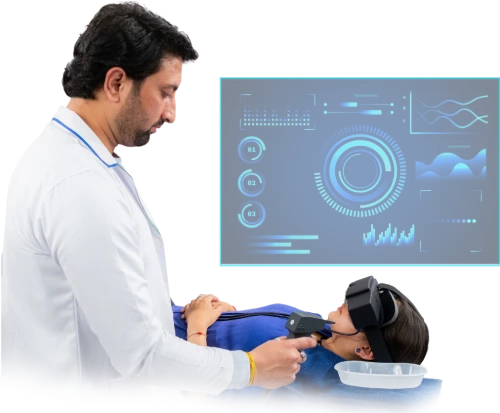
A man adjusts a tool like VR on his head, preparing for an Craniocorpography

What is Giddiness Treatment?

Giddiness treatment is a management approach of diagnosing and treating balance-related symptoms within a medical facility, which is organized.

The giddiness is often used to mean:

  • Lightheadedness
  • Feeling faint
  • Unsteadiness
  • Dizziness

A person should understand that there is no similarity between giddiness and vertigo:

  • Giddiness is a popular word that connotes light, weak or almost fainting.
  • Vertigo refers to the feeling of spinning or developing the impression that the room is spinning.

The two morbidities should be properly evaluated because the treatment will be informed by the underlying cause.

Giddiness is treated in the following way:

  • Finding the root cause
  • The distinction of vertigo and dizziness.
  • Giving one-on-one treatment.
  • Preventing future episodes

With proper care, most of the patients are better.

Divider border Icon
divider Border icon

Worldwide care with 300+ clinics in 90+ cities.

Visit a NeuroEquilibrium Clinic today!

  • Complete vestibular evaluation
  • Same-day diagnosis in most cases
  • Personalized treatment plan

Benefits

  • Accurate Diagnosis: High-quality eye tracking and recording allow better evaluation of oculomotor and vestibular function, essential for a reliable Videonystagmography test.
  • Non-Invasive: Ensures patient comfort during evaluation as high-resolution infrared cameras are used, making the VNG test a comfortable option for vertigo diagnosis.
  • Noise Reduction: Eliminates myogenic and electrical noise, enhancing reliability.
Divider icon
divider icon

Symptoms of Giddiness and Dizziness

Giddiness can be dissimilar to a person. There is the slight form of disequilibrium experienced by others. It may be hard for others to conduct their daily chores.

Common symptoms include:

  • Lightheaded or imbalanced.
  • Unsteadiness while walking
  • Sudden loss of balance
  • The feeling of the floating or weight of the head.
  • Impairment of movement vision.
  • Nausea
  • Weakness
  • Spinning sensation (in case of vertigo)

It is important to consider medical analysis in case the symptoms are widespread, severe or progressive.

Why Does Giddiness Happen?

Proper coordination of the inner ear, the brain, the eyes, muscles and nerves is required to create balance. When such a system is derailed, giddiness may occur.

Common causes include:

In other cases, a mixture of factors could be taken. This is why it is necessary to test provisions in detail.

Information about whether the symptoms were brought about by the trivial lightheadedness or the actual vertigo aids in the successful treatment of the giddiness.

Diagnosis – How We Identify the Cause of Giddiness

Accurate diagnosis is the foundation of effective treatment.

Our experts follow a step-by-step approach to understand each patient’s symptoms clearly.

1. Detailed Medical History

We carefully discuss:

  • When the giddiness started
  • How long episodes last
  • The presence or absence of spinning sensation.
  • Intimations like movement of head.
  • Symptoms such as headache or nausea associated with it.

This aids in distinguishing between the feeling of dizziness, vertigo or fainting..

2. Advanced Balance and Vestibular Testing

We also have high quality and risk free diagnostic tests to test the inner ear functionality and balance system functionality.

These may include:

  • DVA (Dynamic Visual Acuity): Measures how well your vision maintains clarity while your head is in motion to assess the vestibulo-ocular reflex.
  • SVV (Subjective Visual Vertical): Evaluates your perception of verticality to detect tilt or dysfunction in the inner ear’s otolith organs.
  • VNG (Videonystagmography): Uses infrared cameras to track eye movements to determine if dizziness stems from the inner ear or the brain.
  • Caloric Testing: Stimulates the inner ear with temperature changes to check the responsiveness of individual vestibular systems.
  • VEMP (Vestibular Evoked Myogenic Potentials): Evaluates the function of the saccule and utricle sensors and their associated nerves.
  • CDP (Computerized Dynamic Posturography): Assesses balance control while standing on a platform under various sensory conditions.

These are non-invasive tests that help to determine the exact cause.

In case the cause is identified, a certain treatment plan is created.

Giddiness Treatment – How We Provide Care

We provide personalized giddiness treatment based on individual diagnosis. Each patient receives a tailored plan designed for safety and comfort.

1. Repositioning Manoeuvres for Vertigo

Special head movements (repositioning manoeuvres) are applied in case BPPV is the cause of giddiness (dislocated inner ear crystals).

These:

  • Reposition the crystals carefully in place.
  • Reduce spinning sensation
  • Provide instant help in the majority of cases.

It is non-invasive surgery under the supervision of an expert.

2. Vestibular Rehabilitation Therapy (VRT)

Vestibular rehabilitation Therapy is a physical exercise program aimed at enhancing balance.

It includes:

  • Eyes and head coordination drills.
  • Training on balance and stability.
  • Walking practice
  • Slow exposure to movement provokes.

The exercises re-train the brain to make it flexible again to control balance.

Our specialists develop individual exercise programs depending on how the tests are.

3. Treatment for Vestibular Migraine

In case giddiness is associated with migraine:

  • Triggers are identified
  • It is recommended to change lifestyle.
  • Medical management can be recommended.
  • Vestibular exercises are supplemented.

With proper care, the episodes can be cut down to a significant extent.

4. Managing Non-Vertigo Giddiness

To overcome lightheadedness unconnected with vertigo:

  • Co-morbidities like blood pressure problems are considered.
  • Nutrition and hydration information is given.
  • Fall prevention methods are addressed.
  • Balance and exercises that build strength are encouraged.

It concentrates on enhancing the safety and stability.

5. Continuous Monitoring and Support

Regular follow-ups ensure:

  • Steady improvement
  • Modification of treatment where necessary.
  • Prevention of recurrence
  • Emotional reassurance

The comfort and safety of the patients are our concern during treatment.

Why Choose NeuroEquilibrium for Giddiness Treatment?

Choice of the right center is a difference in recovery.

Reason entrusts us with our service of giddiness treatment, because of:

  • Balance disorders and dizziness speciality.
  • Vestibular professionals of high level.
  • State-of-the-art diagnostic medical equipment.
  • Optimal practices in care treatment plans.
  • Personal attention towards patients.
  • Non-invasive and risk-free operations.
  • Intensive patient education and assurance.

Through proper communication and care provided in a human manner, patients feel confident in the process of recovery.

When to Seek Help for Giddiness

Professional assistance is to be taken into account in case:

  • Giddiness does not end in several days.
  • Episodes keep returning
  • Walking feels unsafe
  • It feels like it is spinning.
  • There is fear of falling
  • Dizziness is accompanied by headaches.
  • Day to day activities are hard.

The sooner the disease is detected, the better.

Take the First Step Toward Steady Living

Giddiness can influence the quality of life and result in anxiety. However, it can be successfully treated.

We treat giddiness in a holistic manner and this is achieved via high-level diagnostics and comprehensive treatment policies. Our professionals are particularly attentive to the administration of certain care and finding of the exact cause that should be eliminated in the long term.

Balance problems or dizziness should not be ignored on most occasions. Reserve and receive the first step towards a stable and confident situation. Our employees will be happy to help us recover in a safe and comfortable way.

Frequently Asked Questions

How do you stop dizziness?

Sit or lie at once and make no movements of the head or the body to prevent dizziness. Look at a non living object to reduce the spinning feeling and take water just in case it is dehydration. In the case of dizziness, acuteness, frequentness, and other associated symptoms like chest pain or weakness, a medical professional should be consulted.

Top three causes of dizziness include inner ear dysfunctions (e.g. BPPV or vestibular dysfunctions), low blood pressure or dehydration, and anxiety or stress. The changes could also be brought about in certain instances by change in sugar level or drugs.

Of course, dizziness may be suppressed by maintaining hydration, eating normal balanced meals, getting sufficient sleep and eliminating stress. Balance and balance-training exercises, or caffeine or alcohol abstinence may help but it depends on the cause.

First aid entails sitting or lying down, holding head immobility, loosening of tight clothes, and slow breathing with deep breaths. In case he or she feels faint, then raising the legs can help in the circulation of blood to the brain.

The most suitable option as a first choice is plain water particularly when the reason is dehydration. Fluid and mineral imbalance can also be replaced with the help of electrolyte drinks, oral rehydration solutions, or coconut water.

footer-divider icon
divider
WhatsApp Call Now

Vertigo, Headaches, nausea, or ringing in your ears? Find its root cause. Talk to expert.

I would like NeuroEquilibrium to contact me to provide information about vertigo, and offers.

Vertigo, Headaches, nausea, or ringing in your ears? Find its root cause.Talk to expert.