


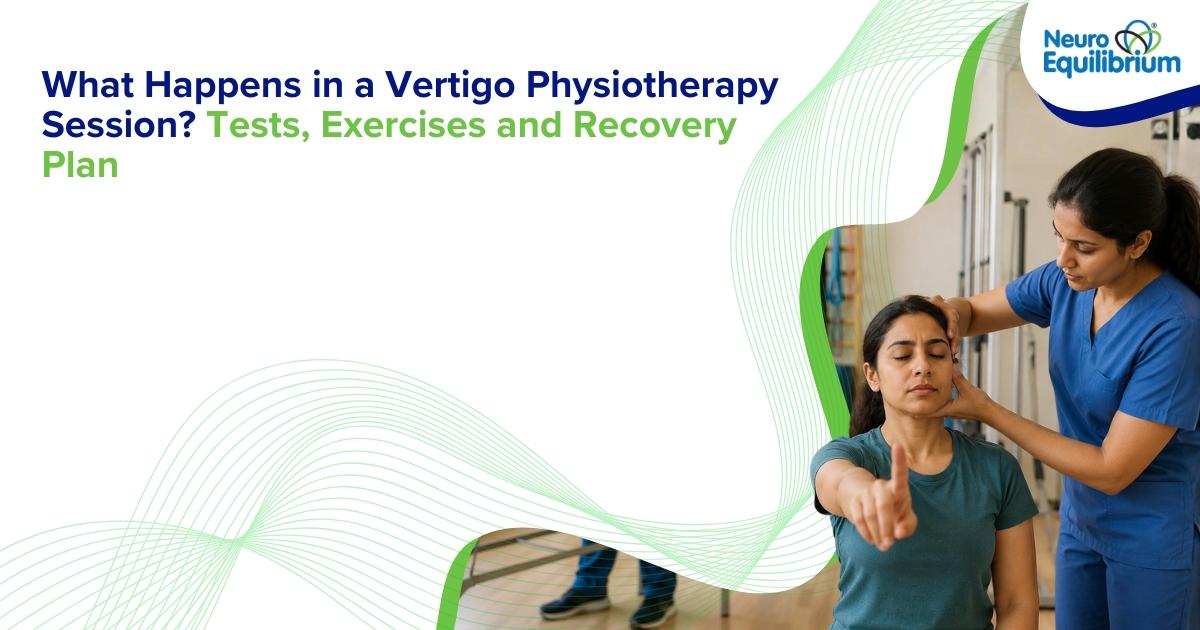





A vertigo physiotherapy treatment will not just address muscle or joint pain but targets the balance system – the inner ear, eyes, brain and body. This session typically starts with an exploration of what the dizziness feels like, what precipitates it, its pattern and what may be causing it. Walking, balance, eye and head movements are then evaluated, and clinically, if necessary, vestibular testing is performed. Treatment will be gaze stabilisation, habituation, balance and walking exercises, virtual-reality based rehabilitation, Posturography based exercise or canal specific repositioning manoeuvre (if BPPV has been diagnosed). Each patient should have a rehabilitation plan tailored to that patient instead of the same exercises for all patients.
How Does a Vertigo Physiotherapy Session Begin?
A thorough review of the history and physical examination usually occurs at the start of the examination. The clinician may want to know when the dizziness occurred, how long it lasts, if it feels like spinning, swaying, chakkar, lightheadedness, or being off balance, and which motions or circumstances trigger it.
Vertigo is a sensation of movement or spinning; dizziness is a general term that may also refer to lightheadedness, unsteadiness, swaying, or feeling off balance. Therefore, it is important to understand how the patient is using the word “dizziness” so as to direct the examination.
This information can be helpful as it allows the identification of distinct symptom pattern, which can indicate different issues. The patient through “dizziness” creates a pattern that can help guide the same pattern as dizziness that lasts for longer periods. Walking with difficulty in maintaining visual stability may indicate problems with maintaining vision while moving the head. People with visual motion sensitivity may experience symptoms in busy or visually crowded places.
Walking, balance and eye and head movements can also be assessed prior to creating a rehabilitation strategy.
Know More About
- Physiotherapy Balance Exercises You Can Start at Home Today
- Top Misdiagnoses in Vertigo & How to Avoid Delayed Treatment
- 7 Effective Yoga Poses for Vertigo Relief
Which Vestibular Tests May Be Needed Before Rehabilitation?
Not all patients require all of the vestibular tests. The tests required depend on the symptoms, medical history, clinical exam and suspected cause of dizziness.
Evaluation typically proceeds through the process of taking a symptom pattern and medical history, conducting a clinical exam, and, if clinically indicated, a vestibular examination. Interpretation of results is done in conjunction with each other; not all causes of vertigo are diagnosed from one test.
In a special vertigo center, various tests can help to determine the function of the inner ear, eyes and brain in maintaining balance.
VNG Test
VNG Test (Videonystagmography) involves taking videotapes of eye movement with special goggles.
These eye movements can assist the clinician to determine function of various components of the balance system, and may indicate the need for additional assessment.
vHIT Test
Video Head Impulse Test (vHIT) examines the vestibulo-ocular reflex, which helps maintain stability of the eye’s image when the head is jerking around quickly.
If the environment seems to move or blur when the head is moving, for instance, vHIT might provide a clue as to whether or not this reflex is normal.
DVA and SVV Tests
Dynamic Visual Acuity, or DVA, is the test to measure how well a person can see when moving the head.
Subjective Visual Vertical (SVV) is an evaluation of one’s perception of upright and vertical.
These tests can be helpful if symptoms are blurry vision, shakiness or instability of vision with head movement and walking.
Each of the vestibular tests tests a specific component or function of the balance system. Test results should thus be interpreted in the context of symptoms, history and clinical examination. There is no one vestibular test that is sensitive to all causes of vertigo.
What Happens if Your Vision Feels Shaky?
Some people feel as if their surroundings are bouncing, shaking, or moving when they walk or turn their head.
If assessment shows difficulty keeping vision stable during head movement, the therapist may suggest gaze stabilisation exercises.
During these exercises, the patient may be asked to look at a fixed target while slowly moving the head from side to side or up and down.
As control improves, the therapist may gradually increase the time or difficulty of the exercise.
The goal is to improve the ability to keep vision clear and steady while the head is moving.
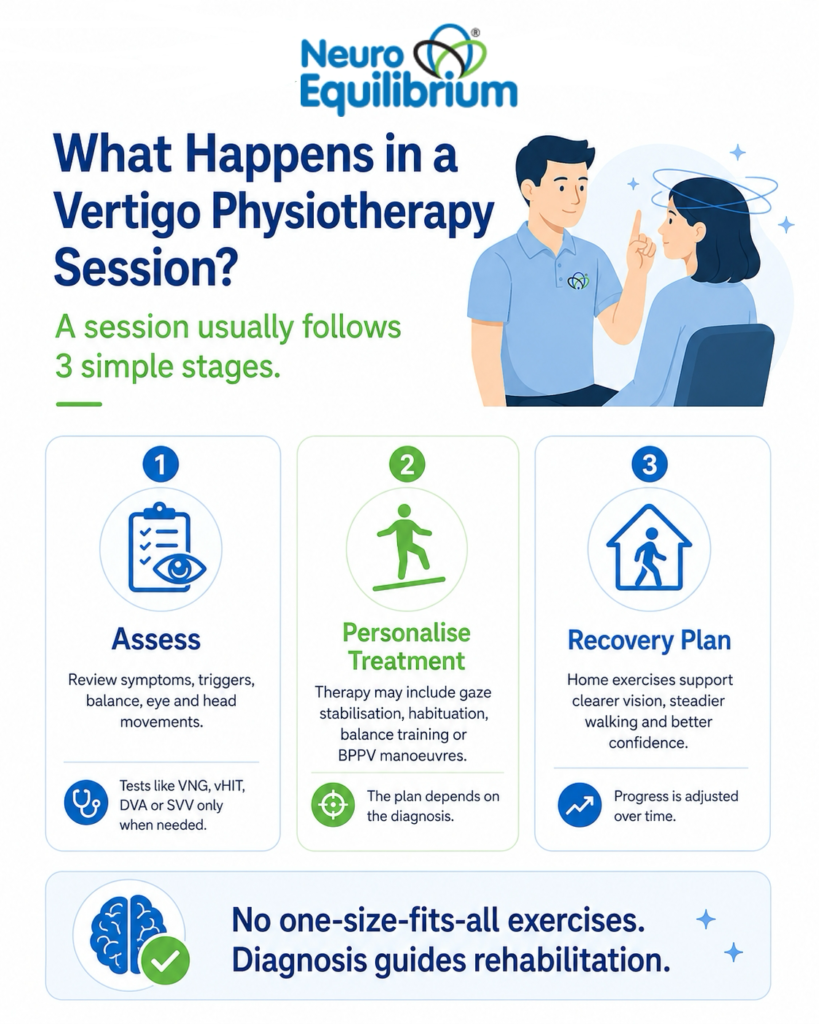
Why Is Vestibular Rehabilitation Therapy Personalised?
Vestibular Rehabilitation Therapy, or VRT, should be planned according to the patient’s symptoms, diagnosis, and assessment findings.
The same exercises may not be suitable for every patient. Following a general exercise video without knowing the cause of dizziness may therefore not address the underlying problem.
People with vestibular weakness may benefit from supervised balance and gaze stabilisation exercises.
These exercises are designed to help the brain manage movements that currently trigger dizziness.
The type of exercise, its difficulty, and how quickly it progresses should depend on the patient’s diagnosis, symptoms, and response to rehabilitation.
When Are Habituation Exercises Used for Movement-Related Dizziness?
Some patients feel dizzy when they bend down, turn, stand up, walk through a supermarket, or look at busy surroundings.
In such cases, the therapist may recommend habituation exercises when they are appropriate for the diagnosed vestibular problem.
During a supervised session, the patient may repeat a safe movement that causes a mild and short increase in dizziness.
With repeated and controlled practice, the brain may gradually become more comfortable with that movement and symptoms may reduce over time.
However, this does not mean that every person with dizziness should intentionally provoke symptoms.
The exercises should be selected according to the cause of the symptoms and performed under professional guidance when needed.
Habituation is one aspect of vestibular rehabilitation therapy, and the number, speed, and duration of movements should be determined by the diagnosis and patient response.
This can be particularly relevant for people who have started avoiding head movement or visually busy environments because they are concerned about triggering dizziness again.
How Do Balance and Walking Exercises Help During Vertigo Physiotherapy?
Balance depends on more than the inner ear. The brain integrates information from the vestibular system, eyes, feet, muscles, and joints.
A vertigo physiotherapy session may therefore include walking while turning the head, changing direction, stepping over obstacles, or practising balance exercises in different positions.
Some exercises may alter visual input or change the surface under the feet. This challenges the balance system to use available sensory information more effectively.
The exercises can become progressively more challenging during vestibular rehabilitation according to the patient’s progress and response.
The purpose is not to make the exercise difficult for its own sake. The goal is to improve tasks such as walking outdoors, changing direction, using stairs, moving more quickly, and navigating crowded environments more confidently.
Does BPPV Need a Repositioning Manoeuvre Before Regular Rehabilitation Exercises?
BPPV is a common cause of short episodes of spinning triggered by changes in head position. It occurs when tiny calcium crystals move into one of the semicircular canals of the inner ear.
If BPPV is confirmed, a vertigo physiotherapy session may involve a canalith repositioning manoeuvre rather than beginning with routine vestibular exercises.
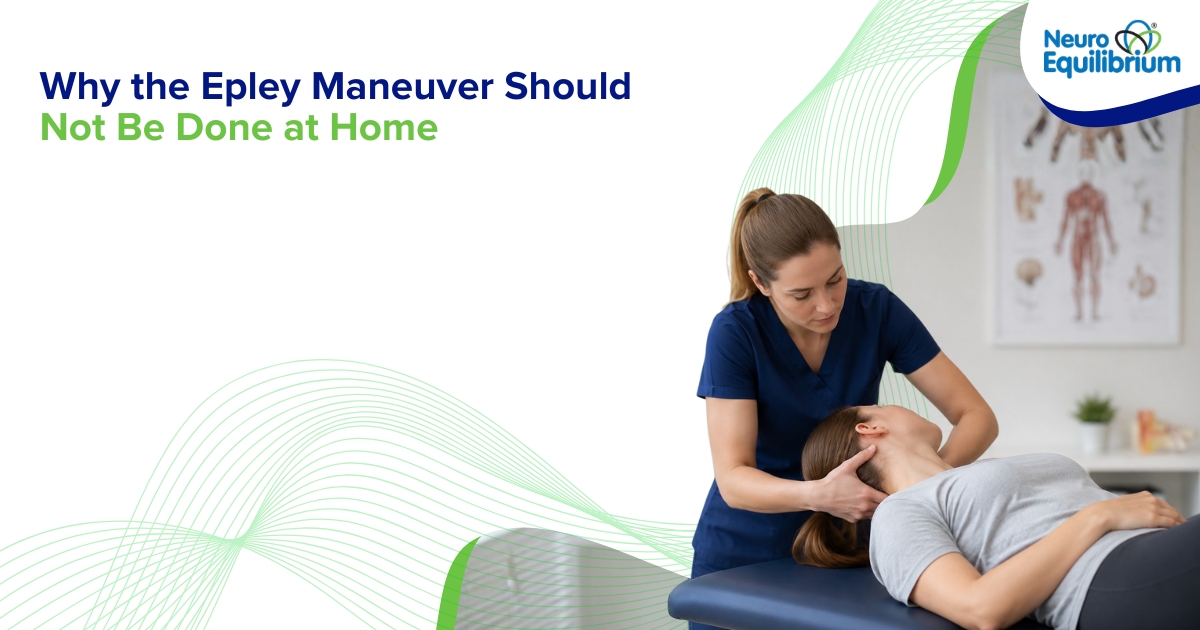
The correct manoeuvre depends on the affected ear, semicircular canal, and type of BPPV. Techniques such as the Epley manoeuvre, Semont manoeuvre, Barbecue roll, Zuma manoeuvre, or another canal-specific approach may be selected when appropriate.
Because the correct technique depends on the diagnosis and affected canal or side, repositioning manoeuvres should be selected and performed or advised under appropriate specialist supervision rather than attempted independently without confirming the type of BPPV.
The aim of the manoeuvre is to move the displaced crystals into a part of the inner ear where they no longer trigger the abnormal movement signal.
If imbalance or instability continues after the positional spinning improves, vestibular rehabilitation may then be considered.
Once the type of BPPV is determined, canalith repositioning is an important part of condition-specific management, as detailed in NeuroEquilibrium’s BPPV guidance.
When Can Virtual Reality Be Used in Vestibular Rehabilitation Therapy?
Some people are comfortable when sitting in a quiet room but feel dizzy in shopping centres, traffic, escalators, or environments with many people and moving objects.
These challenges can be simulated using virtual reality therapy as part of vestibular rehabilitation therapy when clinically appropriate.
Patients may practise gaze control, balance, and movement while being exposed to progressively more challenging visual environments. This may be used for people with visual vertigo, motion sensitivity, or difficulty tolerating crowded environments.
A physiotherapy session using VR may also use sensors to observe movements of the head and body, helping the clinician monitor the patient’s response and adjust the difficulty.
The VR exercises currently included in NeuroEquilibrium rehabilitation services include gait stabilisation, sensory reorganisation, motion desensitisation, and balance retraining.
VR-based rehabilitation does not replace diagnosis and is not required for every patient. It is an additional rehabilitation tool that may be used when it matches the patient’s symptoms, assessment findings, and rehabilitation goals.
What Happens Between Vertigo Physiotherapy Sessions?
Recovery does not usually depend on a single treatment session. A personalised home plan may form an important part of vestibular rehabilitation therapy.
The clinician may provide selected exercises and explain how often they should be performed, how they should progress, and when an exercise should be modified or stopped.
As gaze control, balance, walking, and confidence improve, the plan can be adjusted accordingly.
Recovery time varies between patients because the underlying causes and rehabilitation needs differ.
Exercise programmes may also include a gradual return to walking, work, travel, and visually busy environments rather than unnecessary avoidance of movement when this is appropriate for the diagnosed vestibular problem.
Can a Vertigo Physiotherapy Session Make Dizziness Worse at First?
A mild and temporary increase in dizziness can occur during some vestibular exercises because the balance system is being challenged.
During a vertigo physiotherapy session, the therapist should monitor the patient’s response and modify or reduce an exercise if symptoms become excessive or take too long to settle.
More dizziness does not mean better rehabilitation.
Not every type of dizziness is appropriate for vestibular rehabilitation therapy. The cause should be evaluated first, particularly when symptoms are new, severe, or unusual.
When Does Dizziness Need Urgent Medical Assessment Instead of Physiotherapy?
Exercises should not be the first step when new or worsening dizziness or vertigo occurs together with warning signs that could require urgent medical assessment.
Seek urgent medical evaluation when dizziness or vertigo is accompanied by symptoms such as:
- weakness or numbness
- slurred speech
- double vision
- fainting
- a severe new headache
- chest pain
- significant new difficulty standing or walking
These symptoms should be medically assessed before beginning or continuing an exercise programme.
How Long Does Vestibular Rehabilitation Therapy Take to Work?
There is no single recovery time because the cause and severity of dizziness vary between patients.
A person with appropriately diagnosed BPPV may improve relatively quickly after the correct repositioning manoeuvre. Patients recovering from vestibular neuritis or another vestibular disorder may require a longer course of exercises.
People with chronic imbalance, visual motion sensitivity, vestibular migraine-related symptoms, or PPPD may need to progress more gradually as tolerance to movement and sensory triggers improves.
Walking, gaze stability, balance, symptom tolerance, and the ability to carry out activities of daily living are possible ways to measure progress.
The rehabilitation plan can therefore change as the patient improves rather than keeping the same exercises throughout the entire recovery period.

What May a Vertigo Physiotherapy Plan at NeuroEquilibrium Include?
A vertigo physiotherapy session should begin by understanding what is causing the imbalance rather than giving every patient the same exercise programme.
A pathway of specialised vertigo care may combine assessment with personalised treatment.
Depending on the patient’s symptoms and clinical findings, this may include VNG, vHIT, DVA, SVV, audiometry, positional testing for BPPV, canalith repositioning manoeuvres, customised gaze and balance training, or VR-based rehabilitation.
Specialised investigations such as VEMP or posturography may be considered when clinically relevant rather than being required routinely for every patient.
A patient with BPPV may require a repositioning manoeuvre. Someone with vestibular weakness may require gaze stabilisation and balance training. Another person whose symptoms are triggered by visually busy surroundings may require balance retraining or gradual exposure to those environments.
Vestibular rehabilitation therapy is therefore not simply a list of exercises. The exercises and treatment approach should match the balance problem identified during evaluation.
What Should You Do Next if You Have Been Advised Vertigo Physiotherapy?
A typical vertigo physiotherapy pathway involves understanding the symptoms and triggers, examining the balance system, performing specialised vestibular tests when indicated, identifying the likely cause, selecting appropriate exercises or manoeuvres, and monitoring recovery.
Treatment may include eye- and head-movement assessment, balance assessment, gaze stabilisation, habituation, walking practice, VR-based rehabilitation, Posturography based exercises or a BPPV repositioning manoeuvre depending on the diagnosis.
If recurring dizziness, spinning, motion sensitivity, blurred vision during movement, or imbalance is affecting everyday activities, an appropriate next step is to have the cause evaluated before beginning a general exercise programme.
At NeuroEquilibrium, vestibular assessment and vestibular rehabilitation therapy are used to connect the diagnosis with an individual rehabilitation programme. The aim is to help patients understand the cause of their dizziness and gradually return to walking, work, travel, and other activities of daily living with improved balance and confidence.
Frequently Asked Questions
What happens during the first vertigo physiotherapy session?
During the first session, the symptoms and triggers will be discussed in detail and then tests will be conducted on balance, eye movements, walking and head movements. Based upon the assessment the therapist can then indicate when appropriate, specific tests of the vestibular system and/or begin a customised treatment plan.
What exercises are done during vestibular rehabilitation therapy?
Gaze stabilisation, habituation, balance retraining, and walking exercises are all examples of possible exercises that may be used as part of the vestibular rehab therapy. Exercises are selected according to diagnosis and symptoms, balance skills and tolerance for motion.
What tests may be done before vertigo physiotherapy?
The kind of tests performed depends on the symptoms and the suspected cause of the disease. They can be VNG, vHIT, Dynamic Visual Acuity, Subjective Visual Vertical or hearing assessment. If clinically relevant, specialised investigations (VEMP or posturography) may be performed. Not everyone must have all of the tests.
Can a vertigo physiotherapy session make dizziness worse at first?
During certain exercises, the balance system may be challenged and a mild temporary dizziness may occur, but this will subside after a short while. Any adjustments to the exercises should be made to ensure that the symptoms are kept to a manageable level and not severe or prolonged.
How long does vestibular rehabilitation therapy take to work?
The recovery time is dependent on the cause and severity of the vestibular problem. The symptoms of some patients may improve relatively quickly while others might need a longer period of regular rehabilitation, if they have vestibular weakness, long lasting imbalance or motion sensitivity.