


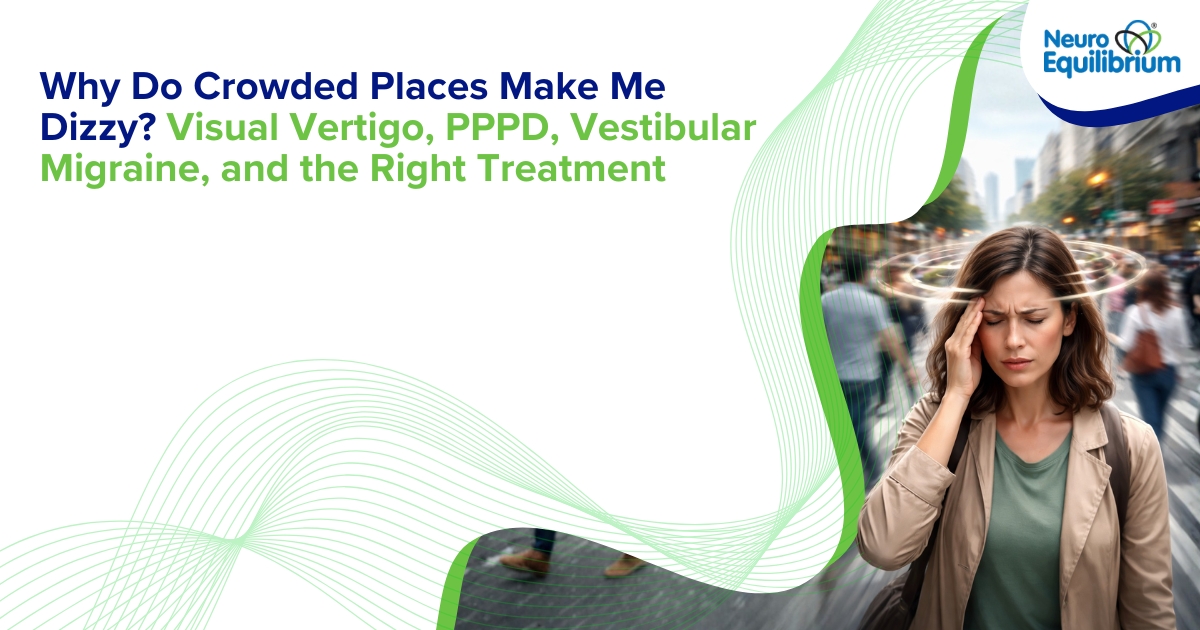





In our clinic, we see this pattern again and again. Someone walks into a busy supermarket with bright lights, long aisles, people moving in every direction and within minutes, their head starts to swim. It is not spinning exactly. It feels more like the floor is gently rocking, as if they are standing on a boat. By the time they reach the checkout, they feel foggy, unsteady, and desperate to step outside. At home, they feel completely fine. Their scans come back normal. And yet supermarkets, malls, and busy roads have slowly become places they avoid.
If this sounds like what you are going through, you are not imagining it and you are not alone.
If you have ever walked into a supermarket, mall, crowded market, airport, or busy road and suddenly felt strange, unsteady, foggy, or dizzy, you are not imagining it.
For some people, it is not a spinning sensation exactly. It feels more like:
- the floor is shifting
- the body is swaying
- the eyes cannot settle
- the brain is overloaded
- the surroundings feel “too much” to process
Many patients struggle to describe it. They say things like:
- “I feel dizzy in supermarkets.”
- “Crowds make me feel off balance.”
- “I can walk at home, but malls make me miserable.”
- “I feel strange when there’s too much movement around me.”
- “Scrolling on my phone or being in traffic makes me feel worse.”
This pattern is very real. And it often points to a visual-vestibular problem, not weakness, not drama, and not “just in your head.”
In some people, the cause may be PPPD (Persistent Postural-Perceptual Dizziness). In others, it may be vestibular migraine, residual dizziness after a vestibular disorder, chronic visual dependence, or another form of vestibular dysfunction. Sometimes the symptoms overlap.
That is exactly why the correct diagnosis matters.
Quick answer: why do crowded places make me dizzy?
Crowded places can trigger dizziness because your brain has to process a huge amount of moving visual information while also integrating signals from the inner ear, eyes, muscles, and joints.
If those systems are not coordinating properly, busy environments such as supermarkets, traffic, escalators, malls, airports, and scrolling screens can create:
- rocking or swaying sensations
- disorientation
- imbalance
- nausea
- brain fog
- a sense that the floor is moving
Common causes include:
- PPPD (Persistent Postural-Perceptual Dizziness)
- vestibular migraine
- residual imbalance after BPPV or vestibular neuritis
- visual vertigo / visual dependence
- broader vestibular dysfunction
The key point is this: dizziness in crowds is a symptom pattern, not a final diagnosis.
Why Can This Symptom Affect Everyday Life?
This kind of dizziness is especially unsettling because it attacks ordinary life.
It is one thing to feel dizzy while lying down during a vertigo attack. It is another thing to feel unsafe in:
- grocery stores
- shopping malls
- wedding venues
- metro stations
- airports
- traffic-heavy roads
- busy offices
- scrolling screens and visually dense digital spaces
People start changing behavior quickly. They avoid markets. They stop going out alone. They rush through errands. They prefer empty places. Some begin to fear escalators, patterned floors, bright lights, and head turns in crowded settings.
Over time, that avoidance can shrink daily life.
And that emotional burden is not trivial. Vestibular disorders are strongly associated with anxiety, distress, loss of confidence, and reduced quality of life. NeuroEquilibrium’s own content also notes that chronic vestibular dysfunction often brings brain fog, anxiety, avoidance, and fear of recurrence, especially when symptoms linger without a clear diagnosis.
What is happening inside the brain and balance system?
Your balance does not come from one organ alone. It depends on coordination between:
- the inner ear (vestibular system)
- the eyes
- the muscles and joints (proprioception)
- the brain’s balance-processing networks
When these systems agree, you feel stable.
When they conflict, the brain struggles to interpret where you are in space.
Crowded places are a perfect stress test for this system because they contain:
- moving people
- bright lights
- reflective surfaces
- repeated visual patterns
- constant peripheral motion
- shifting depth cues
- sensory overload
If you already have a vestibular vulnerability, the brain can become overwhelmed and produce dizziness, rocking, instability, nausea, or visual discomfort.
One common cause: PPPD
One of the most important diagnoses behind dizziness in crowded places is PPPD, short for Persistent Postural-Perceptual Dizziness.
What does PPPD feel like?
PPPD usually does not feel like a brief BPPV-style spinning attack.
Instead, patients describe:
- rocking
- swaying
- floating
- chronic unsteadiness
- visual discomfort
- worse symptoms in crowded or visually busy places
- worse symptoms when upright
- dizziness that lingers day after day
This is one reason it is frequently misunderstood.
A patient may say, “I am not spinning, but I never feel steady.”
That statement matters.
Why crowded places make PPPD worse
PPPD often becomes worse with:
- malls
- supermarkets
- traffic
- crowds
- phone scrolling
- fast-moving visuals
- patterned flooring
- visually busy spaces
That symptom pattern is so characteristic that crowded places and screen-heavy environments are part of how clinicians think about this diagnosis.
NeuroEquilibrium’s own PPPD-related material describes chronic dizziness that is aggravated by upright posture, body movement, and moving visual fields such as crowded areas or screen scrolling.
How PPPD begins
PPPD often starts after another event, such as:
- BPPV
- vestibular neuritis
- vestibular migraine
- panic linked to dizziness
- an intense vertigo episode that sensitized the brain
In other words, the first problem may have been physical and vestibular, but then the brain stays on high alert and keeps processing balance cues in an overprotective, over-sensitive way.
That is why some people say:
- “The worst attack passed, but I never felt fully normal after.”
- “My tests were normal, but crowds still make me feel awful.”
Another major cause: vestibular migraine
Crowded places can also trigger symptoms in people with vestibular migraine.
This is one of the most underdiagnosed causes of recurrent dizziness.
What makes vestibular migraine different?
Vestibular migraine may cause:
- dizziness or vertigo with or without headache
- motion sensitivity
- light sensitivity
- sound sensitivity
- visual overload
- nausea
- head heaviness
- neck discomfort
- episodes that last much longer than BPPV
Some patients never realize migraine is part of the story because they are expecting dramatic headache every time.
But vestibular migraine may present mainly as:
- motion-triggered dizziness
- supermarket dizziness
- light-triggered imbalance
- screen intolerance
- dizziness after poor sleep, missed meals, dehydration, or stress
These are all classic migraine-adjacent clues.
NeuroEquilibrium’s current vestibular migraine content also emphasizes that vestibular migraine can be triggered by stress, lack of sleep, missed meals, bright light, loud sounds, and prolonged screen exposure.
What about BPPV or other inner-ear disorders?
BPPV is still one of the most common causes of vertigo overall, but it usually presents differently.
BPPV usually looks like this:
- brief spinning
- triggered by head position change
- turning in bed
- getting up from bed
- bending down
- looking up
- episodes lasting seconds, usually under a minute
If your main issue is crowded places, visual overload, and prolonged uneasiness, that pattern is less typical for isolated BPPV and more suggestive of PPPD, vestibular migraine, visual vertigo, or residual vestibular dysfunction.
That said, BPPV and chronic visually triggered dizziness can coexist. Some patients first have BPPV, then later develop lingering visual intolerance or PPPD-like symptoms after the original mechanical problem improves.
What is visual vertigo or visual dependence?
Some people become overly dependent on visual input for balance.
That sounds harmless until the visual world becomes too busy.
In that situation, environments such as:
- supermarket aisles
- patterned floors
- scrolling screens
- moving crowds
- traffic
- escalators
- glass corridors
- airport terminals
can overload the system.
Patients may feel:
- dizzy
- pulled visually
- disoriented
- unsteady when objects move around them
- uncomfortable when they themselves are still but the environment is visually active
This is one reason posturography and broader vestibular testing can be so useful. These tests help assess how the body integrates visual, vestibular, and proprioceptive signals.
Why so many patients get dismissed or misdiagnosed
This symptom pattern is often poorly understood in general practice.
Patients may hear:
- “Your MRI is normal.”
- “Maybe it is cervical.”
- “Maybe it is just anxiety.”
- “Try some tablets and rest.”
The problem is that many vestibular disorders are functional, not purely structural. MRI and CT scans show anatomy, but they do not tell the full story about how the balance system is functioning.
NeuroEquilibrium’s own diagnostic education repeatedly makes this point: normal imaging does not rule out vestibular dysfunction, and functional tests such as VNG, vHIT, VEMP, DVA, and posturography may reveal what scans miss.
That is especially important in chronic crowd-triggered dizziness, where the issue may lie in the dynamic coordination of balance rather than a gross structural lesion.
When should you worry about something more serious?
Most dizziness in crowded places is not a stroke.
But urgent medical assessment is needed if dizziness comes with:
- double vision
- slurred speech
- facial droop
- new weakness
- numbness
- inability to walk properly
- sudden severe headache
- sudden hearing loss
- fainting
These are red flags and should not be treated as routine vestibular symptoms.
How is this problem properly diagnosed?
Good diagnosis starts with the story.
A specialist should want to know:
- Does it feel like spinning, rocking, floating, or swaying?
- Is it triggered by crowds, patterns, traffic, supermarkets, or screens?
- Is it worse when upright?
- Did it start after BPPV, migraine, infection, or stress?
- Is there light sensitivity, nausea, brain fog, or motion intolerance?
- Are there hearing symptoms?
- Do symptoms last seconds, hours, or all day?
That history already narrows the field considerably.
Tests that may help
There is no single test that explains dizziness in crowded places. Instead, a specialist chooses a small set of tests based on your symptoms. These tests look at how your eyes move, how steady you are, how well your vision and balance work together, and how your inner ear is functioning. The goal is not just to confirm that you feel dizzy it is to find the real reason behind it, so your treatment can target the right cause.
Depending on the pattern, useful evaluation may include:
- Videonystagmography (VNG)
- Video Head Impulse Test (vHIT)
- Dynamic Visual Acuity (DVA)
- Subjective Visual Vertical (SVV)
- Posturography
- Audiometry
- Positional testing for BPPV
These tests are not ordered to create complexity. They help answer a simple question:
Is the problem coming from the inner ear, migraine network, visual-vestibular processing, chronic vestibular compensation, or something else?

Why posturography and advanced vestibular testing matter here
Crowd-triggered dizziness is one of the strongest scenarios where posturography can become clinically valuable.
Why?
Because it helps assess how the body handles balance using:
- vision
- vestibular input
- proprioception
NeuroEquilibrium’s own posturography content specifically highlights its value in patients whose symptoms are worse in crowded or visually stimulating places, and in patients whose routine scans are normal but everyday balance still feels wrong.
That makes it highly relevant for this patient group.
What treatment depends on the cause
There is no one pill that fixes all crowd-triggered dizziness.
Treatment depends on the diagnosis.
If it is PPPD
Treatment may include:
- vestibular rehabilitation
- graded visual exposure
- movement confidence retraining
- migraine/stress trigger management where relevant
- CBT-informed support in selected patients to break the fear-dizziness cycle
If it is vestibular migraine
Treatment may include:
- regular sleep
- hydration
- trigger identification
- meal consistency
- reduced sensory overload where appropriate
- migraine-focused medical management when needed
- vestibular rehabilitation in selected cases
If it is residual vestibular dysfunction
Treatment may include:
- gaze stabilization work
- balance retraining
- postural rehabilitation
- habituation exercises
- gradual re-exposure to busy environments
If BPPV is part of the picture
Then canal-specific repositioning manoeuvres may also be necessary.
The crucial point is this: effective treatment follows diagnosis, not guesswork.
What can patients do before the appointment?
You do not need to self-diagnose, but you can observe useful patterns.
Notice:
- Do crowds trigger rocking or spinning?
- Are supermarkets worse than open outdoor walking?
- Do scrolling screens make symptoms worse?
- Is bright light or poor sleep a trigger?
- Did the problem begin after a previous vertigo attack?
- Is it worse with upright posture?
- Are you avoiding certain places because of symptoms?
That information can speed up diagnosis significantly.
When should you book a specialist evaluation?
You should consider specialist assessment if:
- crowded places repeatedly make you dizzy
- you feel unsteady in supermarkets, malls, traffic, or airports
- screens and visual motion worsen symptoms
- the problem has lasted weeks or months
- MRI or routine tests are normal but you still feel off-balance
- you have already tried medicines without a clear answer
- dizziness is beginning to change behavior and daily confidence
This is especially important if you have started shrinking your life around the symptom.
Why the right diagnosis changes everything
The biggest shift for these patients is often psychological and practical at the same time.
Before diagnosis, the experience feels mysterious.
After diagnosis, it becomes explainable.
That alone can change the patient journey from:
- confused
- frightened
- self-doubting
- activity-avoiding
into:
- informed
- reassured
- systematic
- hopeful
That is what good vestibular care should do.
Frequently Asked Questions
Why do I feel dizzy in crowded places?
Crowded places can make you dizzy when the brain struggles to process heavy visual motion together with balance signals from the inner ear, eyes, and body. This commonly happens in conditions such as PPPD, vestibular migraine, visual vertigo, and other vestibular disorders.
Why do supermarkets make me feel off balance?
Supermarkets contain bright lights, long aisles, repeating patterns, moving people, and strong peripheral visual motion. In people with visual-vestibular sensitivity, this can trigger rocking, swaying, or dizziness.
Is dizziness in crowds caused by anxiety?
Sometimes anxiety worsens the symptoms, but dizziness in crowded places should not automatically be dismissed as anxiety alone. Vestibular disorders and chronic visual-motion sensitivity can be the real drivers, and anxiety may develop secondarily.
What is PPPD?
PPPD stands for Persistent Postural-Perceptual Dizziness. It is a chronic dizziness disorder that often causes ongoing swaying, rocking, or imbalance, especially when upright or in visually sensitive busy places like crowds, traffic, or supermarkets.
Can vestibular migraine cause dizziness in malls or supermarkets?
Yes. Vestibular migraine can make patients highly sensitive to motion, bright light, screen exposure, and busy visual environments, which is why malls, traffic, and crowded places can trigger symptoms.
Why is my MRI normal if I still feel dizzy?
MRI primarily looks at structure, not at how the balance system functions. Many vestibular disorders, including BPPV, vestibular migraine, PPPD, and residual vestibular dysfunction, may not show up on MRI but still cause significant symptoms.
What tests help diagnose dizziness in crowded places?
Tests may include VNG, vHIT, DVA, SVV, posturography, audiometry, and positional testing. The right combination depends on the symptom pattern and helps identify whether the cause is vestibular, migraine-related, visual-motion related, or mixed.
Can this type of dizziness be treated?
Yes. Treatment depends on the cause but may include vestibular rehabilitation, visual-motion retraining, migraine-focused treatment, repositioning manoeuvres for BPPV, and structured recovery plans for chronic dizziness disorders like PPPD.
When should I see a specialist for crowd-triggered dizziness?
You should see a specialist if crowded places, supermarkets, visual motion, or screens repeatedly trigger dizziness, especially if the symptoms are affecting daily life, persisting for weeks, or continuing despite normal routine tests.