







It is so disturbing to live with vertigo. Then one minute you are fine, the next minute you are spinning, you have lost your balance, and even such simple tasks as walking or standing can be terrifying. Most of the patients say it is like that they are in a rocking boat, walking on shaky ground or trapped in a lift that will not stop swaying. In case this reminds you of what is happening to you, then you should understand that you are not alone and that your emotions are quite natural. Vertigo is frustrating, devastating, and not predictable yet in the modern time, treatments have become more accommodative, less baffling, and more inclined to help you feel confident again in your daily life.
Virtual reality therapy is one of the newer patient-friendly processes that is a safe and gentle form of intervention and helps your brain re-learn balance in a safe and guided environment. VR therapy is a step by step process of not only dealing with dizziness but instead eliminating it at its cause, which after time makes normal movements less frightening. We will describe its functionality and its benefits and what you can expect in a very simple and understandable language in this article, making your comfort and success the priority. Having the proper support, you will surely feel stable once again, and this may be one of the things that will enable you to proceed towards recovery more confidently.
Know More About Vestibular Rehabilitation
- What is the Vestibular System? A Beginner’s Guide
- Top 5 Vestibular Rehabilitation Exercises for Vertigo Relief
- Vertigo Exercises And Home Remedies
Understanding Vertigo and Balance Problems
Vertigo is different from normal dizziness. It happens when the balance system in your inner ear and your brain struggle to work together. Your inner ear constantly sends signals to your brain to help you stay steady. But when those signals don’t match what your eyes and body are experiencing, the brain gets confused. That confusion can lead to the spinning feeling, nausea, or the sense that you might fall, even when you’re standing still. Everyday situations like walking in busy places, using escalators or lifts, watching fast movement on screens, turning your head too quickly, or traveling by different modes of transport can all trigger these symptoms. For many people, standard balance exercises can make a big difference, but some patients find them hard to stay motivated with because they can feel repetitive, dull, or even a little frightening to do.
Virtual reality exposure therapy was created to make balance therapy feel safer, more engaging, and easier to follow. Instead of staring at a printed chart or repeating the same movements, VR therapy places you in a controlled digital environment that guides your brain through balance training step by step. Many patients find it more interesting than traditional exercises, and less intimidating because everything happens in a safe space, with clear instructions and therapist support. It’s not meant to replace all other treatments, but it can be a helpful option for people who want a more modern and patient-focused approach to retraining balance and reducing symptoms.
Virtual Reality Therapy for Vertigo
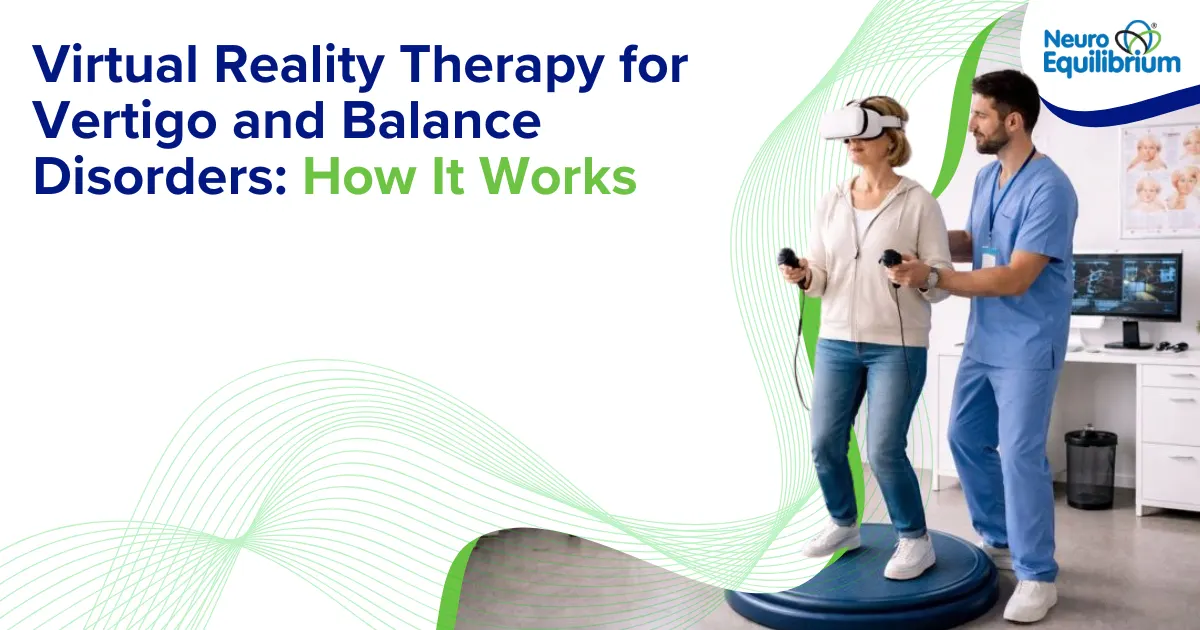
Virtual reality therapy involves a comfortable headset and motion sensors so that you can be put in a realistic digital world. It is not that your brain is even imagining the difficult scenarios, it literally moves and feels three-dimensional even when you are in the real world. The only difference here is that all this is done in a safe and controlled environment where the intensity can be manipulated to your comfort. Due to vertigo, the relevant environments in the cases of people with such conditions may be walking on a wavy floor or standing on a wavy surface and around a crowded street or market. All that happens is that you keep your physical body stationary, completely supported, and your brain has to be taught to process motion in a slow and controlled manner.
Although your human body is not traveling through those areas, your brain balance system is being re-trained step by step to process movement information more securely. This also assists in eliminating the fear and the discomfort which daily movement can give. The brain also eventually becomes less overloaded with mixed balance messages and therefore normal activities become easier and less provocative. VR therapy will be used to help you go at the pace that you can comfortably work at, and that helps you to regain stability without compromising your well-being or forcing you to work too quickly.
How Virtual Reality Therapy Works Step by Step
1. Simulating Real-Life Balance Challenges
Dizziness in everyday life is usually manifested in particular circumstances such as supermarkets, traffic jams or buses. Virtual reality therapy re-creates these moments and does not expose you to risk.
Within the headset, you can have:
- Balancing walkways that are narrow.
- Unstable floors that put a strain on posture.
- Hyperactive visuals that cause vertigo.
Since it seems like you are falling, your brain receives good exercise with no fear of falling.
2. Graded Exposure Through Virtual Reality Exposure Therapy
Granted exposure is one of the most important aspects of the recovery, i.e. beginning with small and gradually increasing the difficulty.
For example:
- To begin with, you can be standing in a serene virtual environment.
- Smooth movement is later added.
- As time progresses, turns become sharper and images more complicated.
This step by step method will enable your brain to adapt rather than being overwhelmed. As exposure increases, the signals of dizziness diminish, and confidence increases.
3. Helping the Brain Relearn Balance (Neuroplasticity)
Neuroplasticity is an amazing ability of your brain. This means it can learn new ways to balance, even when part of the inner ear isn’t working properly.
The virtual reality therapy conditions the brain to:
- Trust body movement again.
- Disregard disorienting balance information.
- Enhance communication between the ears and the muscles as well as the eyes.
Imagine that you are training your brain to learn a new map since the old map had failed.
4. Real-Time Feedback and Progress Tracking
In classes, machines monitor your body movement:
- Head position
- Body sway
- Reaction speed
This enables the therapy difficulty to be changed on-the-fly. Patients are also motivated to proceed with treatment due to the evidence of improvement like balance time or easier movement.
5. VR-Based Balance Testing (Posturography)
Other than treatment, virtual reality is also applied to know why an individual is dizzy. Therapists can observe the reaction of your balance system, by altering the visual and movement conditions.
This helps identify:
- Visual dependency (dizziness caused by movement of images)
- Inner ear imbalance
- Poor body coordination
The therapy becomes more effective and individual as soon as the root problem becomes clearer.

Conditions Where Virtual Reality Therapy Helps
Virtual reality therapy is used for many balance-related problems, including:
- BPPV (Benign Paroxysmal Positional Vertigo) – especially lingering dizziness after repositioning
- Vestibular neuritis – nerve-related balance problems
- Motion sickness – dizziness during travel
- Peripheral vestibular disorders – balance issues from inner ear damage
Is Virtual Reality Therapy Safe?
Yes, It is conducted with the supervision of trained professionals, and we at NeuroEquilibrium ensure that each of the sessions is entirely controlled and tailored to each specific patient. As we lead you through the VR balance therapy we have close supervision over your reaction. When the symptoms become excessively high, we may slow down or even stop immediately. When your brain and balance system indicate that you are ready to take the next step, then we only increase the intensity. Our utmost care is your wellbeing, and we never make you do what you find uncomfortable.
In the majority of cases, VR therapy, according to patients, is supportive, involving, and simpler to adhere to than regular exercises. Rather than making the same motions repeatedly, VR enables the brain to feel motion in a risk-free setting and remain physically stable and elevated. Most of them think it will be scary but most find out that it is actually reassuring since we control everything in real time depending on their comfort and progress. We only want to achieve one thing at Neuroequilibrium: to restore confidence in balance, make dizziness fade, and get everyday movement less overwhelming in your brain again one carefully guided session at a time.
Why Choose NeuroEquilibrium For Virtual Reality Therapy
In Neuroequilibrium, we are well aware of the fact that the location of vertigo treatment can be a vital decision. Our patients visit us not only seeking answers, but with clarity, safety and something they are confident in and can experience as progress. We are concerned with the true cause of dizziness being diagnosed with an enhanced technology and the construction of the therapy plans based on each person rather than a one-size-fits-all model. In our created virtual reality therapy program, your brain will be trained to undergo balance retraining in a comfortable and carefully supervised environment, and the sessions will be tailored to your comfort. The majority of the patients report that they prefer this method since it does not feel much like repetitive exercise as it seems rather like a process of recovery with support and stepwise approach. We also assist you with monitoring improvements as you are going through it so that you could see the progress you are making and to feel more confident about your recovery process.
Conclusion
Virtual reality therapy and virtual reality exposure therapy are opening up new opportunities to people with instances of vertigo and balance problems. These devices render rehabilitation interesting, efficient, and more palatable to patients so that they can proceed with it without starting to feel overburdened and disheartened. At Neuroequilibrium, we do not think that stopping treatment and knowing how the treatment works is the initial step to feel in control once again. When spinning becomes a serious issue or you become scared of falling over, we would like you to know that it is not a far off hope or recovery, but it is a process that starts all along. Through proper guidance and a team that has the proper understanding of the balance system in the brain, it is possible to have steady movement and again have confidence. We aim to make you feel safer when moving about, more balanced and clearer headed in one guided session at a time.
Frequently Asked Questions
What is Virtual Reality Exposure Therapy (VRET) and how does it help anxiety?
VRET is one of the types of exposure therapy, which involves immersive virtual reality experiences so that individuals could safely experience fears, including phobias, PTSD, or social anxiety. Through repetition of the situations that cause fear, as one goes through them in a controlled environment, the brain will eventually learn that these situations are not dangerous, thus anxiety will decline over a period of time.
How does a VRET session actually work?
You put on a VR headset (and in some cases, headphones) during a session and are immersed in a hyperreal world, like being on a plane, or high in the air. The therapist is in charge of the situation, keeping escalating to the point, as they take you through coping and relaxing skills to deal with anxiety.
Is Virtual Reality Exposure Therapy safe?
Yes, VRET can be regarded as safe when it is administered by a trained therapist. The therapist observes your responses during the session and is able to interrupt, alter or terminate the experience anytime. Such level of control renders it safer than real life exposure to strong or hard to copy situations.
What conditions can be treated with VRET?
VRET is also applied to specific phobias (such as fear of heights, flying or spiders), social anxiety disorder, post-traumatic stress disorder (PTSD) and school related anxiety. It may be modified to fit into a variety of fear-based disorders where exposure at a low rate is positive.
What should I expect before and during my first VRET session?
We will begin with the discussion of your triggers, fears, and therapy objectives. After that, you will be placed in the VR equipment and take part in a virtual situation of about 1545 minutes. Your therapist will teach you breathing and coping techniques to eliminate anxiety and develop confidence during and following the exposure.