



If you have ever felt the room spinning, the floor tilting, or your body swaying for no apparent reason, you know how scary vertigo can be. Many people first visit a regular ENT doctor, hoping for quick relief. Sometimes that works, but in many stubborn or confusing cases, the dizziness recurs.
There is another kind of expert who looks much deeper into balance problems: a vertigo specialist, a vertigo doctor with advanced training in both the ear and the brain. These doctors are often called neurotologists, and they focus on the entire balance system, not just what can be seen on scans.
In this guide, we’ll try and walk you through what a neurotologist checks that general ENT doctors may miss in clear, simple language that anyone can understand. If you’re tired of guessing games with your health, this guide will help you know what to look for next.
Know More About
- Why Some Vertigo Treatments Don’t Work the First Time
- Vertigo Exercises And Home Remedies
- What to Expect During Vertigo Treatment
How a Neurotologist’s Training Differs from a Regular ENT for Vertigo Problems
A general ENT doctor is trained to treat ear, nose, and throat conditions, including infections, hearing loss, sinus issues, and ear blockage. That is very important care.
But a neurologist has additional training in neurology, the study of the brain and nerves. This matters because balance is not just in the ear; it is a teamwork project between the following:
- The inner ear
- The eyes
- The brain
- The nerves and muscles
A true vertigo specialist studies how all these parts talk to each other. When dizziness does not improve, this bigger-picture view often makes the difference.
Why Normal MRI or CT Scans Can Miss the Real Cause of Vertigo
Many patients get an MRI or CT scan early. When the report says “normal”, it can feel both relieving and confusing because the spinning is still there.
Scans mainly show structure. They look for tumours, strokes, or bleeding. But they cannot show how well your balance organs are working.
A neurotologist focuses on function, not just shape. Specialised tests can measure whether the balance sensors inside your ears are sending correct signals to your brain even if everything looks perfect on a scan.
This is one big reason people seek a vertigo specialist, a vertigo doctor, when routine tests come back clear, but symptoms continue.
Who is a neurotologist?
A neurotologist is a vertigo specialist with advanced training in disorders that involve both the inner ear and the nervous system. While general ENT doctors manage many ear-related problems, neurotologists study how the ear communicates with the brain and nerves that control balance and posture.
Their additional expertise allows them to evaluate the entire balance network rather than focusing only on visible ear disease. When dizziness becomes persistent or complicated, this deeper training often makes a critical difference in diagnosis.
When Someone Might Be Referred to a Neurotologist
Neurotologists are normally consulted when a patient does not respond to standard vertigo treatments or when symptoms recur without any apparent reason. Some people hear well during testing yet still feel unsteady. Others experience recurrent attacks involving both ear and neurological factors, or ongoing dizziness despite prior evaluation.
Referral may also be due to previous scans or balance tests that appear inconclusive. The implication of these scenarios is that the functional evaluation of the balance system must be conducted more comprehensively.
Advanced Balance Testing
Neurotologists use specialised instruments to assess the function of the balance organs rather than imaging.
Other tests include the Video Head Impulse Test, which assesses inner-ear stabilisation of the eye when the head is rapidly moved. Vestibular Evoked Myogenic Potentials (VEMPs) are used to test the gravity-sensing organs within the ear. Rotational chair testing assesses the balance responses at various speeds of motion. whereas advanced positional testing might reveal complex forms of BPPV that cannot be identified using standard manoeuvres.
Dynamic visual acuity testing can also be used to assess an individual’s ability to see clearly while the head is in motion, providing additional information on inner-ear function.
Detailed Eye-Movement Analysis
Eye-movement testing is central to vertigo evaluation because the eyes respond quickly to balance signals from the inner ear.
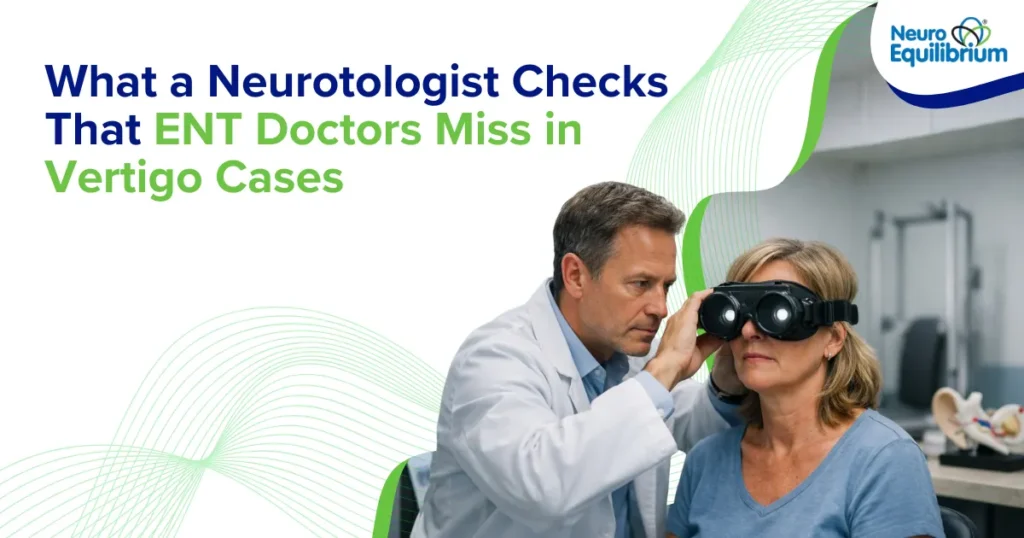
Neurotologists use goggles equipped with cameras to record subtle eye movements in darkness. These recordings help them identify abnormal patterns that may indicate specific inner-ear disorders or suggest brain involvement.
By analysing these movements carefully, specialists can separate peripheral ear causes from central neurological ones, providing clarity when symptoms are otherwise confusing.
Brain Versus Inner-Ear Differentiation
A major goal of advanced testing is determining whether vertigo originates in the inner ear or the brain.
Neurotologists look for warning signs that raise concern for neurological involvement, such as unusual eye-movement patterns, coordination problems, weakness, or sensory changes. When needed, imaging studies may be ordered to rule out stroke, inflammation, or other brain-related causes.
This careful distinction helps ensure that serious conditions are not missed and that treatment is directed at the correct system.
Chronic or Hard-to-Diagnose Vertigo
Patients seeking neurotology services typically present with months to years of dizziness. Others have recurring unexplained attacks, whereas others may feel that they are always off balance without the typical spinning.
Other causes, like the vestibular migraine or the brain-adaptation disorders following illness or stress, may cause long-lasting symptoms that cannot be attributed to routine examinations. Neurotologists are trained to identify such patterns and treat them with targeted rehabilitation, rather than simply suppressing symptoms.
How Treatment Planning Differs
Advanced test results are used directly to make treatment decisions.
Certain patients have benefited from both accurate repositioning procedures and more complex cases of BPPV. Some patients may need drugs to be changed or tapered that have had an adverse effect on the healing process. Vestibular rehabilitation therapy is a specialised programme that is commonly prescribed to retrain the balance mechanisms of the brain.
Surgery is only undertaken in selected cases where there is a distinct structural cause. Follow-up is usually systematic and ongoing, so progress can be tracked and plans revised as the recovery process continues.
Real-World Outcomes
Seeing a neurotologist often leads to clearer diagnoses for people who have struggled for answers. Many patients finally understand why previous treatments did not work and which part of the balance system is responsible for their symptoms.
Those with recurrent attacks, complex BPPV, vestibular migraine, medication-related dizziness, or chronic imbalance tend to benefit the most from this level of evaluation. For many, the experience marks a turning point from frustration toward steady improvement.

What This Does Not Mean About ENTs
ENT doctors remain highly trained specialists and play a crucial role in diagnosing and treating many causes of vertigo. Neurotologists frequently work alongside ENTs, sharing findings and coordinating care.
Referral is not about errors or missed effort. It reflects the complexity of certain cases and the need for deeper investigation when symptoms persist despite appropriate first-line treatment.
Why Choose Neuroequilibrium for Advanced Vertigo Care
We operate a network of clinics that specialise in dizziness and balance disorders, employing advanced technology, clinical expertise, and personalised treatment planning.
Instead of guesswork, functional testing is highly emphasised. The underlying cause of the symptoms is identified, and recovery is guided through active rehabilitation. For patients who are tired of the same round trip and spinning around, such an intensive approach can ultimately make them feel heard.
Conclusion: Getting the Right Answers Starts With the Right Specialist
The inner ear, eyes, nerves, and brain are in constant communication in this form of vertigo. Although general ENT care is necessary, some cases may require further examination.
Neurotologists examine balance function in real time, analyse eye movements in detail, detect complex inner-ear diseases, and consider migraines, medications, and brain-adaptation issues that others might overlook.
For those who have not yet found relief, the next step may be choosing a qualified vertigo specialist who can provide relief through the clarity they bring. At Neuroequilibrium, we aim to assist the patients to regain solid ground by conducting thorough testing and providing tailored support.
Which doctor do you see for vertigo?
Vertigo should generally be referred to an ENT (ear, nose, and throat) doctor, as the majority is caused by the inner ear. They can diagnose balance problems and prescribe appropriate treatment. If necessary, they can refer you to a neurologist.
Is vertigo an ENT or neurologist issue?
ENT issues are most frequently associated with vertigo, as they are typically initiated in the inner ear. Nevertheless, a neurologist can also be consulted if symptoms of a brain or nerve issue are present. The two can collaborate to arrive at an accurate diagnosis.
What is the fastest cure for vertigo?
The fastest-acting manoeuvre, especially for BPPV, is the canalith repositioning manoeuvre, such as the Epley manoeuvre. Medications and vestibular therapy may also be useful, depending on the cause. The right medication depends on the vertigo type.
How do I know if my vertigo is neurological?
It is possible that vertigo is neurological when it is characterised by symptoms such as weakness, numbness, slurred speech, double vision, severe headache, or difficulty walking. All these indications need immediate medical intervention. Tests can be done to help a doctor determine the cause.
What illness can be mistaken for vertigo?
Low blood pressure, anaemia, dehydration, anxiety, migraine, and heart problems are some of the conditions that can be confused with vertigo. Some of the neurological conditions may also cause similar dizziness. Proper diagnosis requires a medical examination.