



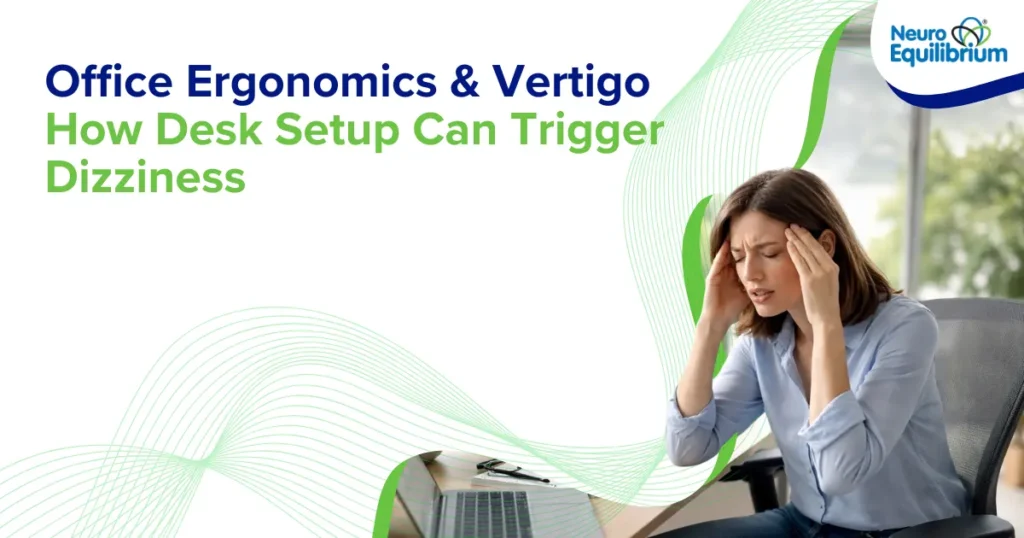
Have you ever gotten up from your desk after work and felt like the room was spinning? Or perhaps you’ve had that strange floating sensation in the middle of the afternoon where you can hardly concentrate? You’re not imagining things. It is possible that your work environment is contributing to your vertigo, and more people than you realize may be experiencing the same issue.
What Is Vertigo and Why Should Office Workers Care?
Vertigo is a spinning or dizzy sensation where a person feels that they or the world around them is moving, even though nothing is actually in motion. It is not a case of being a little dizzy. To a great number of individuals, it may be severely disrupting and it may be hard to work, drive or even walk straight.
You may unknowingly trigger your vertigo due to your workspace layout, especially when you spend 6–8 hours a day at a desk. The good news? Even small adjustments can make a big difference.
Know More About
- Why Some Vertigo Cases Need Multiple Tests Over Time
- Top Misdiagnoses in Vertigo & How to Avoid Delayed Treatment
- When Should You See a Vertigo Specialist Instead of a General ENT?
How Staring at Screens All Day Can Trigger Vertigo
Surprisingly, your computer monitor can mislead your balance system.
Your eyes are moving but your body is not moving when you scroll through a long spreadsheet or a webpage. This sensory mismatch between your eyes and body can trigger dizziness, imbalance, or a rocking motion in individuals who already possess a sensitive balance mechanism.
This is particularly common in individuals with a condition known as PPPD (Persistent Postural-Perceptual Dizziness), wherein the brain remains alert to the loss of balance although the cause is no longer present. Scrolling screens fuel the fire.
Moreover, staring at a bright screen for hours strains your eyes and your nervous system. Individuals with Vestibular Migraines (a form of migraine that makes a person feel dizzy rather than having a headache) are especially susceptible to screen glare and flickering lights both predominant in the office settings. In their case, the presence of a harsh fluorescent light that is overhead can trigger an episode worthy of vertigo treatment.
Why Your Sitting Posture Is Secretly Messing With Your Balance
You have probably heard “Sit up straight!” your whole life. Turns out there is a balance-related cause of such advice.
When you lean over your computer or bend your head downward because the monitor is positioned too low, your neck and shoulder muscles become tight and strained. It is also referred to as text neck and not only does it cause pain, but it can even disrupt the body balance signals.
This is because: the muscles of your neck send crucial information to the brain on the position of your head in space. All those signals may be distorted when these muscles are strained and overworked. The result? This can lead to lightheadedness, unsteadiness, or dizziness, causing people to complain that their vertigo issue is getting worse whilst at work.
Another situation is known as the Cervicogenic Dizziness condition in which balance is impaired by issues in the neck region. It should also be noted that cervical spondylosis (wear and tear of the spine) is often blamed for vertigo, but it rarely causes true spinning vertigo. it only causes pain, or makes the body feel like it is spinning, which is not really the feeling that people are describing.
How Office Lighting Can Make Vertigo Worse
Bright overhead lights. Shining off your screen. There is a flickering tube light in the corner. These may be treated as simple irritants, but to a person who is likely to be subjected to vertigo treatment, this can be an actual trigger.
Vestibular migraine can make people sensitive to light (photophobia). When subjected to bright office light over a long period of time, they may then develop a migraine attack but this time it does not manifest itself as a headache but rather as a dizzy feeling.
When you realize you are straining your eyes at work or you are having headaches due to the lighting, then there is your body telling you something.
Work Stress and Dizziness – The Connection Nobody Talks About
Deadlines. Back-to-back meetings. Looking at figures that don’t add up. Stress is a massive aspect of contemporary work life and directly relates to your vertigo issue.
When you are stressed, your body enters “fight or flight” mode. Your muscles tighten particularly your neck and shoulders. This tension gets in the way of the messages your inner ear sends to your brain so that you can maintain your balance. This outcome may be increased light-headedness or an incessant feeling of the lack of balance.
Stress also leads to hyperventilation whereby you inhale too fast without consciously knowing it. This reduces the amount of carbon dioxide in your blood and may cause lightheadedness making a vertigo treatment plan even more pressing.
Simple Desk Adjustments That Can Reduce Vertigo Triggers
The best thing is that you do not need to quit your job or get rid of your desk. Even some careful modifications can have a tremendous impact on the frequency of the feeling of lightheadedness that your working space causes.
- Bring your screen to your eye-level- You should not have to bend your head up and down, place your monitor at eye level with you. This alone will relieve a massive neck strain.
- Take a break after every 30-45 minutes- Look out of the screen and focus on something distant (20 seconds) and get your system a fresh start.
- Minimize light on the screen and glare- Install anti-glare screen savers, change your brightness preferences and place your screen device in areas where there is no direct light.
- Scroll at a slow pace and carefully- In case you are predisposed to dizziness, rapid scrolling of screens may aggravate the condition. Move slowly and refer to keyboard shortcuts.
- Check your chair and posture- Have your feet on the floor, your back on a chair and you should be at arm length distance with the screen. In case you are always bending forward to read, then your font is likely to be too small.
- Active work stress management- Even basic deep breathing at your desk 4 counts in, 4 counts out will help eliminate the muscle contraction that makes dizziness worse.
When Office Fixes Aren’t Enough It’s Time to Seek Proper Vertigo Treatment
It is important to know here that fixing your desk set up may enable some reduction of triggers but will not replace real vertigo treatment in case you have an underlying condition.
Such things as BPPV (Benign Paroxysmal Positional Vertigo), Vestibular Migraine, PPPD or Meniere Disease do not disappear simply by moving up or down your monitor. They should be diagnosed and a specific course of treatment provided.
When you are often feeling dizzy, it gets worse and you find it impacting your life and work, it is time to have it looked into. Attempting to overcome without a rest period results in more anxiety, additional symptoms and longer healing time.

Why Choose NeuroEquilibrium for Your Vertigo Problem
Not all clinics would be able to provide you with real answers to your vertigo problem. The majority of the general physicians lack specialized instruments to adequately identify the balance disorders and unless the diagnosis is accurate, the treatment may be misplaced.
NeuroEquilibrium is the biggest network of specialized clinics of vertigo and balance disorders in India. Our solutions are based on diagnosis and latest technology coupled with highly qualified specialists who specialize in dizziness, vertigo, and balance not as an adjunct.
The difference between NeuroEquilibrium and other hospitals is that we have the latest diagnostic equipment that not even the majority of ordinary hospitals possess. This will help our team to appropriately identify what is specifically causing your vertigo either an inner ear issue, a neurological trigger or a combination of both and compile a treatment plan that is specifically tailored to you.
We also know that patients of all backgrounds exist, some of them being busy professionals who have been living a life of misery with only a few years of their lives taking a seat somewhere when they could have felt the cause of their dizziness is something serious, a condition that can be treated.
Conclusion
The office setting can definitely aggravate or cause vertigo treatment requirements in screen glare and bad posture to stress and light. An ergonomic solution is a good start.
However, when dizziness is becoming a frequent occurrence in your life, then it is not time to simply reorganize your desk and pray that everything will work out. Get the right diagnosis. Get the right care.
At NeuroEquilibrium you will find Specialized treatment, high-level diagnostics, and a team that really knows how to treat vestibular disorders. Do not make you wonder why the world keeps spinning.
How to clear vertigo?
Treatment for vertigo is determined by the cause. In cases of vertigo caused by Benign Paroxysmal Positional Vertigo (BPPV), some repositioning maneuver may be performed to move the displaced calcium crystals back to position and relief is obtained in a short period. When vertigo is due to vestibular neuritis, Méniere disease or dizziness induced by migraines, the treatment of the disorder may involve medicines, vestibular rehabilitation therapy, fluids, and lifestyle changes. The trick is that it should be treated at the right cause, since it will relieve much faster and longer.
How long does vertigo last?
Dizziness varies by state. BPPV episodes typically take between a few seconds and minutes but may be repeated in days or weeks. Vestibular neuritis vertigo can take days to gradually improve over a few weeks. In Ménière’s disease, episodes may last between 20 minutes and several hours. People with vestibular migraine may experience episodes lasting from a few hours to up to a day. Constant dizziness lasting weeks or months may indicate an untreated vestibular disorder and should be examined medically.
Can vertigo cause nausea?
Yes, vertigo is usually accompanied by nausea and even vomiting. Balance is controlled by the inner ear (vestibular system), and when it sends incorrect signals to the brain, it produces a spinning effect. This mismatch of the senses between the eyes, inner ear, and the brain usually causes nausea, sweating and the feeling of motion sickness. The underlying cause is usually reduced through managing it, which minimizes spinning and nausea.
What medication is used for vertigo?
Drugs rely on cause and severity. Physicians may prescribe vestibular suppressants for inner ear conditions such as betahistine, antihistamines such as meclizine, or anti-nausea medication in case of severe vomiting. Steroids can be suggested in the situations involving infection or inflammation. Nonetheless, symptoms are normally managed using medications and hence diagnosis should be done to identify the cause of the disorder.
What is the best quick fix for vertigo?
The most effective urgent fix will be based on the diagnosis. In the case of BPPV, certain manoeuvres can be very quick to relieve some of the symptoms, and it can be effective within a single treatment. In the case of sudden dizziness, it is recommended to sit or lie down at once, concentrate on a fixed point, remain hydrated, and avoid abrupt movements of the head and stabilize the symptoms. Nevertheless, a specialist must always examine recurring or severe vertigo to avoid continued imbalance and falls.