








Vertigo is a symptomatic disorder due to problems of the inner ear or the brain. When the inner ear gets affected due to an injury, infection, or any other cause, the person experiences vertigo or unsteadiness. For many patients, home remedies for vertigo and simple balance exercises can provide relief when done correctly under guidance.
Exercises can help when they match the diagnosed vestibular problem. They cannot safely rule out a stroke, treat every inner-ear condition or replace medical assessment when vertigo is sudden, severe or accompanied by neurological symptoms.
Which Type of Vertigo Exercise Do You Need?
The correct exercise depends on the condition causing the dizziness. A repositioning maneuver is used for a confirmed type of BPPV, while vestibular rehabilitation may be used for vestibular weakness, persistent imbalance or motion sensitivity. Gaze-stabilisation exercises are used when head movement makes vision blur, and general balance exercises may support walking and fall prevention.
| Exercise category | Who it may be suitable for | Who should not begin it without assessment |
| BPPV repositioning maneuvers | Patients with confirmed positional vertigo, an identified affected ear and an identified semicircular canal | Patients with an uncertain diagnosis, continuous dizziness, neurological symptoms, significant neck or back limitations, vascular conditions or a recent injury |
| Vestibular rehabilitation | Patients with vestibular neuritis, peripheral vestibular weakness, persistent imbalance, motion sensitivity or residual dizziness after treatment | Patients with an untreated emergency condition, unstable medical condition or symptoms that have not yet been assessed |
| Gaze-stabilisation exercises | Patients whose vision becomes blurred or unstable while moving the head because of vestibular hypofunction | Patients with unexplained double vision, new neurological signs or an exercise that has not been selected for their impairment |
| General balance exercises | Patients working on standing, walking, strength, coordination or fall prevention after an assessment | Patients who cannot stand safely, have frequent falls or need physical assistance that is not available at home |
| Yoga and relaxation practices | Patients using gentle movement, breathing or stress management as supportive care | Patients with unsafe positions, severe imbalance, neck or back restrictions or an active vertigo episode |
Know More About
- 10 Early Signs You Might Have a Vestibular Disorder
- How Juggling Enhances the Balance System and Coordination
- 5 Questions to Ask Your Doctor Before Vestibular Testing
Inner Ear Problems That Cause Vertigo
- Meniere’s Disease
This is caused by the excess fluid build-up in the inner ear that may cause hearing loss and a blocked ear feeling along with vertigo. It usually affects one ear. Following a low-salt diet and relaxation techniques like yoga for vertigo treatment can help manage symptoms. - BPPV (Benign Paroxysmal Positional Vertigo)
In this condition, calcium carbonate crystals (otoconia) get displaced in the semicircular canals, leading to vertigo. This is one of the most common conditions treated with vertigo home remedy techniques and vestibular exercises. - Vestibular Neuritis
A viral infection in the inner ear that leads to vertigo and imbalance. Exercising how to stop vertigo can help retrain the brain and restore balance gradually.
Other Common Causes of Vertigo
Vestibular migraine, labyrinthitis, perilymph fistula, stroke, multiple sclerosis, and medication side effects can also trigger vertigo. Some of these may benefit from personalized remedies for vertigo, including gentle exercises, yoga, and dietary changes.
Why the Diagnosis Must Come Before the Exercise
Different conditions can create similar dizziness but require different interventions:
- Brief spinning after rolling over in bed may indicate BPPV and may respond to a canal-specific repositioning maneuver.
- Continuous vertigo after an infection may require medical evaluation followed by vestibular rehabilitation.
- Vertigo with migraine features may require migraine-directed management rather than a BPPV maneuver.
- Recurring vertigo with tinnitus, ear pressure or hearing changes may require hearing and inner-ear assessment.
- Persistent rocking or visual-motion sensitivity may require a customised rehabilitation programme rather than repeated positional exercises.
- Sudden vertigo with neurological symptoms requires emergency assessment, not exercise.
Canalith repositioning procedures such as the Epley or Semont maneuver should be selected according to positional examination findings. Persistent symptoms may require further assessment rather than repeated generic treatment.
Vertigo Exercises
These treatment vertigo exercises and yoga routines, also called vestibular rehabilitation exercises, help to improve balance and reduce dizziness by stimulating the central nervous system.
They help stabilize vision on moving objects, improve posture, and make daily movement easier. Before starting, consult a vertigo specialist to identify the most suitable exercises on how to stop vertigo safely at home.
Four Different Types of Vertigo Exercise
1. BPPV repositioning maneuvers
These are specific sequences of head and body movements used to reposition displaced inner-ear crystals. They are not general balance exercises and do not treat vestibular migraine, Meniere’s disease, PPPD or every form of dizziness.
2. Vestibular rehabilitation exercises
These are customised exercises used to improve compensation, movement tolerance, balance and daily function in selected vestibular disorders.
3. Gaze-stabilisation exercises
These aim to improve the ability to keep an object clear while the head is moving. They are generally used when vestibular weakness affects the vestibulo-ocular reflex.
4. General balance and gait exercises
These focus on standing, walking, weight shifting, coordination, strength and fall prevention. They do not reposition inner-ear crystals.
Some Home Exercises Include:
- Head Movement
Sit straight with your eyes focused on your thumb and move it side-to-side while following with your head. This simple vertigo home remedy improves visual focus and balance. - Exercise While Walking
Walk in a straight line and slowly turn your head side to side. This is one of the best exercises on how to stop vertigo naturally. - Sitting and Standing
Practice sitting and standing repeatedly to build balance and coordination. - Throwing & Catching Ball
Throw and catch a ball above eye level this helps strengthen reflexes and improve spatial awareness. - Touch the Toes
Bend down to touch your toes with a fixed gaze. This easy stretch promotes blood flow and stability.
It is not advisable to perform canalith repositioning maneuvers without first consulting a vertigo specialist. At NeuroEquilibrium, specialists recommend personalised treatment, vestibular exercises and yoga programmes based on each patient’s specific vestibular condition.

How the Existing Exercises Should Be Classified
| Existing exercise | Exercise category | Who it may be for | Important safety point |
| Head movement while focusing visually | Gaze or visual-movement exercise, depending on how it is performed | Selected patients with movement-related visual blurring or motion sensitivity | The target and head must move according to the prescribed protocol. Simply following a moving thumb with both the eyes and head is not automatically a gaze-stabilisation exercise. |
| Walking with head turns | Dynamic gait and balance exercise | Patients who can already walk safely and need to improve balance during head movement | Perform near a stable support or with supervision when there is a fall risk. |
| Sitting and standing | Strength and functional balance exercise | Patients working on leg strength, transitions and standing confidence | Use a stable chair and external support when required. |
| Throwing and catching a ball | Coordination and visual-motor exercise | Patients with adequate standing or seated stability | Begin while seated or with supervision if catching affects balance. |
| Touching the toes | Flexibility and position-change activity | Patients who can bend safely without triggering severe vertigo or losing balance | Avoid when bending is a major vertigo trigger or when there are back, blood pressure or fall-risk concerns. |
It is not advisable to perform canalith repositioning maneuvers without first consulting a vertigo specialist. At NeuroEquilibrium, specialists recommend personalised treatment, vestibular exercises and yoga programmes based on each patient’s specific vestibular condition.
BPPV Maneuvers: How They Differ From General Vertigo Exercises
BPPV maneuvers are appropriate only when positional testing confirms BPPV and identifies the affected ear and canal. Learn more about BPPV treatment and canal-specific care.
Who should not try a home BPPV maneuver without medical clearance?
Seek professional guidance before attempting a maneuver if you:
- Do not have a confirmed BPPV diagnosis
- Do not know which ear or canal is affected
- Experience continuous rather than brief position-triggered vertigo
- Have severe neck or back disease
- Have limited neck or body movement
- Have a vascular condition
- Have retinal detachment or a significant eye condition
- Recently underwent neck, spine, eye or ear surgery
- Recently experienced a head or neck injury
- Have a high risk of falling
- Are pregnant and have not received position-specific medical guidance
- Experience sudden hearing loss or neurological warning signs
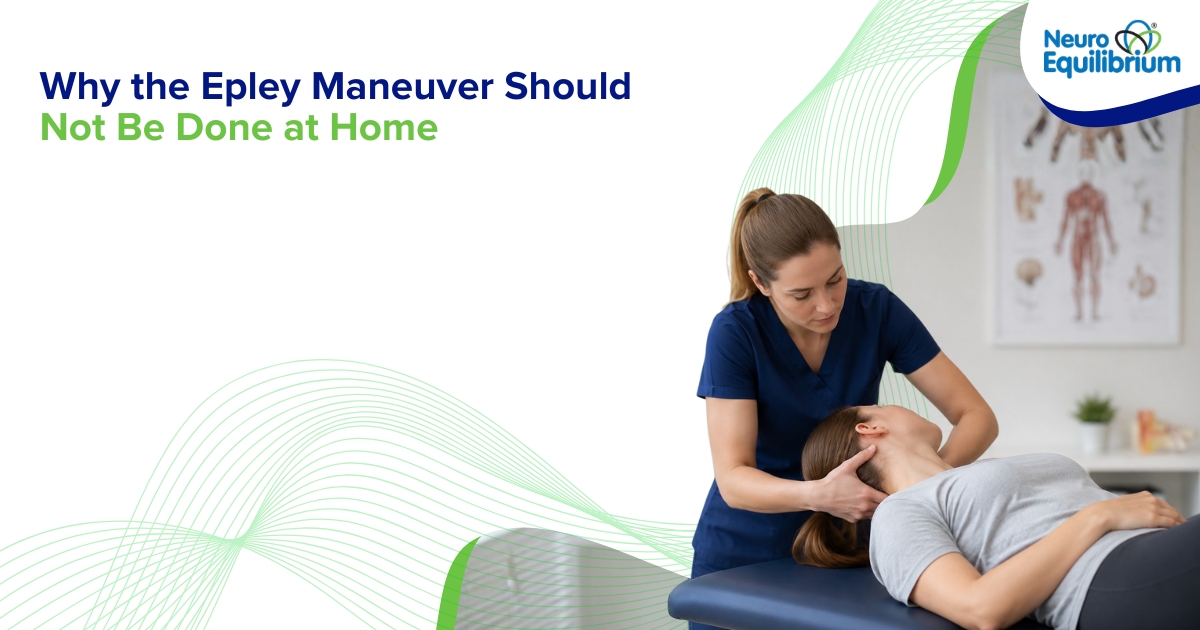
The home Epley maneuver may be unsuitable for people with certain neck, back, vascular, mobility or retinal conditions. A healthcare professional should confirm that it is safe and identify the affected side first.
Epley Maneuver for Confirmed Posterior-Canal BPPV
The following instructions are only for a patient whose clinician has confirmed posterior-canal BPPV, identified the affected ear and advised home use. The directions must be reversed for the opposite ear.
Epley maneuver for the right ear
1. Sit upright on the bed with a pillow positioned so that it will be underneath your shoulders when you lie back.
2. Turn your head approximately 45 degrees towards the right.
3. Keeping your head turned, lie back promptly so that your shoulders rest on the pillow and your head remains slightly reclined. Hold for approximately 30 seconds or until the spinning settles.
4. Without lifting your head, turn it approximately 90 degrees towards the left. Hold for approximately 30 seconds.
5. Turn your head and body another 90 degrees towards the left so that you are lying on your left side and facing towards the bed. Hold for approximately 30 seconds.
6. Return carefully to a seated position on the left side of the bed. Remain seated until you feel steady.
Epley maneuver for the left ear
Use the same sequence in reverse: begin with the head turned towards the left, rotate towards the right and sit up on the right side.
Have a family member or another responsible adult nearby during the first attempts. Do not stand immediately if you remain dizzy. Follow the frequency advised by your clinician rather than repeatedly performing the maneuver throughout the day.
Official patient guidance states that the Epley maneuver should be recommended after the medical history and examination support BPPV, and that persistent symptoms may indicate incorrect technique or another cause of vertigo.
Semont Maneuver for Confirmed Posterior-Canal BPPV
The Semont maneuver involves faster side-to-side movement than the Epley maneuver. It should only be attempted after a clinician identifies the affected side and confirms that your neck, back and mobility allow you to perform it safely.
Semont maneuver for right-ear BPPV
1. Sit upright on the edge of a bed. Turn your head approximately 45 degrees towards the left, away from the affected right ear.
2. Keeping your head in the same position, move promptly onto your right side. Remain there for approximately 30 seconds or until the spinning settles.
3. Move promptly across to your left side without changing the direction of your head. Your face should now point towards the bed. Remain in the position for approximately 30 seconds or until the spinning settles.
4. Return slowly to a seated position and wait until you feel steady.
Semont maneuver for left-ear BPPV
Reverse the directions: turn the head towards the right, move first onto the left side and then move across to the right side while keeping the head in the same position.
A family member should remain nearby during the first attempts because the maneuver can provoke strong temporary vertigo and unsteadiness. Official NHS patient guidance similarly recommends having someone present and performing the maneuver in a safe environment.
When Should You Stop a BPPV Maneuver?
Stop the maneuver and seek medical advice if you experience:
- Severe or unusual neck or back pain
- New weakness or numbness
- Slurred speech
- Double vision or sudden visual loss
- Loss of consciousness
- Chest pain or severe breathlessness
- A sudden severe headache
- Sudden hearing loss
- An injury or fall
- Symptoms that are completely different from your usual brief positional vertigo
Sudden loss of balance, visual changes, facial drooping, arm weakness or speech difficulty may be stroke warning signs and require emergency assessment rather than continued exercise.
How Long Should BPPV Take to Improve?
Some people improve after one correctly selected repositioning treatment, while others need another session. Mild residual imbalance may continue temporarily even after the positional spinning improves.
If the maneuver does not help, possible explanations include:
- The symptoms are not caused by BPPV
- The wrong ear or canal has been treated
- A different type of BPPV is present
- More than one canal or ear is involved
- The maneuver was not performed correctly
- BPPV has resolved but residual vestibular imbalance remains
- Vestibular migraine, PPPD or another condition is also present
Clinical guidance recommends checking whether positional vertigo remains after approximately one to two weeks and considering further evaluation when symptoms persist or neurological findings appear.
Home Remedies for Vertigo
After performing exercises, try these vertigo home remedies to reduce dizziness episodes:
- Yoga & Meditation: Proven relaxation techniques that reduce anxiety and improve balance.
- Low-Salt Diet: Recommended for patients with Meniere’s disease or vestibular migraine.
- Vitamin D: Essential for bone and inner ear health deficiency can worsen vertigo.
- Avoid Alcohol & Limit Caffeine: Reduces dehydration and nerve sensitivity.
- Maintain Regular Sleep: A steady routine improves inner ear balance.
- Reduce Screen Time: Prolonged exposure to screens can trigger dizziness.
These remedies for vertigo and lifestyle adjustments can provide long-term relief and reduce the frequency of attacks.
What Home Remedies Can and Cannot Do
| Home measure | How it may support recovery | What it cannot do |
| Hydration and regular meals | May reduce dizziness related to dehydration or irregular food intake | Cannot reposition BPPV crystals or treat a neurological cause |
| Low-sodium eating plan | May be recommended for selected patients with Meniere’s disease | Is not required for every person with vertigo |
| Consistent sleep and trigger management | May support vestibular migraine management | Cannot diagnose migraine or replace prescribed treatment |
| Yoga, meditation and breathing | May reduce stress and support confidence and movement | Cannot treat stroke, BPPV crystals or an acute inner-ear infection |
| Vitamin D correction | May be recommended when a deficiency is confirmed | Supplements should not be used as a universal vertigo cure |
| Reduced screen exposure | May help selected patients with visual-motion or migraine sensitivity | Complete screen avoidance may reinforce sensitivity and is not needed for everyone |
Medical Guidance
Before starting any vertigo home remedy or exercise plan, consult a vertigo specialist. They will conduct diagnostic tests and recommend a customized plan combining treatment vertigo exercises yoga with other medical therapies if necessary. NeuroEquilibrium specialists help track your improvement and ensure your home-based remedies for vertigo are safe and effective for long-term relief.
Sources
- Han B.I., Song H.S., Kim J.S. (2011). Vestibular Rehabilitation Therapy: Review of Indications, Mechanisms, and Key Exercises. PMC. https://pmc.ncbi.nlm.nih.gov/articles/PMC3259492/ (PMC)
- Hall C.D., et al. (2022). Vestibular Physical Therapy for Peripheral Vestibular Hypofunction: Clinical Practice Guideline. Journal of Neurologic Physical Therapy. https://journals.lww.com/jnpt/fulltext/2022/04000/vestibular_rehabilitation_for_peripheral.8.aspx (Lippincott Journals)
- “4 Exercises for Peripheral Vertigo.” Healthline. https://www.healthline.com/health/exercises-for-vertigo (Healthline)
- “Home remedies for vertigo: The Epley maneuver and more.” MedicalNewsToday. https://www.medicalnewstoday.com/articles/320492 (Medical News Today)
- “Home-based vestibular (balance) exercises.” Vestibular Disorders Association (VeDA). https://vestibular.org/article/diagnosis-treatment/treatments/home-based-exercise/ (Vestibular Disorders Association)
- “Vestibular Exercises for Dizziness and Balance Problems.” UMC Health ENT Patient Handouts. https://umc.edu/Healthcare/ENT/Patient-Handouts/Adult/Otology/Vestibular_Exercises.html (umc.edu)
- “Physical therapy for vertigo: Exercises, benefits, and more.” MedicalNewsToday. https://www.medicalnewstoday.com/articles/physical-therapy-for-vertigo (Medical News Today)
- “Vestibular (Balance) Exercises: Fact Sheet.” Brain & Spine Foundation. https://www.brainandspine.org.uk/health-information/fact-sheets/vestibular-rehabilitation-exercises/ (brainandspine.org.uk)
- “Vestigo: Vertigo, Dizziness and Balance Disorders — Treatment & Rehabilitation.” PMC article on vestibular disorder treatment. https://pmc.ncbi.nlm.nih.gov/articles/PMC8920002/ (PMC)
Frequently Asked Questions
What are the best exercises for vertigo?
Vestibular rehabilitation exercises such as head movement exercises, walking with head turns and sitting-to-standing exercises are used to enhance balance and minimize dizziness.
Can I do vertigo exercises at home safely?
Yes, one can perform simple exercises at home, but such special maneuvers as Epley or Semont must be done only under the supervision of a doctor.
What lifestyle changes help reduce vertigo?
Reduced screen time, yoga, reduced caffeine and alcohol, limiting alcohol intake, low salt diet can decrease the occurrence of vertigo.
Is vertigo a permanent condition?
Not always. Certain causes such as BPPV can be managed whereas chronic ones such as Meniere disease require management over time.
When should I see a doctor for vertigo?
Consult an expert in the case of frequent dizziness, sharpness, or hearing loss, nausea, imbalance, or neurological symptoms.