



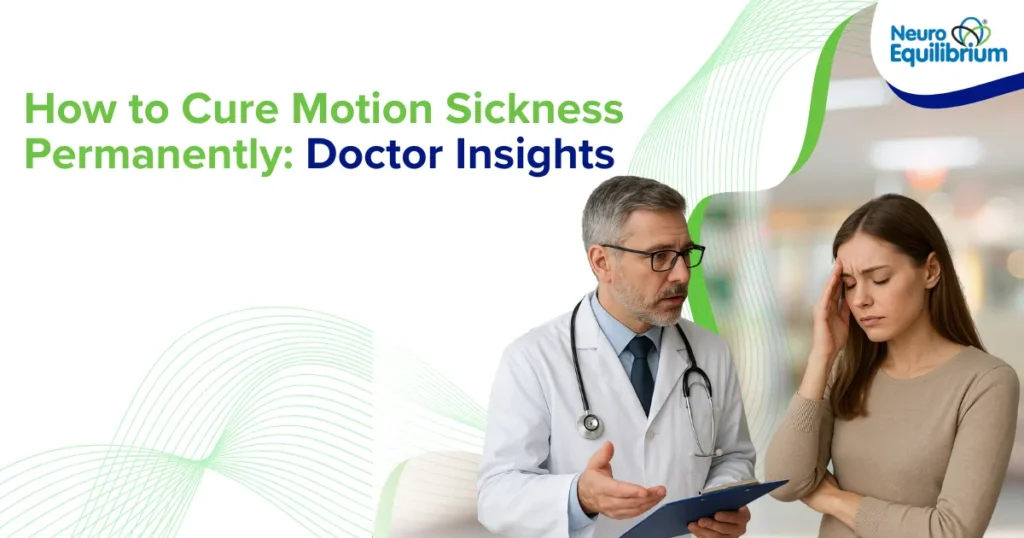
Being dizzy on your way, being sick when riding in a car or on an airplane, or feeling nauseated even when browsing on a moving bus may make normal life annoying and unpleasant. It is common to find many searching for a permanent remedy to the problem of motion sickness because they want it to be a simple solution but the truth is not so easy.
Motion sickness is caused when the brain and balance system in the inner ear get opposing messages concerning movement and position. In cases where this dissonance persists over a period of time, the symptoms may become chronic and, in a few cases, be attributed to underlying vestibular disorders such as vestibular migraine.
We’ll try to explain why motion sickness can become long-lasting, how doctors diagnose and treat it, whether a permanent cure is possible, and the advanced therapies offered by leading vestibular care centers in India to help achieve lasting relief.
Know More About Vertigo and Motion Sickness
- Is It Anxiety or an Ear Problem? How to Tell What’s Causing Your Dizziness
- Neck Pain Causes That Can Lead to Dizziness – Should You Be Worried?
- Nystagmus Explained: How Careful Eye Tests Lead to Better Dizziness Diagnosis
What Exactly Causes Motion Sickness?
The simplest way to understand motion sickness is this:
- Your eyes say you’re moving
- Your inner ear says you’re not moving (or vice-versa)
- Your brain gets confused → nausea, dizziness, sweating, discomfort
For many patients, constant motion sensitivity is a symptom of vestibular disorder. One of the most common medical causes is Vestibular Migraine, a condition where the brain becomes overly sensitive to motion.
Another condition that is often confused with migraine-related dizziness is BPPV (Benign Paroxysmal Positional Vertigo). It is an inner-ear mechanical problem due to displaced crystals, and has a set of symptoms of benign paroxysmal positional vertigo, including:
- Short episodes of spinning sensation lasting a few seconds.
- Vertigo triggered by lying down, turning in bed, or bending forward.
- Loss of balance
- Brief visual disturbance
BPPV can often be permanently treated through special positioning maneuvers performed by qualified professionals, unlike migraine-induced motion sickness, which requires long-term management rather than positioning treatments.
Can Motion Sickness Be Cured Permanently?
Motion sickness is not always a condition that can be cured forever because it is dependent on the cause of the symptoms like issues in the inner ear are associated with motion sickness in some individuals, including benign paroxysmal positional vertigo, in which tiny crystals shift their positions. The cases may be completely solved in several situations with the help of certain head and body movements which are carried out by a professional. Other conditions such as vestibular neuritis or labyrinthitis that involve inflammation or infection of the balance nerve are also usually associated to improve with the correct medical treatment and later with the help of a vestibular rehabilitation therapy.
In other instances, motion sickness is related to chronic disorders which cannot be cured, but have to be treated continuously. These are the vestibular migraine, Meniere’s disease and the persistent postural-perceptual dizziness. Although these conditions do not always disappear completely, their symptoms can be treated adequately with time by using a combination of vestibular rehabilitation therapy, lifestyle changes, dietary modifications, stress management, and medication where necessary. The aim of treatment in such cases is to make the brain learn to adapt, be less sensitive to motion and enable patients to resume normal daily activities that give them more comfort and confidence.
Doctor-Backed Treatments That Actually Work for Long-Term Relief of Motion Sickness
Specialized vestibular-care centres like NeuroEquilibrium use a combination of VR-based exposure therapy, Vestibular Rehabilitation Therapy, and migraine-lifestyle management to steadily reduce motion sensitivity.
Below are treatments explained in simple language so anyone can understand.
1. Virtual Reality (VR) Exposure Therapy: Retraining the Brain
This is one of the most advanced doctor-recommended solutions for people who experience motion sickness during driving, roller coasters, flights, hilly roads, or VR gaming.
How VR Helps Cure Motion Sickness Symptoms
VR modules gently expose your brain to:
- Twisting roads
- Bumpy rides
- Sudden turns
- Elevation changes
Exposure starts mild and slowly increases. This is called graded desensitization therapy.
Why Doctors Prefer VR Treatment
- It is a simulation of real-life triggers that are safe.
- It is personalised.
- It speeds up improvement.
- It is more engaging compared to conventional exercises.
In the long run, the brain becomes used to the signal of motion and the level of nausea and dizziness reduces.
VR desensitization particularly applies to teens, frequent travellers, and individuals who have to travel a long distance to work.
2. Vestibular Rehabilitation Therapy (VRT)
VRT is a set of exercises designed by trained vestibular therapists. It teaches your brain how to handle motion, maintain balance, and reduce dizziness.
Important Parts of VRT
Habituation Exercises
- Through practice, you are gradually and carefully exposed to movements that usually cause dizziness, allowing your brain to adapt.
- With time: the brain becomes no longer responsive.
Gaze Stabilization Practice
- You get to know how to maintain your gaze even when your head rotates.
- This enhances the vestibulo-ocular reflex (VOR) which is the mechanism that stabilizes your eyes as you move around.
- Physicians occasionally use engaging activities such as juggling-based training for patients who have difficulty with conventional VOR exercises.
Balance Training
- Enhances balance and stability and walking confidence.
- VRT does not resolve motion sensitivity immediately. Instead, over time, it builds long-term resilience.
3. Lifestyle & Diet Management (Especially for Vestibular Migraine)
Motion sickness is strongly linked to Vestibular Migraine, so doctors treat the migraine triggers first.
Common Triggers Patients Must Track
- Skipping breakfast
- Stress
- Long gaps between meals
- Poor sleep
- Excess screen time
- Dehydration
Foods That May Trigger Motion Sensitivity
Doctors commonly advise limiting:
- Aged cheese
- Chocolate
- Red wine
- Processed meat
- MSG
- Artificial sweeteners
Healthy Habits That Help
- Regular meal timings
- 7–8 hours of sleep
- Reduced caffeine
- Controlled screen exposure
- Hydration (very important)
- Stress-relief techniques like yoga and deep breathing
Managing these factors reduces the frequency of dizziness episodes.

Why Choose NeuroEquilibrium to Cure Motion Sickness
When dealing with vertigo or motion sensitivity, the right specialist makes all the difference.
NeuroEquilibrium brings together:
- Advanced vestibular testing systems
- VR-based rehabilitation setups
- Specialised VRT programs made for each patient
- Migraine-focused treatment protocols
- Expert doctors trained in balance disorders
All these elements help patients regain confidence, travel comfortably, and resume normal life from accurate diagnosis through rehabilitation. Their multi-level strategy deals with the cause and its management in the long run.
Step-By-Step Plan to Reduce Motion Sickness Long-Term
- Correct diagnosis: We begin by identifying the exact cause of symptoms, whether it is BPPV, Vestibular Migraine, or another balance related condition. This helps us choose the right treatment from the start.
- Targeted therapy: Based on what triggers the symptoms, we start therapy suited to the condition. If travel or movement causes discomfort, controlled exposure therapy may be used to help the brain adjust gradually.
- Vestibular rehabilitation exercises: Patients are guided through specific exercises that improve balance, coordination, and tolerance to motion over time.
- Trigger identification and management: For migraine related cases, we help patients track sleep, food habits, stress levels, and symptom patterns to reduce future episodes.
- Gradual desensitization: Slow and guided exposure to movement helps reduce long term sensitivity and improves comfort during daily activities and travel.
- Regular follow up: Ongoing review allows us to adjust care as needed and support steady improvement and long term control.
Conclusion
If you are dealing with repeated motion sickness or vertigo, the most important step is getting evaluated by a specialist who focuses on balance disorders. At NeuroEquilibrium, we try to help patients understand the cause of their symptoms and guide them through focused testing and therapy designed for lasting improvement. With proper diagnosis and structured care, long term relief and better balance are achievable, helping patients move through life with greater confidence and ease.
Is there a permanent cure for motion sickness?
Motion sickness has no permanent cure. Nevertheless, long-lasting preventive measures and habituation can greatly reduce or manage the symptoms along with vestibular rehabilitation therapy (VRT).
What are the most effective long-term treatments for motion sickness?
Gradual exposure therapy helps the brain adapt to motion. Vestibular rehabilitation therapy (VRT) trains balance and reduces dizziness, while cognitive behavioral therapy (CBT) helps manage anxiety that can worsen symptoms. Together, these provide long-term relief.
What is the best way to prevent motion sickness before it starts?
Some of the preventive measures involve the attention to the horizon, sitting on the least moving seats, avoiding the screens, staying hydrated, having light meals, taking medications or natural remedies before traveling where necessary.
Which medications work best for motion sickness?
Antihistamines such as dimenhydrinate or meclizine are effective in taking before travelling. Prescription options like scopolamine patches offer greater protection than other options. Use should be accompanied by consultation with a doctor.
Can natural remedies really help with motion sickness?
Yes, others relieve themselves using ginger, peppermint or acupressure wristbands. These may also be used to alleviate nausea (although with mixed effects) to treat mild motion sickness.