



One morning, you wake up, and the ceiling is revolving. You can’t walk straight. Each turn of the head causes the world to tilt. You have an inner ear (balance nerve) injury. And now someone is telling you that the nerve cannot be completely repaired. That sounds terrifying.
However, herein lies what no one tells you straight up, clearly, and that is that your brain does not need the damaged nerve to repair itself. Your brain can completely restructure around the injury. This is referred to as neuroplasticity, and one of the most amazing things that your body has figured out how to do.
How A Vestibular Injury Really Impacts Your Brain And Why You Have Vertigo Symptoms
There are three partners in your balance system: your inner ear, your eyes, and your muscles and joints. All three of these work together all the time, sending messages to your brain on where you are in space, which direction is up, whether you are moving, and how fast.
A damaged ear begins to transmit incorrect or incomplete signals when the vestibular system is damaged due to a disease such as vestibular neuritis, labyrinthitis or by an inner ear infection. Suppose a member of a team of three individuals deliberately provides inaccurate information. There is confusion in the brain and it is unable to determine which signal to believe.
The outcome is the entire hurricane of vertigo symptoms: severe spinning, nausea, instability, and a sense that the world has tilted way off its axis. Such vertigo symptoms can be so severe that even lying down won’t help. And since the nerve damage itself is typically irreversible in a medical sense, many patients may find themselves posing the question: Will I always feel like this?
The response is not due to what the brain can perform next.
Know More About
- Vestibular Dysfunction Explained: Symptoms and Treatment
- Vestibular Neuritis Symptoms: Early Warning Signs You Shouldn’t Ignore
- How Neuro Rehabilitation Helps Patients Recover
So What Is Vestibular Compensation and How Does the Brain Begin Rewiring Itself
This reaction of the brain to the damage to the vestibules is known as central compensation or in simple terms, vestibular compensation. The brain is teaching itself to work without use of the damaged ear.
In simple terms, it works like this: gradually, your brain gets used to the faulty signals on the faulty side, and it becomes more trusting of the information your eyes and muscles provide. It does not renew the old road; it makes new ones.
Imagine it to be a closed road. Your brain then takes a detour instead of waiting for that road to reopen, and in the long run, the detour becomes the new road.
This is neuroplasticity, the brain’s capability to restructure throughout its life, develop novel associations, and change in response to new circumstances. And it doesn’t prevent most people from recovering at all due to their injuries to the vestibular apparatus
Why Inactivity Slows The Recovery Rate of Vertigo Symptoms
This is what surprises many. Every instinct when you are feeling the worst of your vertigo is to lie down, keep perfectly still, and wait until the spinning ceases. It is logical during the first 2448 hours of an acute attack. However, once you are done, the last thing you need to do to recover is to remain still.
- This is because the brain can only rewire when it is challenged actively. By not moving and risking causing vertigo, you are also denying your brain the stimulus necessary to develop new pathways.
- Neuroplasticity is an active process. The brain must be exposed to the confusing signals many times, interpret them, and then error, and then progressively learn to interpolate the signals properly. The more you expose your brain to a trigger movement in a safe, controlled setting, the more chances you provide it with to adapt. And with time, the triggers grow weaker.
Vestibular injury recovery is not concerned with protecting the brain against discomfort. It is about sensitive, directed exposure to distress so the brain can learn to navigate it.
The Way Targeted Movement Exercises Physically Recreate Your Balance Pathways
Experts use a method known as Vestibular Rehabilitation Therapy (VRT) to promote brain rewiring. These are not spontaneous exercises; each of them has a particular purpose:
- Gaze Stabilization: You stare at an object that remains still, a letter displayed on a wall, and move your head slowly around to the right or left or up and down. This inhibits a reflex known as the Vestibulo-Ocular Reflex (VOR), which helps to stabilize your vision when you move your head. This reflex is discharged after a vestibular injury, resulting in blurred vision and even more severe vertigo symptoms during movement. It is gradually restored by repeated practice.
- Habituation: You are exposed in a progressive, regulated manner to the particular motions or surroundings that provoke your vertigo symptoms, be it rotating your head at high pace, strolling through a crowded passage, or observing objects in motion. Your brain alarm response is a little quieter each time you do this. After some time, the trigger that used to cause the severe vertigo symptoms becomes manageable, even tolerable, and then normal.
- Sensorimotor Integration: Walking on uneven grounds, balancing on foam, or doing tasks where your body positioning sensors are challenged, can help re-establish your brain in using physical indicators of proprioception to keep you stationary when the inner ear signal fails.
All these exercises not only treat vertigo symptoms. They cause actual, quantifiable alterations of neural pathways in the brain.
The Acceleration of Neuroplasticity In Contemporary Vestibular Treatment Using Virtual Reality
Virtual Reality (VR) is one of the most enthusiastic advances in the rehabilitation of the vestibular system. Conventional exercises, though effective, are tedious and may be difficult to perform regularly. VR changes the equation.
Putting a patient in an immersive simulated environment, a large marketplace, a car on the move, a street full of people, VR makes the brain process extremely complicated and rapidly shifts visual information in real time. The brain cannot take shortcuts. It must commit itself and be responsive.
This is not merely more interesting than a piece of paper listing exercises. It is faster in neuroplasticity. The brain is exposed to the complexity of the real world in a safe, controlled environment, which is quickening the central compensation process, which alleviates vertigo symptoms as time goes by.
Here is Why Anti-Vertigo Medication Pulled the Plug on Brain Recovery
This is a very important and misconstrued point. Anti-vertigo drugs and vestibular suppressants are actually useful during the initial days of a severe attack. You are vomiting, can no longer stand up, and are spinning around: medication helps you to feel better and lets you perform simple tasks.
The issue with these drugs is this: they calm the central nervous system. A sedated brain is a brain that cannot actively process mistakes, make comparisons, and develop new connections.
When you take weeks and months of vestibular suppressants, hoping to maintain vertigo symptoms, you are basically suspending the brain’s ability to reconnect the wires. Symptoms remain less pronounced during the time you use the medication, but compensation never occurs fully. As soon as you stop, vertigo symptoms can reappear because the brain has not had a chance to learn.
The most common causes of people with vestibular injuries not recovering are long-term dependence on vestibular suppressants. Short-term comfort would be achieved at the expense of longer-term rewiring.
What influences the Rate At Which Your Brain Rewires in the Wake of A Vestibular Injury
Recovery periods differ greatly among different people, and the rate or extent of brain compensation depends on a number of factors:
- Age: Young brains are more likely to rewire, although neuroplasticity does not disappear during adulthood. Older adults are capable of, and do, recover; this may take longer and require more structured rehabilitation.
- Regularity of treatment: The brain is rewired by repetition. Even on days when they experience mild vertigo symptoms, patients who do their exercises on a daily basis recover much faster compared to those who only exercise when they feel fine.
- Anxiety: This is a factor that has been underestimated. The stress response of the brain to anxiety and the fear of vertigo symptoms actually disrupts the balance system in its attempt to correct itself. Vestibular recovery includes dealing with anxiety.
- Exercise and fitness state: Individuals who continue exercising as they recover from walking, tedious movement, and slow adaptation to normal life allow their brain more chances to practice compensation.
- Not to take a suppressive drug in the long term: As mentioned, neuroplasticity requires the brain to remain alert and busy to work.

Why Choose NeuroEquilibrium for Vestibular Injury and Vertigo Symptoms
It is one thing to know about neuroplasticity. Having the appropriate, organized help to guide your brain through this is another.
NeuroEquilibrium is an exclusive vertigo and balance disorder clinic in India, designed with individuals who have sustained injuries to their vestibular apparatus and for those who continue to experience persistent vertigo symptoms. There is no single method for recovering from vestibular injury; the nature of the injury, the duration of symptoms, your physical state, and your lifestyle all influence the best approach.
At NeuroEquilibrium, sophisticated diagnostic devices such as Videonystagmography (VNG), Video Head Impulse Testing (vHIT), Computerized Posturography, and Vestibular Evoked Myogenic Potential (VEMP) caloric testing create an accurate image of the way your vestibular system is working. This is not guesswork. It is objective data on precisely which part of your balance system is involved and to what extent.
According to that information, a personalized vestibular rehabilitation plan is created to help your brain with the compensation process by relying on the known mechanisms of gaze stabilization, habituation, and sensorimotor training. Where possible, immersive technology also hastens the brain’s rewiring.
When you have been living with vertigo symptoms for weeks or months, and have been taking anti-vertigo medication for a long time, and still have not addressed the underlying compensation, a structured evaluation is a game-changer.
The Bottom Line: With the Help of the Right Help, Your Brain Can Find a Way
The vestibular injury is not dizziness. Your brain does not require the damaged nerve to repair itself and in fact it may not do so. Your brain can create new pathways, suppress the false signals and help you feel stable again through neuroplasticity and a process known as central compensation.
The point is that recovery needs to be an active process that involves moving, being challenged, patient and guided correctly. The least likely strategies to employ are staying still, taking medicine over an extended period, or just waiting until the vertigo symptoms pass.
There are great things your brain can do. Provide it with the appropriate environment, appropriate exercises, and support and it will rewire.
What is the best treatment for vertigo?
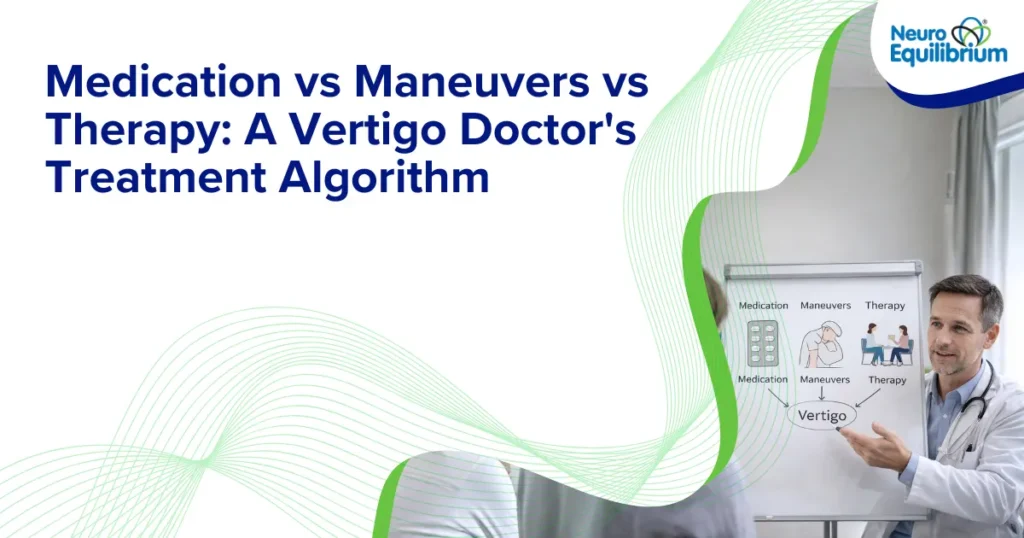
Treatment of vertigo varies with the cause, but standard and useful techniques and treatments include repositioning exercises such as Epley Maneuver to correct position vertigo, medications to decrease dizziness and nausea, and vestibular rehabilitation therapy (VRT) to improve balance. Long-term relief also includes the treatment of underlying conditions like infections, migraines or Meniere Disease.
What are the top 3 causes of vertigo?
The three leading causes of vertigo are Benign Paroxysmal Positional Vertigo caused by head movements; Vestibular Neuritis that may result in sudden severe dizziness; and Meniere Disease that is caused by fluid imbalance in the inner ear and can be accompanied by hearing loss and ringing.
What to drink to get rid of vertigo?
The most notable step is to drink a lot of water, particularly when dehydration is one of the causes of vertigo. Electrolyte drinks or oral rehydration fluids can be used to restore the balance and ginger tea can help to alleviate nausea and dizziness. Alcohol and caffeine should be avoided and restricted because they can aggravate symptoms.
Is it better to lay down or sit up with vertigo?
It is usually advisable to lie down in a comfortable and secure posture when feeling vertigo and remember to keep your head motionless until the spinning feeling clears. In mild cases, sitting up may also work, but lying down will minimize the risk of falling and may more rapidly alleviate the symptoms. When the dizziness subsides you must move gradually so as not to cause another attack.
What vitamin am I lacking if I get vertigo?
A vitamin deficiency is not necessarily the cause of vertigo, yet low concentrations of Vitamin B12 and, in some instances, vitamin D have been related to vertigo and balance impairment. Such conditions may have an impact on nerve functioning and inner ear health but the vast majority of vertigo instances are not related only to nutritional concerns, the inner ear issues are influential.