



There was a time when walking seemed comfortable and easy, standing seemed secure and safe, and balance was in the background working silently. And then suddenly all had changed. The world tilted. Freedom was uncontrollable. Confidence became uncertainty. The body may feel like a stranger to those who are recovering after stroke, vestibular disorders and brain trauma.
Suppose, however, the side of the other: more gradual steps, more definite movement, recovered confidence and a nervous system that will stand by in its stead. Neurorehabilitation, which is a therapy-first method and enables the brain to relearn to move and balance, is the path that leads between these two realities and the neurohealing power of the brain.
This recovery is made possible by neuroplasticity, which is the capability of the brain to develop new connections as well as restore the functions it has lost. Neurorehabilitation does not cover the symptoms; it is the remodelling of the system that has formed the symptoms.
Know More About Vertigo and Rehabilitation
- Anxiety Vertigo Symptoms Explained
- Symptoms of Gastric Vertigo
- 7 Effective Yoga Poses for Vertigo Relief
Understanding Neuro-Rehabilitation
The brain acts as the central control system for the entire body. It coordinates vital abilities such as walking, vision, speech, balance, reflexes, and automatic actions like blinking, breathing, and swallowing. When the brain or nervous system is affected by stroke, trauma, infection, or other neurological conditions, these signals can become disrupted or disorganised. This may lead to symptoms such as vertigo, poor balance, slowed movement, or blurred vision when the head or body changes position.
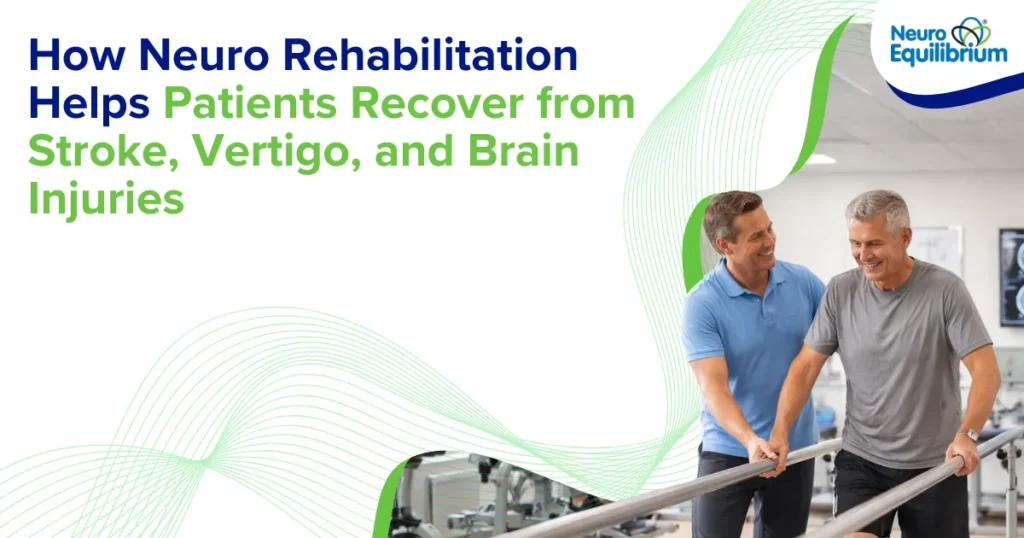
Neuro-rehabilitation focuses on restoring communication between the brain and the systems responsible for movement and stability. It is not only about strengthening muscles or practicing physical exercises. It is a structured clinical approach that retrains the nervous system, helping the brain relearn lost skills, rebuild control, and adapt after injury.
Because every neurological condition impacts the body differently, treatment plans are personalised and guided by precise diagnostics. Some patients may need support to walk again after a stroke. Others may require targeted balance rehabilitation due to vestibular or neurological signal disruption. Some may benefit from vision-focused therapy to reduce dizziness triggered by head or eye movement.
At the core of neuro-rehabilitation is neuroplasticity, the brain’s natural ability to heal, reorganise, and form new connections. Instead of masking symptoms, neuro-rehabilitation works to retrain the systems producing them. With the right clinical guidance and consistent therapy, the brain can rebuild stability, restore confidence in movement, and support long-term independence.
NeuroEquilibrium is an intensified diagnostics combined with specialised treatment to offer that degree of discreet neurological and vestibular care. This is aimed at providing the brain and nervous system with the appropriate training environment that would facilitate more effective and long-lasting recovery of balance, movement, and stability.
How Neuro Rehabilitation Helps with Vertigo Recovery
As a patient who experiences vertigo, even turning your head or stepping outside can feel overwhelming. Vertigo often happens when your brain cannot correctly understand balance signals from the inner ear or other parts of the nervous system.
Here is how neurorehabilitation supports recovery:
Rewiring the Brain
Neurorehabilitation includes exercises that gently encourage both sides of the brain to work together. These activities help improve coordination, reaction time, and how the brain understands signals from the body. Movements that involve using both hands, following rhythms, or combining the eyes and hands help the brain build new nerve connections. With regular practice, the brain becomes more efficient at reading balance and movement signals and responding in a faster, more accurate way.
Vestibular Rehabilitation Therapy (VRT)
VRT supports patients whose dizziness or imbalance comes from inner ear nerve inflammation or damaged balance signals. These exercises help the brain adapt by learning to use new, healthy signals when the original ones are weak. When this retraining does not happen, the brain may rely only on medicine to solve the problem, which can slow down progress. VRT helps the brain take an active role in recovery, which can make improvement more steady and long-lasting.
Gaze Stabilisation
Following a stroke or some balance disorders, some patients report that they experience shaky or blurred vision as they move their head. Gaze stabilisation exercises are aimed at retraining eye focus at movement. Instead, it is able to lessen dizziness and assist the patients to see better during movement, turning, and looking around more easily and securely in their everyday life.
Habituation Exercises
Other individuals experience a state of dizziness in a busy or a fast-paced environment like the shopping centers, buses or even in a busy street. Habituation therapy presents such triggers gradually and in a measured manner, making the brain to be less sensitive to them eventually. This can be a gradual method of reducing the motion associated with dizziness and simplify day to day tasks.
Balance Training
Balance exercises improve body stability on uneven surfaces, in low light, or when walking in the dark. This type of training is especially helpful for older adults and patients who feel anxious about walking alone. Balance-focused rehabilitation can support better posture, steadier steps, and more confidence while moving, which can also lower the risk of falls.
Speech-Language Pathology (SLP)
Speech-Language Pathology focuses on evaluating and treating communication and swallowing disorders. After neurological events such as stroke, brain injury, or in conditions like Parkinson’s disease, individuals may experience difficulty with speech clarity, language processing, voice control, or safe swallowing.
SLP therapy includes personalized exercises for articulation, expressive and receptive language, cognitive-communication skills, and dysphagia management. Techniques may involve speech drills, conversational coaching, language comprehension tasks, voice strengthening, and swallowing safety strategies. The goal is to restore functional communication, enhance social participation, and maintain safe nutrition and hydration.
Cognitive Rehabilitation
Cognitive Rehabilitation is a structured therapeutic approach designed to improve mental processes such as memory, attention, problem-solving, planning, and decision-making. It is commonly used for patients recovering from stroke, concussion, dementia, or other neurological impairments.
Therapy involves targeted brain exercises, strategy training, functional task simulation, and lifestyle adaptations. Patients may use memory aids, attention-training tasks, executive-function activities, and real-world practice such as managing schedules, finances, or daily routines.
The primary objective is to rebuild independence, improve cognitive efficiency, and support long-term neurological recovery through neuroplasticity-driven training.
Behavioral Therapy
Behavioral Therapy helps individuals manage emotional and behavioral challenges that may arise from chronic dizziness, neurological conditions, or sensory-processing overload. Symptoms may include anxiety, avoidance of movement, panic in visually busy environments, or difficulty adapting to external triggers.
This therapy uses evidence-based approaches such as Cognitive Behavioral Therapy (CBT), exposure techniques, stress-response regulation, and behavior modification strategies. Sessions may involve gradual desensitization to motion or sensory triggers, relaxation training, cognitive reframing, and coping-skill development.
The aim is to reduce distress, improve adaptability, rebuild confidence in movement, and support active participation in daily life without fear-driven limitations.

How Neuro-Rehabilitation Helps Patients Recover from Stroke
Stroke recovery can feel like starting life again. Many patients struggle with walking, coordination, balance, and vision instability during movement. Neurorehabilitation helps patients rebuild lost functions step by step.
Central Compensation
The brain is able to correct and compensate for the faulty signals sent by the injured parts. The process will help patients be in balance and stability, even when a section of the system is still weak.
Sensorimotor Integration
It is the capacity of the brain to relate sensory input (what you see, feel or hear) and motor output (how your body moves). This relationship can be enhanced through neurorehabilitation exercises that will assist the patients to walk evenly, ascend staircases, reach things, or move freely.
Functional Training
Therapy programs are designed around real-life tasks standing up, walking in a straight line, turning safely, focusing on objects while moving, managing Social skills and emotional regulation This makes recovery practical, useful, and long-lasting.
How Neuro-Rehabilitation Helps Patients Recover from Brain Injuries
Traumatic brain injuries (TBI), concussions, or infections can disrupt balance centers, vision pathways, and muscle coordination. Neuro rehabilitation works by targeting the exact problem instead of using general therapy.
Mechanical and Neurological Recovery
Injuries to the brain may also push the inner ear crystals, leading to dizziness akin to vertigo. A neuro-rehabilitation facility applies specific therapies to re-educate both neurological and mechanical balance issues.
Safe Exposure using Technology
Technology-assisted training equipment enables patients to safely practice real-life movement scenarios in a clinical setting. This assists the brain in adapting more quickly without endangering the patient.
Diagnosis First, Recovery Next with Neuro Rehabilitation
Raised imbalance and dizziness may also appear as an ordinary inner ear complication yet can actually be a stroke or brain trauma. Balance and eye movement assessments can sometimes detect balance dysfunction more effectively than an MRI in the first 48 hours, depending on the type of injury being detected.
Specialised testing assists physicians in developing an effective, personalised, and safe therapy plan. It is due to this that recovery outcomes are enhanced when treatment is influenced through the guidance of a centre that possesses a deep sense of neurological balance.
Supporting the Mind During Recovery
Dizziness and imbalance can cause you to become anxious, scared or reclusive to social life as a patient. Vertigo is also aggravated by anxiety. Extensive neuro rehabilitation plans involve psychological counselling to enable the patients cope with adverse thoughts and restore their confidence. A relaxed mind will learn and recover.
Why Choose a Comprehensive Neuro-Rehabilitation Approach
This treatment modality is effective in that:
- It is not a cover-up of symptoms, but a cure.
- It enhances balance, vision stability, and movement confidence.
- It educates the brain to learn and adapt.
- It facilitates emotional health as well as physical healing.
- Minimise risk of falls and future injuries.
When therapy is customised and regular, patients usually feel more secure and assured in their normal life in a few weeks.
Why Choose NeuroEquilibrium for Neuro-Rehabilitation
In the event you or a loved one is seeking a long-term recovery solution, this is why many patients are confident in a solution-based rehabilitation program such as NeuroEquilibrium:
Therapy Based on Real Diagnosis
Advanced balance, eye movement, and coordination tests are used to conduct personal and individual assessment to all the patients. This will help the therapists to design programs that will help to contain the specific problem as opposed to giving all the exercises.
Modern Technology for Better Recovery
Rehabilitation interventions rely on the interactive components through Virtual Reality to replicate the actual balance and motion conditions in a secure environment within the clinic. That makes therapy interesting and enables the graded advancement of difficulty so that patients can adapt without being afraid.
Support Beyond the Clinic
Recovery requires time. Comprehensive rehabilitation programs include ongoing guidance, structured sessions, and regular progress tracking to ensure patients continue improving even after the early recovery phase.
Focus on Confidence and Fall Prevention
Balance issues usually result in patients being afraid to walk by themselves. The posture control, visual stability, and walking coordination, and surface adaptability are restored through therapy programs, enabling the patients to feel safe once again and lowering the risk of falls.
Mind and Body Recovery Together
Mental confidence is an issue that is usually affected by chronic dizziness. Full neuro rehabilitation helps patients regain emotional stability, as well as physical stability, so as to recover.
Conclusion
The process of recovery is not one event, it is a change. NeuroEquilibrium helps in the process of such a change using accurate, brain-based rehabilitation methods. The methodology enables individuals to re-establish stability, regain movement and confidence in day to day life by combining neuroscience, modern technology and personalised care.
It is not limited to symptom management. It is regarding the achievement of quantifiable gains, the restoration of autonomy and the quality of life following neurological adversities. Recovery is more than hope as long as the brain is guided correctly, supported and trained accordingly. It is an actual advance that is felt, seen and measured.
What does neurorehabilitation do?
Neurorehabilitation is provided to facilitate movement, balance, strength, speech and cognitive performance after a neurological injury or disease. It incorporates the process of guiding therapy to retrain neural pathways in order to improve independence. Commonly required programs are physical therapy, coordination training, gait support, Cognitive Rehabilitation,Behavioral Therapy, Speech-Language Pathology, and vestibular rehab. NeuroEquilibrium has developed specialised neuro balance rehabilitation protocols that help the patients to regain balance and confidence in their day-to-day activities.
What is the most common neurological disorder?
The most widespread neurological disorders are headaches and migraines. They have an influence on all age groups of people and may be occasional or chronic. Stroke, epilepsy and nerve-related disorders are other commonly occurring disorders, but the primary headache disorders lead the list because of their prevalence and recurrence in the general population.
Who needs neurorehabilitation?
Neuro rehabilitation is prescribed to those who are recovering after having a stroke or brain or spinal cord injury, Parkinson’s disease, multiple sclerosis, neuropathy, cerebral palsy, or balance issues. It helps any person whose coordination is impaired, his/her muscles are weak, he/she has an issue with his/her speech, or his/her gait is unstable. Therapy is tailored to functional goals and the severity of symptoms.
What is the success rate of neurorehabilitation?
Success varies significantly and depends on the condition, severity, age of the patient, and consistency of therapy. Most patients experience functional improvement, particularly when there is early onset of rehabilitation, which involves goal- oriented therapy. Personalised progress is considered to be the most important measure of success because the results are measured in terms of mobility, independence, and symptom reduction instead of a specific percentage.
How long does neuro rehab take?
Neuro rehab time varies with diagnosis and recovery objectives. It can take some individuals 6-12 weeks to see results, and months of therapy can be required in extreme or progressive cases. The sessions are usually arranged several times a week. Speed of recovery is enhanced when therapy is aimed at isolated coordination and balance activities as opposed to general exercise alone.