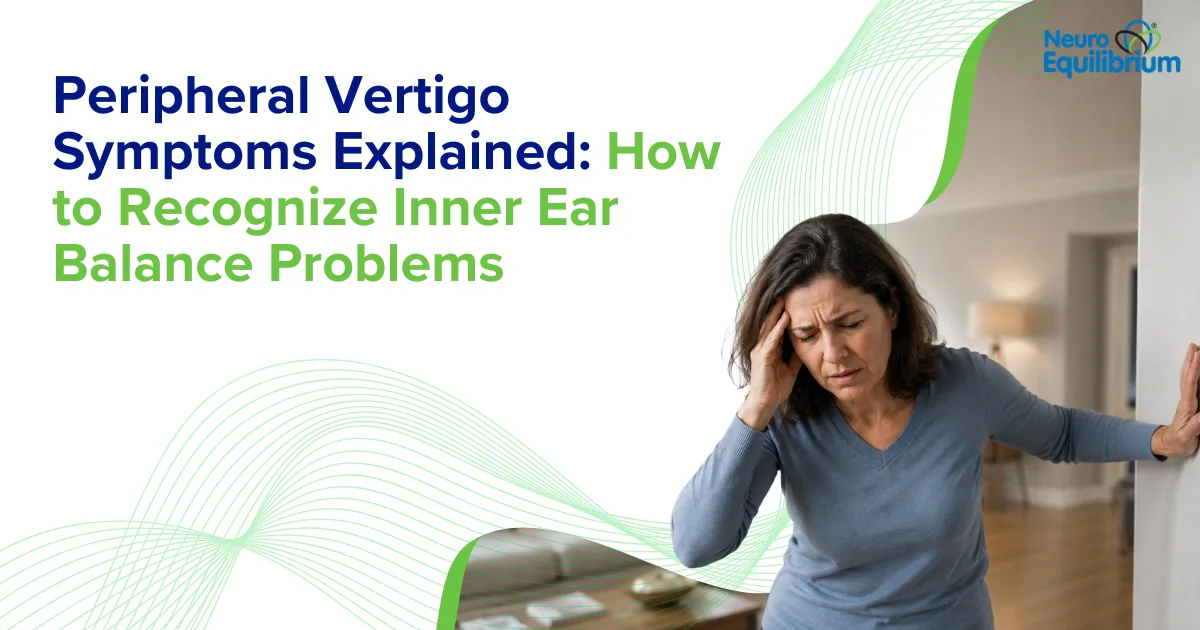








A vertigo attack can end within minutes, but the worry that ensues can last for hours. Standing up or walking outside, using stairs, or visiting a crowded market may feel unsafe after the room spins or one loses their balance.
Vertigo can be accompanied by a fear of falling, particularly if it has occurred more than once. Patients might begin to be able to walk with caution and may be hesitant to move about the head or even leave home for fear of another attack.
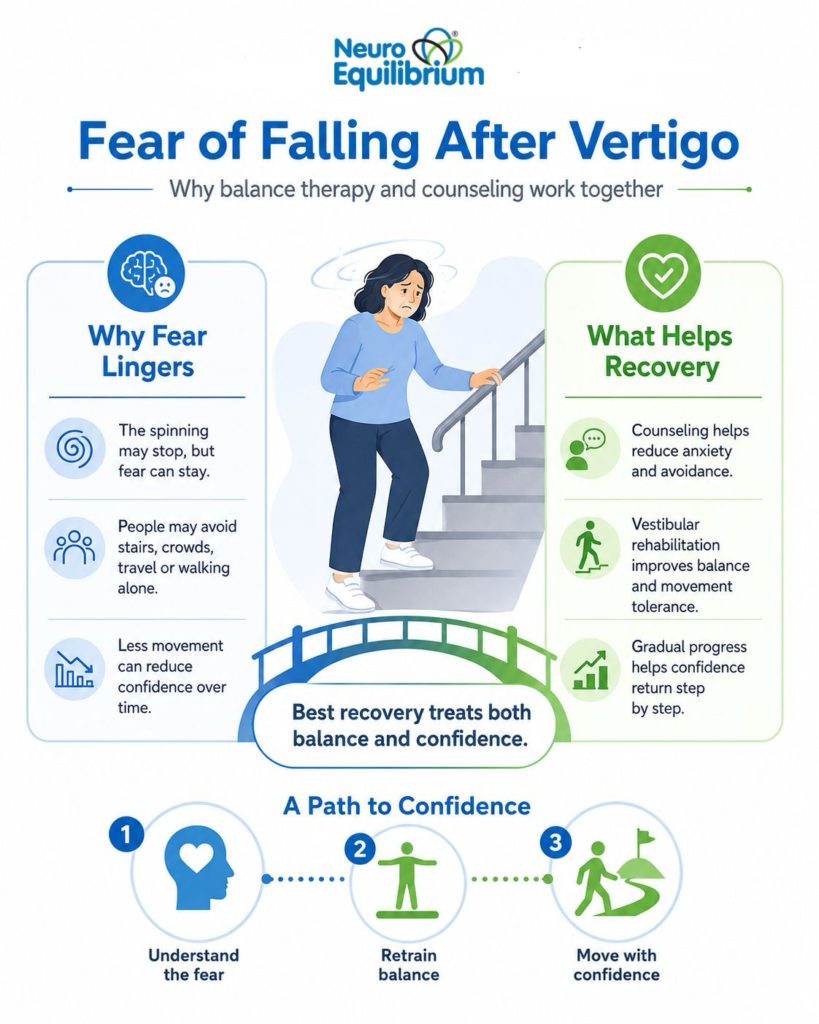
The lack of physical activity and confidence can gradually decrease. This is the point where balance rehab and vertigo counseling can help. The balance therapy helps the body and the brain get used to the movement, and the counselling helps to diminish fear, anxious thoughts, and avoidance.
The goal is not simply to reduce fear but to help people regain confidence, independence, and trust in their ability to move safely
Fear of Falling After Vertigo Can Continue Even When the Spinning Has Stopped
Vertigo can be a whimsical experience. A person could be perfectly fine and then suddenly notice that the room is moving.
The brain’s natural response after an adventure such as this is to be more cautious.
Patients begin to think:
- What if dizziness begins on the stairs?
- What if no one is around to give a hand?
- “What happens if I step into a crowded area and have another attack?”
Vertigo can persist after the condition has improved and cause the fear of falling.Some patients continue to experience genuine imbalance due to an ongoing vestibular disorder, while others develop increased fear and hypervigilance towards normal body sensations. In many cases, both contribute to ongoing symptoms.
This fear is not the same as the feeling that the world is spinning out of control. The symptoms could be coming from a real vestibular problem. Some individuals will have a more difficult time recovering, however, due to anxiety and attention given to balance.
Know More About
- 7 Effective Yoga Poses for Vertigo Relief: Balance Your Mind and Body Naturally
- Anxiety Vertigo Symptoms Explained: How Stress and Panic Affect Your Balance System
- Virtual Reality Therapy for Vertigo and Balance Disorders: How It Works
Avoiding Movement Because of Fear Can Make Balance Recovery More Difficult
It is helpful to prevent a risky situation. Weekly or monthly enforced immobility can be a different story.
Persons who experience vertigo or fear of falling may avoid walking outdoors, rapid turns of the head, physical activity, traveling alone, and visiting busy areas.
This can result in a vicious circle:
- A frightening episode of vertigo can lead to fear of movement. Fear may cause people to avoid activities they believe could trigger dizziness. Over time, this avoidance reduces physical activity, lowers confidence, and gives the brain fewer opportunities to adapt to normal movement. As a result, everyday activities may start to feel even more difficult, reinforcing the fear. Vestibular rehabilitation and counselling work together to help break this cycle by gradually rebuilding both confidence and balance.
- In some vestibular disorders, the brain must also be given safe motion and repeated practice to allow adaptation when it receives a different input of balance signals.
- Treatment is therefore aimed at allowing our patients to gradually regain the ability to move again without pushing them beyond their limits
Vertigo Counseling Helps Break the Cycle Between Dizziness, Anxiety and Avoidance
Vertigo counseling can be beneficial if fear, stress or worry begins to dictate your activities.
The most popular method is Cognitive Behavioural Therapy (CBT). Assists patients to recognise the interrelationships between thoughts, feelings, physical symptoms and behaviour.
- A person shopping in a supermarket might experience some dizziness and say to themselves, “A severe attack is coming.”
- That thought can cause anxiety. Breathing could speed up, muscles might tighten, and the person might be even more focused on each movement. This dizziness then becomes more intense.
- Patients are able to identify this loop and acquire more balanced reactions through vertigo counseling.
- Counselling does not aim to convince patients that nothing is wrong. Instead, it helps them distinguish between realistic precautions and fear-driven avoidance, allowing them to gradually rebuild confidence while continuing appropriate medical treatment.
- An important goal of counselling is improving self-efficacy the confidence that ‘I can cope even if symptoms appear.’ This confidence often develops gradually through repeated successful experiences.
Vertigo Counseling Uses Gradual Exposure to Make Everyday Activities Feel Safe Again
Counselling does not just tell a patient not to be worried.
Graded Exposure can be a helpful component of vertigo therapy. This involves gradually reintroducing activities which were avoided.
Recovery is not about waiting until all dizziness disappears before moving again. It is about learning that mild symptoms can sometimes be experienced safely while gradually returning to meaningful activities
A quiet shop for a few minutes may be enough to get someone worried about crowded places started. Later, the patient can go to a slightly busier environment. A supermarket or shopping centre will eventually be able to be managed once again.
- There are similar steps that can be developed for travelling, escalators, screens, traffic, bending, turning the head, or walking outside.
- No, it is not to induce a bad flare-up. It is about helping the brain to realize that normal movement and environments can become manageable again over time.
- This can include relaxation, controlled breathing, grounding, and coping strategies as well.
Balance Therapy Treats the Physical Side of Fear of Falling After Vertigo
Counselling covers the emotional response, and physical balance problems should also be assessed.
Vestibular Rehabilitation Therapy (VRT): A special exercise program for dizziness, imbalance, motion sensitivity and certain vestibular disorders.
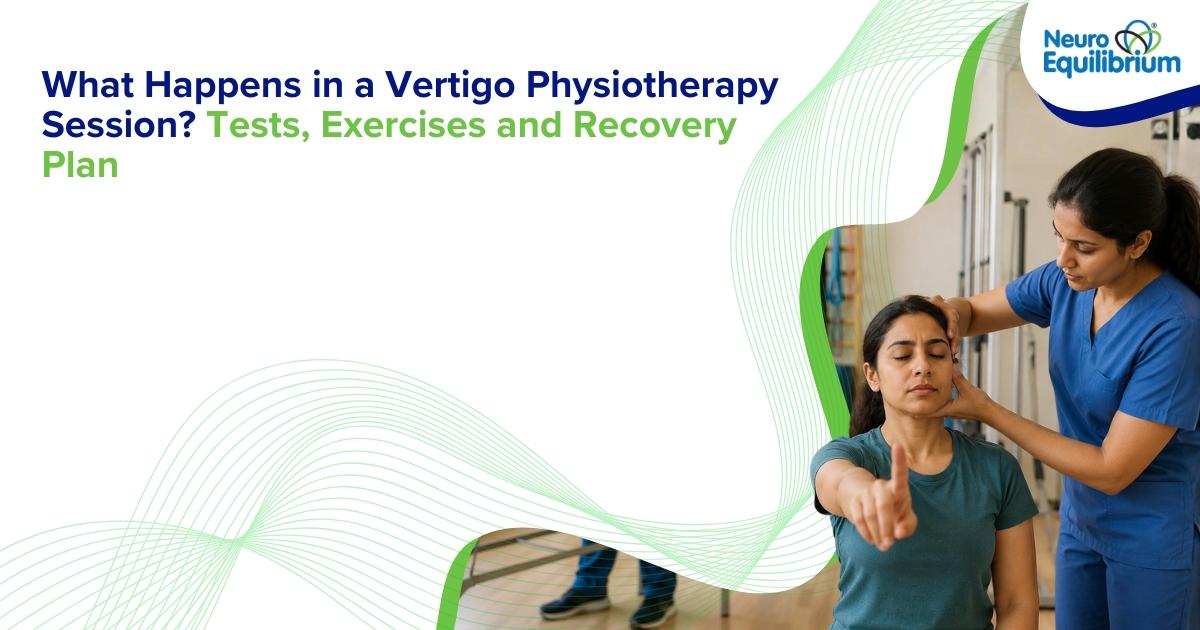
If you are having a fear of falling following a vertigo episode, treatment might start by evaluating your walking, balance, eye and head movements.
If it is determined that rehabilitation is necessary, it may consist of:
- Stabilization of gaze: stabilizing the eyes during head motion to increase visual stability.
- Balance retraining: Practising standing and walking under gradually more challenging conditions.
- Habituation: The process of repeating movements (as appropriate) to tune out their sensitivity in the brain.
- Walking exercises: Performing head turns, direction changes and other movements used during daily activities.
The exercises are to be appropriate to the diagnosis and ability of the individual.
Balance Testing Can Show Why a Patient Still Feels Unsteady After Vertigo
Occasionally the powerful spinning has ceased, but walking is not normal.
A specialist might then have to know what aspects of the balance system are causing problems.
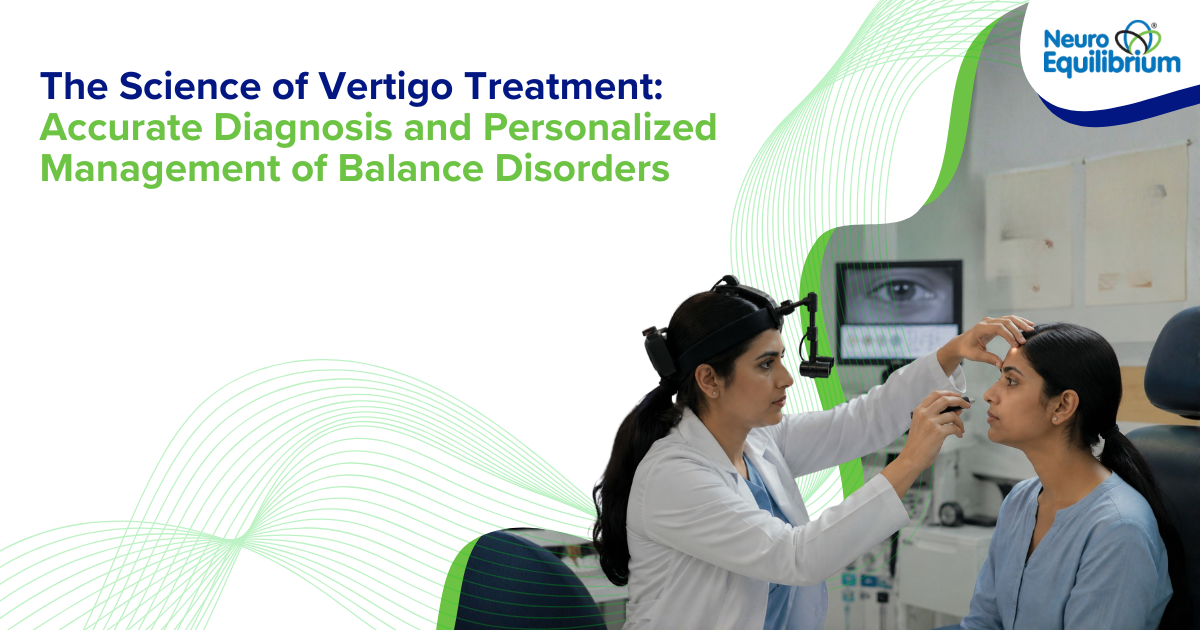
Depending on symptoms, tests like VNG, vHIT, Dynamic Visual Acuity or other vestibular tests may be used.
However, objective assessment may be helpful for patients who are afraid of falling after experiencing vertigo because specific findings of balance can give a basis for treatment.
It can also be used to identify if the rehabilitation methods should be more towards improving gaze stability, sensory integration and walking or another aspect of balance control.
Virtual Reality Can Help Patients Practise Difficult Situations Without Facing Them All at Once
Others are most uncomfortable in areas where there is a large amount of visual activity.
The environment may seem intense when at a supermarket, the road is busy, or it is at a railway station.
VR Vestibular Rehab can simulate specific visual demands in a controlled environment. A patient can start with simpler environments and then slowly work up as they become more balanced and confident.
For someone who experiences vertigo and is frightened of falling, this establishes a link between basic exercising in the clinic and in real life.
VR rehabilitation can be employed for gaze stabilization, motion desensitization, and visual vertigo and balance retraining. Progress can be worked out rather than a situation that feels overwhelming being asked to be entered by the patient.
Vertigo Counseling and Balance Therapy Work Better When Fear and Physical Instability Are Both Addressed
Think of a patient who has physically improved, but is still too afraid to walk outside by himself.
Improved stability with balance exercises alone can lead to the patient not using the improved balance in daily life.
Now think about a person who is only getting vertigo counseling but continues to have an actual vestibular weakness. Discussing the fear can help, but imbalance during physical activity may need specific rehabilitation.
That’s why joint care may be beneficial.
- Balance therapy focuses on movement, stability, and coordination of the eyes.
- Vertigo counseling works on anxiety, avoidance, negative thoughts, and confidence.
- They work together to help patients practise movement, as well as to alter how patients respond to it.
Recovery From Fear of Falling After Vertigo Happens in Small, Measurable Steps
Recovery doesn’t necessarily mean waking up one morning without fear.
The first step will be simply standing without using furniture. Subsequently, it could involve walking to the gate, to a nearby shop, travelling with someone, and finally returning to activities independently.
However, a recovery plan for fear of falling due to vertigo may follow a path of more than just dizziness.
Significant items that can be assessed are walking confidence, balance performance, movement tolerance, visual busy situations, and activities now being done again in daily life that were previously avoided.
No one has a set time frame for recovery. A person’s improvement rate depends on the cause of vertigo, length of symptoms, physical balance issues, and anxiety levels.
The key is to take it slow, not attempting to do everything.
Fear of Falling After Vertigo Should Not Be Assumed to Be Anxiety Without a Proper Assessment
It’s natural to feel nervous following vertigo, but repeated imbalance shouldn’t necessarily be considered an anxiety disorder.
Dizziness or unsteadiness may result from conditions like BPPV, vestibular migraine, vestibular neuritis, PPPD, and other vestibular disorders.
A proper assessment can distinguish whether physical balance issues stem from fear due to the issues or not. In some cases, both are found.
This is why vertigo counseling shouldn’t be a substitute for medical and vestibular treatment but should be an addition to it.
New dizziness with weakness or numbness, difficulty speaking, double vision, dizziness that causes the person to faint, or a new headache that is severe or a sudden new big problem with walking should be evaluated by a healthcare worker right away, not as a routine balance exercise or with counseling.
Why Choose NeuroEquilibrium for Fear of Falling After Vertigo?
Following vertigo, more than one specialist may be needed to deal with the fear of falling.
A dizziness program will combine vestibular assessment, ENT or neurological evaluation (if necessary), vestibular physiotherapy and psychological support.
Advanced testing of the vestibular system, individualised Vestibular Rehabilitation Therapy (VRT), gaze stabilisation, balance exercises, VR rehabilitation, CBT and vertigo exposure therapy.
This is particularly helpful when dizziness has caused you to be afraid of movement, sensitive to light, avoidant, or lacking in confidence.
The goal is not just to assure patients that there’s no problem. It’s important to know why they are feeling unstable, treat what’s treatable, and provide them with a secure road to return to normal activity.
The Right Plan Treats Both Balance and Confidence
Vertigo can occur in more than the inner ear. When a person has had multiple episodes, the chance of being dizzy again may affect their walking pattern, activities they do or don’t engage in, and where they go.
But after experiencing vertigo, fear of falling does not have to be a way of life.
Recovery from vertigo is not only about improving balance it is also about rebuilding trust in your body. When vestibular rehabilitation and psychological support work together, many people gradually regain the confidence to return to work, travel, social activities, and everyday life.
Vestibular rehab can retrain balance, gaze control, and movement. Vertigo counselling can assist with feeling anxious, decrease avoidance behaviour, and improve self-assurance. Once both physical and emotional challenges have been solved, patients can slowly come back to walking, travelling, shopping, working, and enjoying everyday activities.
The first step we take at NeuroEquilibrium is to grasp the root cause of dizziness and how it has affected life. Then, personalized vestibular rehabilitation, advanced balance assessment, and psychological care are used if necessary to assist the patient with moving forward in a more balanced and confident manner.
Frequently Asked Questions
Why does fear of falling continue after vertigo improves?
After a major and recurrent episode of vertigo, the brain may be more susceptible to movement and balance changes. When a person feels better, they may still be concerned about having another episode and this can cause loss of confidence and reduce activity.
Can anxiety make vertigo and imbalance feel worse?
Yes. However, anxiety can also cause muscle tension, affect breathing and heighten the awareness of the normal sense of balance. This can make one feel dizzy or unsteady, especially in people recovering from a vestibular condition.
How does vestibular rehabilitation reduce fear of falling?
Vestibular rehab targets physical balance, gaze stability, walking and movement tolerance. As patients become more stable and comfortable with moving, their confidence may gradually be built up and fear of falling may slowly come down.
Can vertigo counseling and balance therapy be done together?
Yes. If the physical instability and anxiety are contributing to the recovery process, counselling could be used in conjunction with balance therapy. One is focused on balance and movement and the other on fear, avoidance and confidence.
How does vertigo counseling help with fear of falling?
Vertigo counseling can involve strategies like Cognitive-behavioural therapy, which can assist patients in identifying upsetting ideas, lessening avoidance, and gradually returning to activities that are challenging. Relaxation or coping strategies might be a part of treatment as well.