







Why Patients Are Turning to Apps for Vertigo Treatment
The Access Gap in Vestibular Rehabilitation
Vestibular rehabilitation therapy, or VRT, usually requires repeated practice over several weeks. Patients may find it difficult to continue because of distance, limited specialist availability, transport problems, work schedules, age-related mobility concerns, cost or fear of triggering dizziness outside the home.
Compliance may also fall after the first few clinic visits. A printed exercise sheet can be forgotten, movements may be performed incorrectly, and patients may not know whether temporary dizziness is expected or a reason to stop.
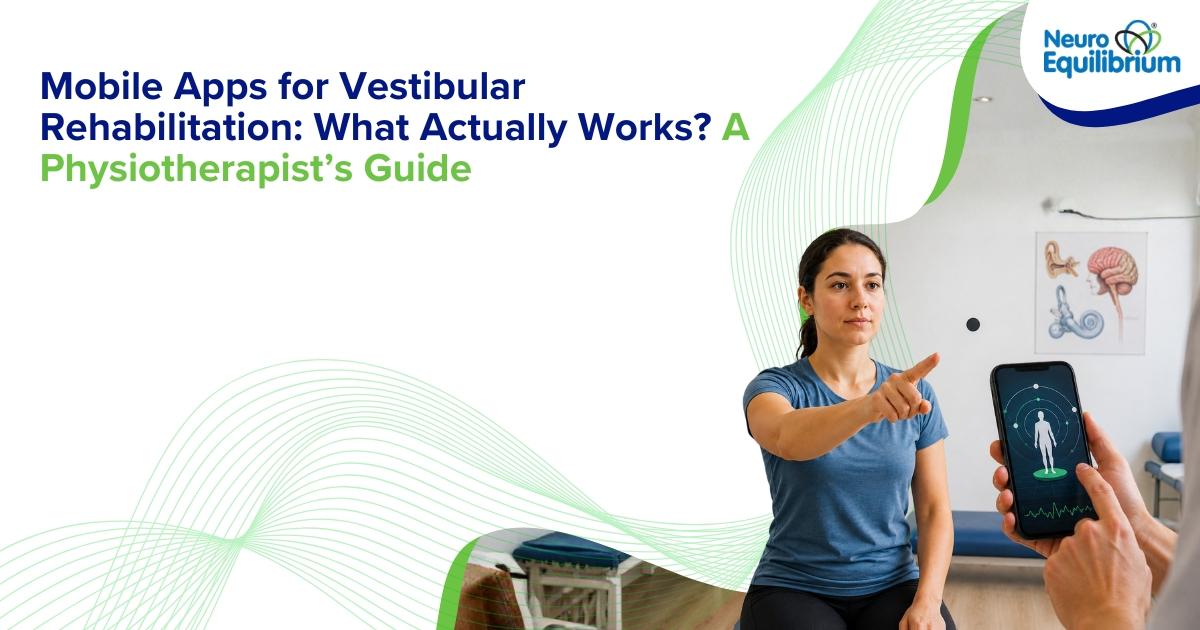
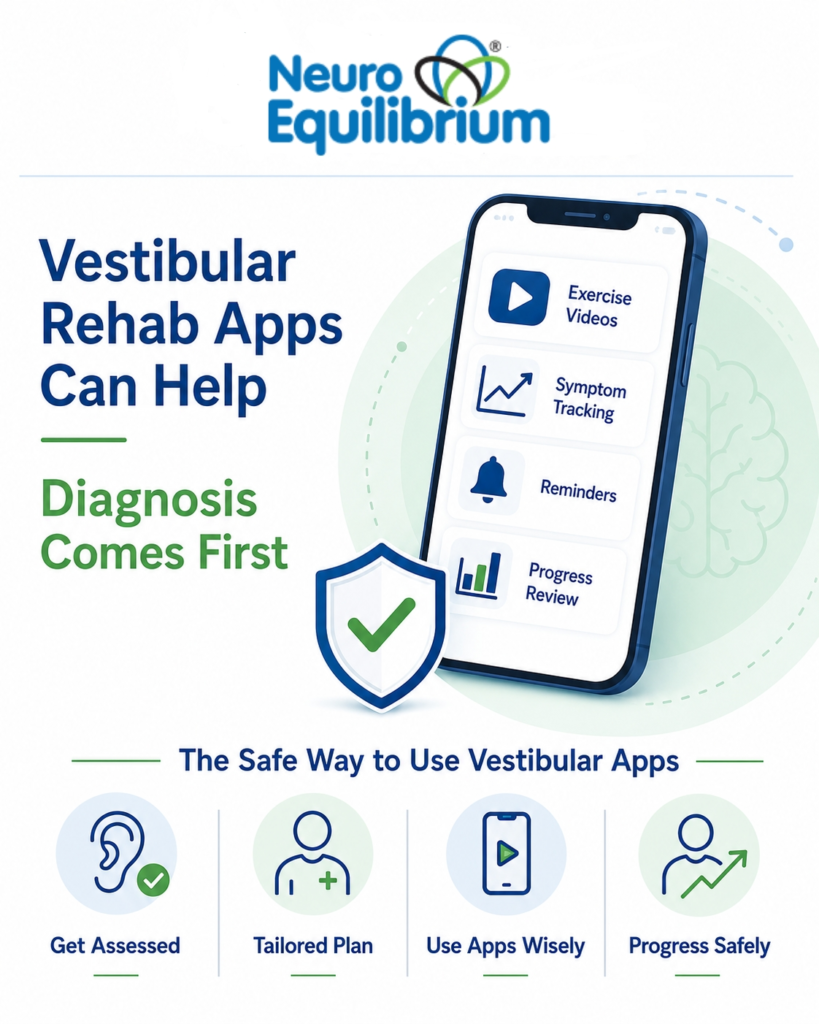
A well-designed vestibular rehabilitation app can place the prescribed program on the patient’s phone. Video demonstrations, reminders, symptom records and therapist reviews may support regular practice.
Research involving selected patients with chronic vestibular symptoms has found that structured internet-based vestibular rehabilitation can reduce dizziness and dizziness-related disability.
What Vestibular Rehabilitation Apps Promise and What They Deliver
Most apps provide some combination of:
- Exercise demonstration videos
- Gaze-stabilisation activities
- Balance and walking exercises
- Repositioning manoeuvre guides
- Symptom diaries and questionnaires
- Relaxation and controlled-breathing modules
- Games using phone sensors, virtual environments or balance boards
These features may be useful, but an exercise library is not the same as a rehabilitation program.
A proper clinical program must determine which exercise is needed, how frequently it should be performed, how the patient’s response should be monitored and when the difficulty should be changed.
The Critical Caveat Every App User Must Understand
An app cannot determine why a patient is dizzy.
Vertigo and imbalance may arise from the inner ear, vestibular nerve, brain, vision, medication effects, blood-pressure changes or a combination of factors. Different conditions require different forms of treatment.
BPPV is generally treated first with a canal-specific repositioning manoeuvre. Vestibular hypofunction may require gaze-stabilisation, habituation, balance and gait training. An active Ménière’s episode requires medical management and safety precautions. Sudden dizziness accompanied by neurological symptoms may be a medical emergency.
Generic gaze exercises do not correct the displaced inner-ear particles responsible for BPPV. Similarly, following a repositioning video without confirming the affected ear and semicircular canal may be ineffective or provoke unnecessary symptoms.
Clinical guidelines recommend diagnosing BPPV through appropriate positional testing and matching treatment to the identified condition.
Diagnosis must come before exercise selection.
How to Evaluate a Vestibular Rehab App
Is It Based on Recognised Rehabilitation Principles?
A credible app should explain the purpose of every activity.
Vestibular rehabilitation commonly involves adaptation, substitution, habituation, balance training, gait training, fall prevention and condition-specific repositioning. There is strong evidence supporting vestibular physical therapy for symptomatic peripheral vestibular hypofunction.
An app may mention familiar terms such as Cawthorne-Cooksey exercises, Brandt-Daroff exercises, the Otago program or VOR adaptation. However, the presence of recognised names does not automatically make the app clinically appropriate.
The app should explain:
- Which diagnosis the exercise is intended for
- Which patients should avoid it
- How often it should be performed
- What level of dizziness is acceptable
- How the exercise should progress
- When the patient should contact a clinician
Does It Adjust to the Patient’s Diagnosis?
A one-size-fits-all plan is a major warning sign.
Posterior-canal BPPV requires a very different approach from unilateral vestibular hypofunction. An older adult with a high risk of falling also needs a different progression from a younger person preparing to return to sport.
A useful vestibular rehabilitation app should account for:
- The confirmed vestibular diagnosis
- The affected side or canal, where relevant
- Baseline balance and visual-stability findings
- Age, mobility, vision and neck health
- Fall risk and other medical conditions
- Symptom sensitivity
- Progress during the program
The exercises must become progressively more challenging as the patient improves. Repeating the same routine indefinitely may no longer provide an adequate rehabilitation stimulus.
Is Professional Supervision Available?
An exercise video can demonstrate a movement, but it may not detect unsafe posture, incorrect speed, compensatory movements or excessive symptom provocation.
Apps are safer when a vestibular physiotherapist can review adherence, observe performance, adjust the difficulty and respond when symptoms worsen.
Professional supervision is particularly important for older adults, patients with neurological or orthopaedic conditions and anyone with a history of falls.
Does It Monitor Symptoms and Provide an Escalation Path?
A medically responsible app should record more than the number of completed repetitions.
It should ask about:
- Symptom intensity
- Recovery time after exercise
- Falls or near-falls
- Nausea and vomiting
- Visual blurring
- Headache
- Hearing changes
- Difficulty performing daily activities
Validated questionnaires such as the Dizziness Handicap Inventory may help clinicians monitor the effect of dizziness on everyday function.
The app should also explain when treatment must be paused and provide a way to contact a clinician. A symptom tracker has limited value if it records deterioration but offers no escalation pathway.
Exercises Found in Vestibular Apps and How to Use Them Safely
Repositioning Manoeuvre Guides
Repositioning videos can help a patient remember a manoeuvre after BPPV has been diagnosed and the affected canal has been identified.
They should not be used as self-diagnosis tools.
BPPV can involve different canals and either ear. The correct movement sequence depends on the pattern observed during positional testing. Patients with neck or back problems, recent surgery, limited mobility or certain vascular conditions may also require assistance or a modified approach.
Gaze-Stabilisation Exercises
Gaze-stabilisation exercises are commonly prescribed for vestibular hypofunction. They help retrain the vestibulo-ocular reflex so that vision remains clearer during head movement.
The exercise involves more than looking at a target and moving the head. Its effectiveness depends on:
- Target distance
- Head speed and direction
- Exercise duration
- Visual background
- Sitting or standing position
- Number of daily sessions
- Symptom response and recovery time
An app that demonstrates the movement but omits dosage, progression and stopping criteria provides an incomplete prescription.
Balance and Posturography Games
Phone-based games may improve engagement and encourage regular practice. Some use motion sensors, virtual environments or balance boards to challenge posture.
These should be treated as supportive tools. A phone sensor cannot replace a clinical balance examination or computerized dynamic posturography, which evaluates how the patient uses visual, vestibular and body-position information to remain stable.
A balance game becomes therapeutic only when its difficulty and safety demands are matched to a documented functional deficit.
Breathing and Relaxation Modules
Dizziness can lead to fear of movement, muscle tension, rapid breathing and avoidance of normal activities.
Controlled breathing and relaxation may help patients remain calm enough to participate in rehabilitation. These techniques can support recovery by reducing the anxiety-dizziness cycle.
However, they do not reposition particles in BPPV or restore reduced vestibular function on their own.
Red Flags: When an App Is Not Enough
Clinical review should be arranged when:
- Dizziness becomes progressively worse across sessions
- Falls or near-falls increase
- Exercise causes prolonged symptoms that do not settle as advised
- The app prescribes manoeuvres without a confirmed diagnosis
- New hearing changes, severe headaches or repeated vomiting develop
- There is no way to contact a clinician
- The program does not account for mobility, neck health or other medical conditions
Urgent medical care is required when sudden dizziness or loss of balance occurs with facial weakness, weakness or numbness on one side, difficulty speaking, double vision, severe new headache, loss of coordination, fainting or inability to walk.
These may be warning signs of stroke and should never be managed through an app.
Conditions That Should Not Be Managed by an App Alone
Central Vertigo
New or unexplained symptoms arising from the brain or central nervous system require neurological assessment. Vestibular rehabilitation may later be included, but it should form part of a medically supervised treatment plan.
Acute Vestibular Neuritis
Severe continuous vertigo, vomiting and marked imbalance require diagnosis and medical review. Vestibular rehabilitation can be valuable during recovery, but the initial acute presentation should not be self-managed.
Ménière’s Disease During an Active Episode
Exercise does not control the fluctuating inner-ear process during an acute attack. Management may include medication, dietary changes, hearing assessment and rehabilitation during the recovery or between-episode phase.
Bilateral Vestibulopathy
Customised vestibular rehabilitation can help patients with bilateral vestibular hypofunction. However, oscillopsia, poor balance in darkness and an increased risk of falling make professional assessment and progression particularly important. Clinical guidelines support VRT for bilateral hypofunction while emphasising individualised dosing and monitoring.
The Best Use of Vestibular Apps: A Bridge, Not a Replacement
The ideal model is straightforward.
The clinic establishes the diagnosis and prescribes the exercises. The app helps the patient complete the required repetitions at home, records adherence, and supports progress reviews.
In this model, technology improves consistency without making clinical decisions independently.
Telerehabilitation and Apps
Telerehabilitation combines remote clinical contact with structured home practice.
Studies involving selected adults with chronic vestibular symptoms have found that internet-delivered vestibular rehabilitation can be effective and safe. Vestibular rehabilitation guidelines also recommend supervised exercise programs for patients with symptomatic peripheral vestibular hypofunction.
The strongest digital program therefore includes two elements:
- A convenient platform for delivering and tracking exercises
- Access to a trained professional who can assess the response and modify the prescription
How NeuroEquilibrium’s Supervised Home Program Combines Both Approaches
At NeuroEquilibrium, we begin vestibular rehabilitation by identifying the underlying balance deficit.
Depending on the patient’s symptoms and clinical findings, the assessment may include tests such as VNG, VEMP, Dynamic Visual Acuity, or Computerized Posturography. These tests help determine which part of the balance system is affected and which rehabilitation approach is appropriate.
The rehabilitation plan is then built around the diagnosis rather than selected from a generic exercise library.
A structured program includes physiotherapist-led sessions twice a week for five weeks, supported by home exercise videos. Supervised video sessions may be incorporated for suitable patients who cannot attend regularly.
This is clinically supervised telerehabilitation supported by technology. It is not simply a collection of exercises stored on a phone.
Conclusion: The Best Vertigo App Is Built Around the Diagnosis
A vertigo app can make rehabilitation more accessible, organised and consistent. It can deliver exercise videos, encourage adherence, record symptoms and connect home practice with clinical review.
It cannot replace diagnosis.
The best vestibular rehabilitation app begins after assessment, follows a condition-specific prescription, monitors progress and provides access to professional guidance.
When patients search for a “home exercises vertigo app,” “mobile app balance disorder” or “dizziness exercises app,” the safest choice is not necessarily the app with the largest exercise library.
It is the program that understands why the dizziness is occurring and changes the exercises accordingly.
Frequently Asked Questions
Can a vertigo app cure vertigo?
No app can treat every cause of vertigo. It may support a prescribed rehabilitation program for conditions that benefit from exercise. BPPV may require a repositioning manoeuvre, while other causes may need medication, migraine management, counselling or neurological care.
Are vestibular rehabilitation apps safe?
They can be safe for selected patients when the diagnosis is known, the exercises are appropriate and symptoms are monitored. Generic unsupervised programs may be unsuitable when symptoms are acute, fall risk is high, neurological signs are present, or the diagnosis is uncertain.
What should a vestibular rehabilitation app include?
Look for diagnosis-specific exercises, clear dosage and progression, video guidance, symptom tracking, fall-safety instructions, clinician access and a defined pathway for worsening symptoms.
Can balance exercises be performed at home?
Many balance exercises can be performed at home after assessment and instruction. The exercise area should be safe, stable support should be available, and the difficulty must match the patient’s balance ability.
Is telerehabilitation as useful as clinic-based treatment?
Telerehabilitation can be effective for suitable patients, particularly when structured exercises are combined with professional monitoring. Some patients still require in-person testing, hands-on manoeuvres or equipment-based assessment.
Disclaimer
This article is for informational and educational purposes only. It is not a substitute for professional medical advice, diagnosis, or treatment. Always seek advice from a qualified healthcare professional regarding dizziness, vertigo, or balance-related symptoms.