



Imagine waking up in the morning and thinking that the room is spinning around you. Even the most basic activities such as turning your head, leaving the bed or walking to the kitchen suddenly seem risky. This is a daily reality for millions of individuals who experience dizziness and vertigo.
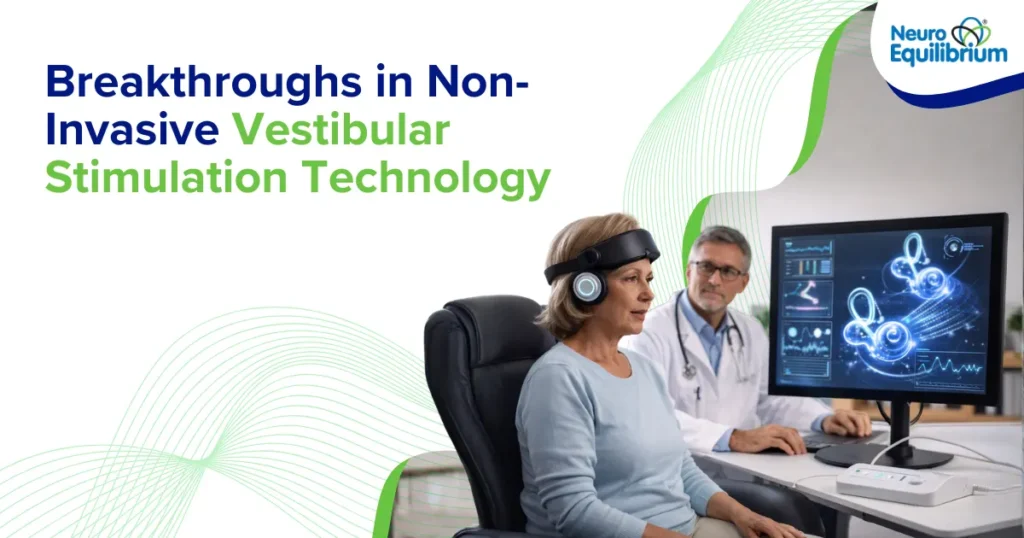
The good news? The game is changing fast due to science and technology. The latest non-invasive tools are helping patients receive more accurate diagnoses, more precise vertigo treatment, and faster recovery without surgery, needles, or guesswork. What is happening at the forefront of vestibular care, and what does it mean for you?
Know More About
- Virtual Reality Therapy for Vertigo and Balance Disorders
- Vestibular Neuritis Symptoms: Early Warning Signs You Shouldn’t Ignore
- Vestibular Dysfunction Explained: Symptoms and Treatment
What Is the Vestibular System and Why Does It Break Down?
It is important to know what the vestibular system does before diving into technology. Small organs deep inside your inner ear constantly send signals to your brain about your head’s position in space whether you are tilting, spinning, or moving forward. Your brain mixes these signals with what you can see with your eyes and what you can feel with your body and makes you balanced.
When something goes wrong in this system, whether due to a viral infection, displaced crystals in the ear canal, fluid buildup, or a neurological issue, dizziness can occur. Vertigo may be mild, causing slight imbalance, or severe spinning sensations that make it impossible to stand.
Conventional methods of treating vertigo were based on medication and generic exercises. Today, high-tech innovations make that traditional approach look like just the tip of the iceberg.
How Virtual Reality Is Revolutionizing Vertigo Treatment
Virtual Reality (VR) is one of the most exciting innovations in dizziness management, especially in vestibular rehabilitation. Balance therapy in the past meant repeating the same exercises over and over again, something that was most often boring, confusing or difficult to maintain at home.
VR changes this by placing patients in fully immersive digital environments. A patient does not have to stand in front of a wall and exercise. He or she could be virtually walking over a narrow bridge, down an aisle in a crowded grocery store, walking on a floating boat – all this with a safe margin in an actual clinic room.
What does this mean for treating vertigo? The brain improves balance by repeatedly exposing itself to controlled challenges. VR can make such an exposure controlled, graded. The system begins simple and becomes increasingly complicated with patient progress. The sensors monitor all the movements in real time and provide the therapists with accurate data regarding the response of the vestibular system of the patient.
This means there is no more guesswork about whether the patient is improving. The technology measures it.
Augmented Reality and Graded Exposure for Dizziness Relief
VR is closely connected with Augmented Reality, or AR, a kind of technology which superimposes digital images onto the real environment. AR is being used as a form of graded exposure therapy for individuals whose dizziness is triggered by environments such as crowds, escalators, or complex visual patterns.
Imagine it in the following way: in case you are terrified of heights, one of the methods is to start very small, i.e., stand on a small step and build up the difficulty. AR does the same with vertigo problems that are triggered by visual stimulation. A patient starts with mild visual complexity and gradually progresses to environments that once made them feel severely dizzy.
Over time, the brain adapts. The dizzy effect is reduced. Patients become more confident in real-life situations that were previously daunting.
3D Humanoid Technology: A Smarter Way to Treat BPPV
BPPV (Benign Paroxysmal Positional Vertigo) is one of the most common causes of sudden and severe vertigo. It occurs when minute crystals of calcium in the inner ear are loosened and fall into the incorrect canal. Conventional vertigo therapy is specific head movements, such as Epley manoeuvre, which help to bring these crystals back to where they belong.
The difficulty lies in doing it by hand, however. The head must just be angled the correct amount of time, exactly the right amount of time, and moved in just the right order. The slightest mistake will cause the crystals failing to clear out at all, or more likely, traveling to a different canal.
This is solved by advanced clinics using 3D humanoid guidance technology. The inner ear canals of the patient are modelled into a three dimensional model using a software program and the real time movement of the crystals is displayed on every step of the manoeuvre. The clinician aligns the real position of the patient’s head with a 3D humanoid on-screen figure – and it is always perfectly angulated.
This level of accuracy could not exist a decade ago. It implies much more successful BPPV treatment rates today in one session.
VR-Based Posturography: Measuring Balance Like Never Before
VR-based posturography is another potent non-invasive device that is currently joining prestigious balance centers. Posturography is a test that is applied to determine the distribution of weight and the posture that an individual undertakes under various circumstances.
Posturography has been used. However, it is combined with a VR headset, and it is much stronger. The patient is on a special stand and has a VR headset, which designs various visual conditions – a sitting room to a floating deck of a ship. The system captures precise balance movements in response to visual input, separating what the patient sees from what they physically feel.
This provides clinicians with an immensely clear image on the exact location of the vestibular deficit. Does the patient have problems due to inner ear dysfunction? Visual processing issues? Half-heartedness in coordinating between the two? These factors can be distinguished with VR posturography and a far more specific vertigo treatment plan can be guided.

Why Choose NeuroEquilibrium for Advanced Vertigo Treatment
All these technologies are as good as the skills that are involved. That is where NeuroEquilibrium is different. NeuroEquilibrium is the most specialized of the chain of dizziness and balance clinics in India, We use the latest technology in the form of non-invasive diagnostic and rehabilitation equipment and trained professionals in the field of the vestibular to operate the equipment correctly.
Is it an inner ear crystal disorder, a nerve disorder, some form of a migraine, or something neurological? In this case the starting point would be to determine the exact underlying cause of the dizziness, with the same internationally validated tools. Based on this evaluation, an individualized vertigo treatment plan is developed according to your condition, your lifestyle and your recovery goals.
No generic exercises. No guesswork. Only accurate, evidence-based patient care with the most up-to-date technology.
The Future of Vestibular Care Is Already Here, Are You Ready?
Being dizzy or having a vertigo issue does not necessarily imply lifetime drug use and decades of discomfort. Diagnostic, treatment, and rehabilitative technologies for the vestibular system have improved significantly and are available today.
If you are experiencing persistent dizziness, the most important first step is a proper evaluation by specialists using advanced technology to identify the real cause.
How do you get rid of dizziness?
The treatment of dizziness is dependent on the cause but sometimes the easiest way to cure it is to lie down in a quiet place, drink plenty of water, and make the head move slowly. In cases of dizziness that are connected with inner ear issues, balance exercises or certain movements of the head can be prescribed. Episodes can also be reduced through managing stress, having regular meals and getting enough sleep. When dizziness continues to recur or disrupts normal life, it is prudent to seek a medical consultation to pinpoint the cause of dizziness.
How to stop feeling dizzy or lightheaded?
In case you are dizzy or lightheaded, you must sit or lie as soon as possible to eliminate the risk of fall and enable your body to stabilize. Light electrolyte drink or drinking water can also be helpful in case the symptoms are being exacerbated by dehydration. Having a light snack can assist in case of low blood sugar. Sudden decreases in blood pressure leading to lightheadedness may also be avoided by rising gradually after sitting or lying. Light dizziness can be relieved by breathing slowly and gradually and breathing in fresh air.
What are the top 3 causes of dizziness?
The three most prevalent causes of dizziness are inner ear diseases like Benign Paroxysmal Positional Vertigo, which brings about feelings of brief spinning when the head turns; migraine like Vestibular Migraine that can cause dizziness together with or without a headache; and inner ear diseases like Vestibular Neuritis, which can lead to sudden and severe vertigo. The other usual causes are dehydration, low blood pressure, anxiety, and medication side effects.
When to worry about dizziness?
Dizziness is a problem to be taken seriously as it is acute, long lasting, or comes together with other conditions like chest pain, trouble speaking, blurred vision, severe headache, fainting, or weakness on one side of the body. Sudden dizziness in guests or those having some medical problems should be also checked. Another symptom, which is indicative of seeking medical help, is frequent or exacerbating dizziness which alters walking or balance.
What is the red flag for dizziness?
Signs of dizziness to look at include a sudden severe vertigo, difficulty walking, loss of coordination, slurred words, confusion or face weakness, arm weakness, or leg weakness as it could denote serious causes such as a stroke. Recurrent vomiting, hearing loss in one ear, fainting or dizziness in case of head trauma are also warning signs. Urgent medical attention may be sought in case any of these symptoms appear.