







That overlap is exactly what makes these two conditions so frustrating to live with. It’s not unusual to have seen two or three doctors, been told “migraine” by one and “Ménière’s” by another, and still have no real answer for why the room keeps spinning. Both are common causes of recurring vertigo, both come and go without much warning, and both can knock out entire days. Understanding where they overlap, where they part ways, and what a real evaluation looks like can make the road to the right treatment a lot less confusing.
Why vestibular migraine and Ménière’s disease get confused
The vestibular system – the balance organ in the inner ear, plus the brain pathways it connects to – only has so many ways of telling you something’s wrong. Spinning sensation, unsteadiness, nausea, that feeling like the world’s tilting: all of it can come from very different underlying problems. So when two separate conditions both produce episodic vertigo, it’s genuinely hard to tell them apart just from a description, even for clinicians.
There’s also a real biological overlap at play. People with Ménière’s disease are more likely than average to also have migraine, and vestibular migraine can itself cause ear symptoms like fullness or tinnitus during an attack. In a smaller group of patients, both conditions show up at once. That’s part of why vestibular migraine vs Ménière’s disease isn’t always something a single appointment can answer – sometimes it takes watching things unfold over time.
What is vestibular migraine?
Vestibular migraine is a type of migraine in which vertigo or dizziness is a prominent symptom, with or without headache. Episodes typically last from 5 minutes to 72 hours and may be associated with nausea, sensitivity to light or sound, and visual disturbances. It is one of the common causes of recurrent spontaneous vertigo and can overlap with Ménière’s disease and other vestibular disorders.
Attacks can feel like spinning, rocking, swaying, or just a vague sense of being unsteady. They might last a few minutes or stretch on for hours, occasionally up to three days. A headache can come along with the dizziness, but often it doesn’t – which is part of why the migraine connection gets missed so easily. Instead, people often notice sensitivity to light or sound during an episode, visual disturbances like shimmering or zigzag patterns, or just a lingering “off” feeling for a day or two afterward.
Most people with vestibular migraine have a personal history of migraine headaches – sometimes from years earlier – or a close family member who gets migraines. Common triggers include poor or irregular sleep, skipped meals, dehydration, stress, hormonal shifts, and certain foods or drinks. Between attacks, some people stay sensitive to motion, busy visual environments, or scrolling on a screen.
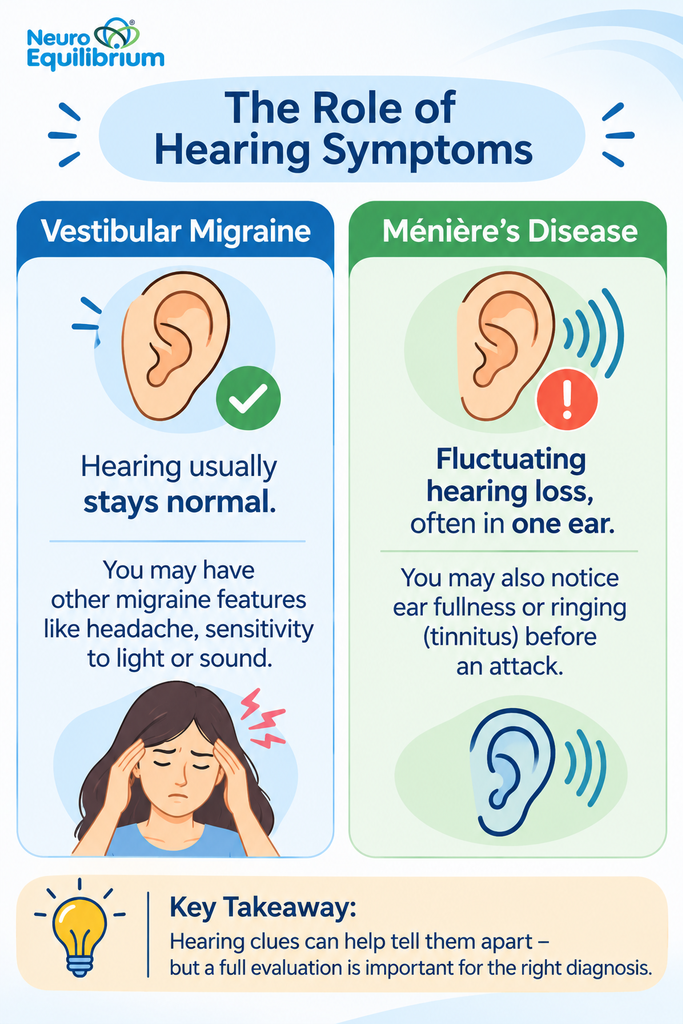
Hearing usually stays normal with vestibular migraine. Tinnitus or ear fullness can show up, but they tend to be mild, affect both ears, and don’t lead to progressive hearing loss.
What is Ménière’s disease?
Ménière’s disease is an inner-ear disorder, thought to involve a buildup of fluid pressure inside the inner ear – a state sometimes called endolymphatic hydrops. Ménière’s disease affects the inner ear, which controls both hearing and balance, so problems in this system can cause both hearing symptoms and vertigo and sometimes can occur with imbalance .
A typical Ménière’s attack brings on intense spinning vertigo lasting roughly twenty minutes to several hours, often with nausea and vomiting. What sets it apart is that the ear itself gets involved. Before or during an attack, people often notice a blocked or full feeling in one ear, a roaring or ringing sound (tinnitus), and reduced hearing on that side. In the early stages, hearing tends to bounce back between attacks. Over months or years, though, the hearing loss usually becomes permanent and can keep progressing.
Ménière’s disease typically starts somewhere between ages 30 and 60. Attacks can come in clusters, with quiet stretches in between that might last weeks or months. Later on, the vertigo attacks often ease up in frequency, but the hearing loss and imbalance can stick around.
Know More About
- What Is Ménière’s Disease? Symptoms, Diagnosis & Treatment
- Vestibular Migraine
- Vestibular Migraine: Understanding Your Spinning Headache
Vestibular migraine vs Ménière’s disease: the key differences
The clearest way to compare them is side by side. Keep in mind these are typical patterns – not every patient fits the mold exactly.
| Feature | Vestibular migraine | Ménière’s disease |
| Nature of the problem | A brain-based migraine disorder | An inner-ear fluid disorder |
| Vertigo duration | Minutes to hours, sometimes up to 72 hours | Usually 20 minutes to 12 hours |
| Hearing | Normally preserved | Fluctuating hearing loss in one ear, usually worsening over time |
| Tinnitus and ear fullness | Can occur, but mild and often on both sides | Prominent, typically in one ear, often signalling an attack |
| Headache and migraine features | Headache, light or sound sensitivity, or visual aura in many attacks | Headache not a core feature, though migraine can coexist |
| Personal or family migraine history | Very common | Not required, but more common than average |
| Typical triggers | Sleep changes, stress, missed meals, dehydration, hormonal shifts | Less clearly trigger-driven; high salt intake and stress sometimes worsen attacks |
| Which ear | Not ear-specific | Usually one ear |
Symptom patterns and timing
Both conditions come and go in attacks, but the rhythm often looks different. Ménière’s attacks tend to be dramatic, clearly bounded events – a distinct start and end, often preceded by some change in the ear. Vestibular migraine episodes are more of a mixed bag. One attack might be a short burst of spinning, the next a full day of rocking and imbalance, and there can be a low-grade dizziness humming in the background that never quite goes away.
The role of hearing symptoms
When people ask how to tell vestibular migraine and Ménière’s disease apart, hearing is usually the first thing a vestibular specialist wants to know about. Hearing loss that comes and goes with attacks, and is measurably worse in one ear, points fairly strongly toward Ménière’s disease. Normal hearing, even after several attacks, makes Ménière’s disease less likely. That said, early hearing changes in Ménière’s disease can be subtle enough to go unnoticed – which is exactly why a formal hearing test matters more than how your hearing “feels.”
Headache and other migraine features
Vestibular migraine doesn’t require a headache, but migraine features usually show up in at least some episodes: throbbing head pain, discomfort with bright light or loud noise, visual aura, or just needing to lie down in a dark room. A history of motion sickness as a kid, or migraines that seemed to fade with age only for dizziness to take their place later, is also a pretty common story.
Why symptoms alone are not always enough
It would be convenient if a symptom checklist could settle this. In practice, a few things get in the way.
Early Ménière’s disease can show up as vertigo before the hearing symptoms become obvious. Vestibular migraine can cause ear fullness and tinnitus during attacks. Some people genuinely have both. And by the time most people make it into a clinic, the attack is already over, so the doctor is working from the patient’s memory of what happened.
This is where a structured evaluation earns its keep. It usually involves a detailed history mapping out the timeline of each attack, an ear exam, a hearing test, and, where it makes sense, vestibular function tests. The goal isn’t finding one test that hands down a verdict – it’s building up enough evidence to tell the two conditions apart, or to recognize when they’re overlapping.
How audiometry and vestibular function tests help
Audiometry
Audiometry is a hearing test done in a sound-treated room, measuring how well each ear picks up sounds at different pitches and volumes. In Ménière’s disease, the classic finding is sensorineural hearing loss in the affected ear that’s worse for low-pitched sounds, at least early on. Because hearing in Ménière’s disease fluctuates, one normal audiogram doesn’t rule it out – a test done soon after an attack, or repeated over time, tends to be more telling. In vestibular migraine, audiometry is usually normal, and a normal result across several tests helps back up that diagnosis.
Vestibular function tests
Vestibular function tests check how each inner-ear balance organ, and its connections to the brain, are working. Depending on the clinic, this might include videonystagmography (VNG), which tracks eye movements for abnormal patterns; caloric testing, which checks how each ear responds to gentle warm and cool stimulation; the video head impulse test (vHIT), which measures how steady the eyes stay during quick head movements; and vestibular evoked myogenic potentials (VEMP), which test the parts of the inner ear that sense gravity and linear motion.
In Ménière’s disease, these tests often show reduced function on the affected side, especially on caloric testing, and the pattern can look quite distinct from other inner-ear conditions. In vestibular migraine, results are frequently normal or show only mild, non-specific changes. Test results get read alongside the history and audiogram, not in isolation – an abnormal result on its own doesn’t hand someone a diagnosis.
Other assessments
A clinician may also check for positional vertigo, since benign paroxysmal positional vertigo (BPPV) shows up more often in people with either migraine or Ménière’s disease, and can add its own brief, position-triggered spinning on top of the underlying condition. In some cases, brain imaging is used to rule out other causes, particularly if symptoms are unusual or come with neurological signs.
How treatment differs
Getting the diagnosis right matters because the two conditions aren’t managed the same way.
Vestibular migraine is treated as a migraine disorder. That usually starts with identifying and cutting down triggers, keeping a steady sleep and meal schedule, staying hydrated, and managing stress. If attacks are frequent or disabling, migraine preventive medication may come into play. Plenty of people improve a lot once the underlying migraine is under control.
Ménière’s disease treatment centers on the inner ear. Cutting back on dietary salt and limiting caffeine and alcohol are common recommendations, alongside medications aimed at reducing fluid pressure or attack frequency. For people whose attacks stay severe despite these steps, a specialist may consider more targeted treatments delivered directly into the ear. Hearing is monitored over time, and hearing support may eventually become part of the picture.
Medications that suppress vertigo during an acute attack can help for short stretches with either condition, but they’re not a long-term fix – used continuously, they can actually slow down the brain’s natural recovery.
Where vestibular rehabilitation fits in
Vestibular rehabilitation is an exercise-based approach that helps the brain adapt to changes in the balance system and dulls sensitivity to movement and visual motion. It won’t stop migraine attacks or Ménière’s attacks outright, so it’s not a substitute for treating the underlying condition – but it plays an important supporting role in both.
With vestibular migraine, a lot of people are left feeling unsteady, motion-sensitive, or uncomfortable in busy visual settings even between attacks. Rehabilitation exercises, brought in gradually and ideally once the migraine itself is reasonably controlled, can ease that background dizziness and help rebuild confidence with movement.
With Ménière’s disease, rehabilitation generally isn’t used during active attacks, since those are unpredictable and tend to resolve on their own. It becomes valuable when someone is left with lingering imbalance between attacks, when the affected ear has lost function over time, or after treatments that intentionally reduce inner-ear function to stop the attacks. In those cases, structured exercises help the brain compensate for the weaker ear.
A rehab program should be built around a person’s test results, symptom pattern, and daily life – and revisited over time, rather than handed out as a fixed set of exercises.
When to seek further evaluation
It’s worth booking a specialized vestibular assessment if you’ve had two or more episodes of spontaneous vertigo, if you notice any change in hearing, ringing, or fullness in one ear around the time of attacks, if different doctors have given you different diagnoses, or if treatment for one condition hasn’t actually helped.
Some symptoms need prompt medical attention rather than a routine appointment: vertigo paired with a sudden severe headache, weakness or numbness, trouble speaking or swallowing, double vision, trouble walking that seems out of proportion to the dizziness, or sudden hearing loss. These aren’t typical of either vestibular migraine or Ménière’s disease and shouldn’t wait.
Medical Disclaimer
The content on this blog is intended for informational and educational purposes only. The information provided should not be considered a substitute for professional medical advice, diagnosis, or treatment, as vertigo and dizziness can have different underlying causes and symptoms may vary from person to person. Always consult a qualified vertigo specialist for an accurate diagnosis and personalized treatment recommendations. Do not disregard professional medical advice or delay seeking medical care based on information you read on this blog.
Frequently Asked Questions
How do I know if my vertigo is vestibular migraine or Ménière’s disease?
You usually can’t tell from symptoms alone. Hearing loss, tinnitus, or ear fullness lean more toward Ménière’s disease, while a migraine history, headaches, or sensitivity to light and sound lean toward vestibular migraine. A specialist pulls together your history, audiometry, and vestibular tests to work out the cause.
Can vestibular migraine and Ménière’s disease occur together?
Vestibular migraine and Ménière’s disease can occur together in the same patient. They may also lie on a Ménière’s–migraine spectrum, as both conditions share overlapping symptoms and may have common mechanisms. Therefore, the presence of one condition does not rule out the other.
What tests can confirm the difference between vestibular migraine and Ménière’s disease?
There’s no single test that confirms it either way. Audiometry and vestibular tests like VNG, caloric testing, vHIT, and VEMP are used together with your symptoms and medical history.
Can vestibular rehabilitation help with VM or MD?
Yes. It can help with persistent imbalance and motion sensitivity in both conditions. It works alongside medical treatment and should be tailored to your needs.
Can vestibular migraine or Ménière’s disease cause permanent balance problems?
Yes, both vestibular migraine and Ménière’s disease can cause ongoing balance problems. In Ménière’s disease, repeated episodes may damage the inner ear’s balance system, while vestibular migraine can cause persistent dizziness or unsteadiness even between attacks. However, permanent balance problems do not occur in everyone, and appropriate treatment and vestibular rehabilitation can help improve balance.