








Most irritating about the experience is that vertigo is not easily understood or confused with other illnesses. Most patients waste months or sometimes even years attending to various doctors and undergoing treatment methods which never really achieve success due to the fact that the actual cause was overlooked. Such indecision can have a toll on your self confidence, living and mind.
In this Blog, we are going to attempt to guide you through the most frequent misdiagnoses of vertigo, why it occurs, and how it could be that the appointment with the right specialist could become the difference maker. You will come to understand how a vertigo doctor or an expert in dizziness who really knows the mechanics of balance disorders can reveal the truth of the matter and send you on your way to permanent solutions.
What is Vertigo and Why Does It Get Misdiagnosed?
Vertigo makes you feel like you or the room around you is spinning, even when you’re perfectly still. It may come with nausea, balance problems, headaches, or unsteadiness. Because it’s a symptom, not a disease, it can be caused by many different conditions involving the inner ear, brain, nerves, or overall health. There are over 40 possible causes, which is why common misdiagnoses happen so often.
Sometimes simple tests like MRI or CT scans are done, but they only show pictures of the brain’s structure, not how your balance system is actually functioning. That’s why even “normal” scans can miss conditions like BPPV or vestibular migraine.
If your condition is misdiagnosed, you may receive the wrong treatments and wait too long to see a specialist, such as a vertigo doctor or dizziness doctor. This delay can affect your quality of life, causing frustration, falls, anxiety, and ongoing dizziness.
Know More About Vertigo
- 7 Effective Yoga Poses for Vertigo Relief
- Positional Vertigo Treatment: Causes, Diagnosis, and Treatments
- How to Stop Vertigo – Simple Steps That Work
Ways VertigoCan Get Misdiagnosed
1. Misdiagnosis: “Cervical Spondylitis is the Cause”
What people think: Neck pain is making you dizzy.
What’s really happening: True vertigo doesn’t come from neck wear.
Often, when someone has neck stiffness and dizziness together, doctors assume the neck problem (cervical spondylitis) is causing the vertigo. But true spinning sensations typically come from the inner ear or balance nerves, not the spine.
What to know: When you feel dizzy in the form of a spinning feeling, the turns are rapid, and the symptoms do not correspond to the pain in your neck, it is rather an inner ear or nervous system problem.
Timely appointment with a vertigo specialist will help save time that is spent on useless neck scans and interventions.
2. Vestibular Migraine Mistaken as “Just Dizziness”
Many people think of migraine with a severe headache, but in the case of vestibular migraine, headache may or may not accompany it.
This means light, sound, or movement triggers dizziness, but the headache pain may be mild or even absent. Because of this, it’s often misdiagnosed as general dizziness, sinus issues, or stress.
Why it matters: Vestibular migraine needs a different treatment plan than simple vertigo. A vertigo doctor or dizziness doctor will look for clues like sensitivity to light, past headaches, or motion triggers.
3. Stroke in the Back of the Brain Seen as Ear Problems
This is one of the most dangerous misdiagnoses.
A stroke involving the brain’s posterior circulation can closely mimic sudden inner ear vertigo, making the symptoms difficult to distinguish at onset. If doctors assume it’s just an ear problem without checking carefully for neurological signs like slurred speech, double vision, or weakness the window for critical stroke treatment may be missed.
Important: If vertigo comes with trouble speaking or moving, seek emergency help immediately.
4. Normal Pressure Hydrocephalus in the Elderly
In older adults, doctors often write off balance problems and shuffling gait as normal aging, Alzheimer’s, or Parkinson’s. However, Normal Pressure Hydrocephalus (NPH) a treatable condition involving fluid buildup in the brain can cause imbalance, memory issues, and urinary problems.
Because NPH can improve with timely intervention, it’s important not to dismiss these symptoms as just “old age.”
5. Anxiety vs. Inner Ear Disorders
These two often get mixed up:
- Inner ear conditions can cause anxiety because constant dizziness is distressing.
- Anxiety can make dizziness worse or chronic.
The problem arises when doctors treat anxiety without checking for inner ear causes like BPPV or vestibular neuritis or vice versa. A trained vertigo specialist understands how these conditions overlap and can guide you toward therapies such as vestibular rehabilitation or Cognitive Behavioral Therapy (CBT), rather than only medication.
| Common Misdiagnosis | What People Are Told | What May Really Be Happening | Why It Matters | What You Should Know |
| Cervical spondylitis blamed for vertigo | Neck pain is causing the dizziness | True spinning sensations usually come from the inner ear or balance nerves, not simple neck wear | Patients may undergo unnecessary neck scans or treatments while the real cause is missed | Rapid spinning, position-related dizziness, or symptoms that do not match neck pain point more toward inner ear or nerve problems. A vertigo specialist can evaluate this properly |
| Vestibular migraine called “just dizziness” | It is stress, sinus trouble, or mild dizziness | Vestibular migraine can cause vertigo even without severe headache | Needs a different treatment approach than typical vertigo | Sensitivity to light or sound, motion triggers, or past migraines are important clues. A dizziness specialist looks for these patterns |
| Stroke mistaken for ear trouble | It is assumed to be an inner ear issue | A stroke in the back part of the brain can feel like sudden vertigo | Missing this can delay life-saving treatment | If vertigo comes with slurred speech, double vision, weakness, or trouble walking, seek emergency care immediately |
| Balance problems in older adults dismissed as aging | It is attributed to age, Parkinson’s, or memory decline | Normal Pressure Hydrocephalus, a treatable brain fluid condition, can cause imbalance, memory changes, and bladder issues | Early treatment can greatly improve quality of life | Do not ignore this combination of symptoms in older adults. Ask about further evaluation |
| Anxiety confused with inner ear disease, or vice versa | Only anxiety is treated, or only ear problems are treated | Anxiety and balance disorders often overlap and worsen each other | Treating only one side may leave symptoms unresolved | Proper evaluation can uncover conditions like BPPV or vestibular neuritis and guide therapy such as vestibular rehab or CBT |
Why MRI and CT Scans Often Fail for Vertigo
MRIs and CT scans are valuable for studying brain structure, but they don’t show the inner ear balance system in action. Things like:
- Loose crystals in the inner ear (BPPV)
- Vestibular nerve problems
- Functional imbalance
will often look normal on scans yet still cause severe vertigo. This is why functional testing is essential.
How to Avoid Delayed Vertigo Treatment
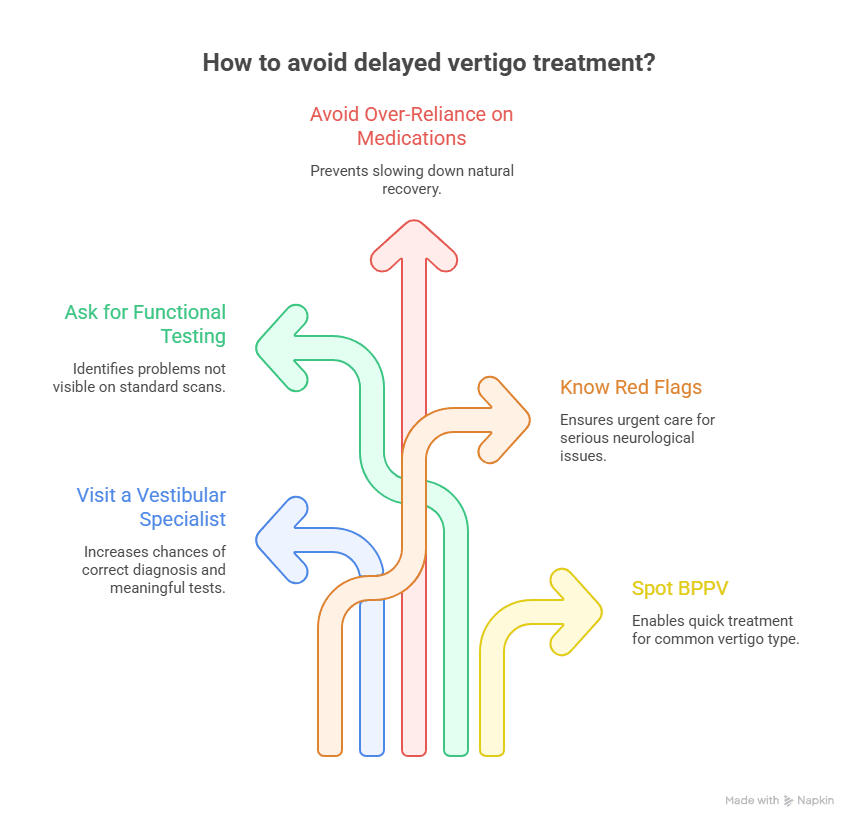
The key to avoiding misdiagnosis is early evaluation by professionals who specialize in balance disorders.
1. Visit a True Vestibular Specialist
Seeing a specialist, an expert in evaluating balance and dizziness increases the chances of a correct diagnosis. A vertigo specialist, vertigo doctor, or dizziness doctor can untangle complex symptoms and guide you toward meaningful tests rather than guesswork.
2. Ask for Functional Vestibular Testing
Standard scans are not enough. Your doctor should recommend tests that examine how your balance system actually works:
- Videonystagmography (VNG) checks eye movements to find inner ear versus brain imbalance.
- Caloric Testing compares vestibular responses from the two ears and can help identify one-sided vestibular weakness. at the eye response to sudden head turns.
- Dynamic Visual Acuity (DVA) assesses clear vision during motion.
These tests help identify problems that no MRI or CT scan can see.
3. Stop Relying Only on Dizziness Medications
Medications like Meclizine or Betahistine may help symptoms briefly, but they don’t treat the cause. Overuse can even slow your brain’s natural recovery.
4. Know the Red Flags
Get urgent care if dizziness comes with:
- Trouble speaking
- Double or blurred vision
- Weak limbs
- Inability to walk
These signs could point to serious neurological issues.
5. Learn to Spot BPPV
If your spinning sensations come right after you change your head position, like rolling over in bed, it’s likely Benign Paroxysmal Positional Vertigo (BPPV). Simple maneuvers can often fix this instantly, something only a vertigo specialist will recognize quickly.

Signs You Should See a Vertigo Specialist or Dizziness Doctor
Here are a few simple questions to ask yourself:
- Does your dizziness feel like spinning rather than just lightheadedness?
- Does it come with imbalance or nausea?
- Does it happen when you change your head position?
- Have regular scans not shown a cause?
If you said “yes” to any of these, you deserve a thorough evaluation by a vertigo specialist. Early diagnosis means faster recovery.
How Neuroequilibrium Can Help with vertigo
Vertigo and long-lasting dizziness can feel overwhelming, but they do not have to define your life. Most people struggle not because their condition is untreatable, but because the real cause has not yet been identified. Understanding common misdiagnoses and choosing the right specialist are the first steps toward regaining control.
At NeuroEquilibrium, we focus on three things that matter most. First, we perform detailed balance testing to uncover what is truly happening inside your body. Second, our experienced doctors carefully evaluate how your inner ear, nerves, and brain are working together. Third, we design personalized treatment plans that help your brain and body recover stability over time.
Together, these three pillars replace uncertainty with clarity, frustration with confidence, and repeated appointments with real progress.
If you are living with spinning sensations, unsteadiness, or ongoing dizziness, know that there is a path forward. With the right diagnosis and expert care, you can move out of the cycle of ineffective treatments and toward lasting relief. At NeuroEquilibrium, we are committed to helping you return to daily life with confidence, balance, and peace of mind.
Frequently Asked Questions
Who is the best specialist to see for vertigo?
An ENT (ear, nose, and throat) physician and Neurotologist, is the best specialist to visit when one has vertigo. They concentrate on causes of vertigo in the inner ear which is the most prevalent cause of vertigo. They can recommend you to a neurologist in case it is necessary.
Which type of doctor is best for vertigo?
A physician in the field of ENT is not only the best but the first one who is recommended in the case of vertigo. In case of any evidence of involvement of the brain or nerves a neurologist is consulted. A neurotologist, an ENT physician with specialized training in inner-ear and balance disorders, will also be consulted in complex or persistent cases. Vestibular rehabilitation specialists are also beneficial to some patients.
Is vertigo an ENT or neurologist issue?
Vertigo is an ENT problem that is most commonly associated with the inner ear. But in the event of the symptoms suggesting that there is a neurological cause, a neurologist will be called in. Both can collaborate in order to make a correct diagnosis.
Which specialist to go for vertigo?
Vertigo in the first place should be seen by an ENT specialist. In case of complex or more serious symptoms they can also recommend you to the neurologist or balance specialist. The initial ENT will provide more expedited and timely treatment.
What test is done to confirm vertigo?
The tests that are used to confirm vertigo include the Dix-Hallpike maneuver, balance tests, hearing tests, specialized vestibular tests such as subjective visual vertical (SVV), videonystagmography (VNG), and dynamic visual acuity (DVA). These can be used to determine whether the source is inner ear or neurological. A physician picks tests depending on your symptoms.