







At Neuroequilibrium, we’ve heard this exact moment described so many times. Many patients still remember their very first vertigo episode like it was yesterday. The sudden spinning, the heavy feeling in the head, the nausea that follows, and that instinctive reaction to grab a chair or a wall because it feels like you might fall. At that moment, you didn’t know the medical name for it. You didn’t have the words to explain what was happening inside your body. All you could say was something honest and simple: “Why do I feel this chakkar?” What most people don’t realise is that this experience is often a sign of ear balance issues, not just ordinary dizziness or tiredness. The inner ear constantly sends signals to the brain to help it understand movement, stability, and position. When those signals don’t match what your eyes or body are sensing, the brain gets confused, and that confusion shows up as spinning, imbalance, and discomfort.
We also know that recognising the cause brings the first sense of relief. If you or someone around you is feeling dizzy, unsteady, or disconnected from the surroundings, it could be the ear’s balance system asking for attention. The reassuring part is that you no longer have to face these symptoms without direction. At Neuroequilibrium, we focus on treating the root cause by helping the brain and ear rebuild coordination in a safe and carefully guided way. We take every step at a pace your body can handle, while making sure you understand what the therapy is doing and why it works. We’ve seen so many patients regain confidence in movement when the brain receives the right support. Balance improves, the fear slowly fades, and everyday activities start to feel possible again.
Know More About Ear Health
- What Does Constant Ringing in the Ears Mean?
- Why Some Vertigo Treatments Don’t Work the First Time
- Vertigo Symptoms: A Complete Guide for Patients
Ear Balance Issues What Does It Really Mean?
Inside our ear, there is a tiny system that works like a motion sensor. It is called the vestibular system, and its job is to tell the brain whether we are moving, turning, standing, or lying down. It tracks head position and movement so the body can adjust and stay balanced.
When this system gets disturbed by infection, crystals moving out of place, pressure changes, or nerve swelling the brain starts receiving wrong signals. This creates dizziness, spinning, or wobbliness. That means ear balance issues are not a disease themselves, but symptoms of something deeper going on.
Ear Balance Issues Symptoms
The signs can be different for different people, but most ear balance issues symptoms fall into a few main groups. Many of them matched my own experience:
1. Spinning Sensation (Vertigo)
This seems to be the room spinning or you are a spinning thing yet you are not moving. It may take a few seconds or a number of minutes and it is usually sudden.
2. Unsteady Body Balance
It is as though your feet are not in line with the earth, or that you were walking on a rocking boat. This is what makes all ear balance problems the most disturbing, since it turns even the simplest movements frightening.
3. Feeling Sick in the Stomach
Nausea, lightheadedness, or vomiting can happen when balance signals are confused.
4. Sounds or Pressure in the Ear
Some people hear ringing noises, feel heaviness, or experience a blocked sensation. Sometimes balance issues can come with hearing changes too.
5. Vision Disturbance While Moving
Turning your head quickly may blur your vision or make it hard to focus.
When you connect these all symptoms, you might realise this wasn’t just random dizziness; these were real ear balance issues and symptoms affecting daily life.
What Is an Ear Balance Problem?
An “ear balance problem” is a patient-friendly term for symptoms that may involve the vestibular system, the part of the inner ear that helps the brain understand head movement, position and orientation.
It does not automatically mean that there is “too much” or “too little” fluid in the ear. Different vestibular disorders involve different mechanisms. BPPV involves displaced inner-ear crystals, vestibular neuritis affects the balance nerve, Ménière’s disease is associated with abnormal inner-ear fluid regulation, while vestibular migraine and PPPD involve different patterns of sensory and neurological processing.
The hallmark pattern is vertigo, imbalance, motion sensitivity or blurred vision during head movement that cannot be better explained by faintness, blood-pressure changes, medicines or other neurological or medical conditions. Some inner-ear disorders also cause tinnitus, ear fullness or hearing changes.
Which Type of Ear Balance Problem Might Fit Your Symptoms?
| What happens? | Pattern that may fit | Key clue |
| The room spins when you turn in bed, lie back, bend or look upward | BPPV | Brief, repeatable attacks triggered by head position |
| Vertigo occurs with tinnitus, ear pressure or fluctuating hearing | Ménière’s disease or another hearing-related inner-ear disorder | Hearing symptoms occur with the balance symptoms |
| Sudden severe continuous vertigo after an illness, without new hearing loss | Vestibular neuritis may be possible | Continuous vertigo and imbalance rather than brief position-triggered attacks |
| Sudden prolonged vertigo with new hearing loss or tinnitus | Labyrinthitis or another acute hearing and vestibular disorder must be considered | New hearing loss requires prompt medical evaluation |
| Vertigo or motion sensitivity occurs with migraine features | Vestibular migraine | Migraine history, light or sound sensitivity, visual symptoms or nausea |
| Rocking or swaying persists and becomes worse in crowds, supermarkets or while scrolling | PPPD or visual-motion sensitivity | Persistent non-spinning dizziness worsened by upright posture, movement and complex visual environments |
| Vision becomes blurry when your head moves | Vestibular hypofunction may be possible | Difficulty keeping images stable during motion |
| You mainly feel faint when standing rather than spinning | A non-ear cause such as blood-pressure changes, dehydration or medication may be more likely | Lightheadedness rather than a sense of motion |
Duration and Trigger Clues
| Duration or trigger | Possible clinical direction |
| Seconds after rolling over, bending or looking upward | BPPV may be possible |
| 5 minutes to 72 hours with migraine features | Vestibular migraine may be considered |
| 20 minutes to 12 hours with fluctuating hearing, tinnitus or fullness | Ménière’s disease may be considered |
| Severe continuous vertigo lasting days without new hearing loss | Vestibular neuritis or a central cause needs consideration |
| Prolonged vertigo with new hearing symptoms | Labyrinthitis or another acute audiovestibular disorder may require assessment |
| Rocking or swaying on most days for at least 3 months, worse upright or in visual motion | PPPD may be possible |
| Lightheadedness mainly after standing | A blood-pressure or other non-vestibular cause may be more likely |
Most Common Causes of Ear Balance Issues
Doctors say many conditions can cause these symptoms, but a few appear more often:
BPPV
This is the most common reason for spinning dizziness. Tiny calcium crystals in the inner ear sometimes slip out of place and move into the wrong area. When that happens, they send false movement messages to the brain.
Ménière’s Disease
This is caused when fluid pressure increases inside the inner ear. People may feel dizzy along with ringing sounds or changes in hearing.
Vestibular Neuritis and Labyrinthitis
These are infections that inflame the balance nerve. Labyrinthitis is more serious because it can also affect hearing and may lead to permanent hearing loss if not treated urgently.
Vestibular Migraine
In this type of migraine, dizziness is the main symptom. Some people may not even get the usual headache.
PPPD
This condition causes long-lasting rocking or swaying dizziness, especially in visually crowded or busy environments.
Understanding the cause is the most important part, because different problems need different treatments.
| Condition | What causes it | Most common symptoms | Key notes |
| BPPV | Small calcium crystals shift into the wrong part of the inner ear and send incorrect movement signals to the brain | Sudden spinning, imbalance, nausea, dizziness when turning the head or getting up | One of the most common causes of vertigo, highly treatable with guided manoeuvres |
| Ménière’s Disease | Increase in fluid pressure inside the inner ear | Dizziness, ringing in the ear, hearing changes, pressure sensation in the ear | Episodes may come and go and can affect hearing over time |
| Vestibular Neuritis | Viral or bacterial infection inflames the balance nerve | Spinning dizziness, nausea, imbalance, difficulty focusing | Hearing is usually not affected |
| Labyrinthitis | Infection inflames both the balance system and hearing part of the inner ear | Severe dizziness, nausea, hearing loss, ringing, imbalance | Needs urgent care because hearing loss can become permanent |
| Vestibular Migraine | A migraine condition where dizziness is triggered by the brain’s balance response | Dizziness, motion sensitivity, nausea, visual discomfort, sometimes without headache | Dizziness may happen even when there is no head pain |
| PPPD | Long term imbalance caused by the brain struggling to process balance signals, especially in busy visual environments | Rocking or swaying dizziness, unsteadiness, worse in crowds, markets, malls, or scrolling screens | Symptoms last longer than typical vertigo attacks and increase in visually stimulating places |
Ear Balance Problem vs Other Causes of Dizziness
| Feature | Vestibular/inner-ear pattern | Possible non-ear pattern |
| True spinning | Common in BPPV and several vestibular disorders | Less typical of simple dehydration or low BP |
| Head position triggers symptoms | Strong clue for BPPV when episodes are brief and reproducible | May also occur with neurological or cervical disorders |
| Hearing loss/tinnitus/fullness | Supports an ear-related investigation | Not usually explained by blood pressure or dehydration |
| Vision blurs during head motion | May indicate impaired vestibulo-ocular reflex | Eye disease can also affect vision |
| Faintness after standing | Not the classic ear-balance pattern | Orthostatic hypotension, dehydration or medicine effects |
| Weakness or speech difficulty | Not typical of an uncomplicated peripheral vestibular disorder | Urgent neurological evaluation required |
| Persistent rocking in visual environments | PPPD, migraine or incomplete compensation may be possible | Anxiety and visual disorders may coexist |
Diagnosis The First Step You Needed Before Treatment
Because so many conditions can look alike, doctors use specialized balance tests to find the real source. These tests check how the eyes, head movements, and ear nerves respond when the body moves.
In contrast to regular health checkups, these tests are balance disorder-specific tests. This assists the doctors in knowing whether the problem is either in the inner ear, in the brain, or in the balance nerve.
Effective Treatment Options That Actually Work
Once the cause is found, the treatment focuses on fixing the problem, not just hiding symptoms.
1. Crystal Repositioning Movements
For BPPV, experts use guided head movements to push the loose crystals back to their normal place. Many people feel relief right after the session.
2. Balance Retraining Therapy
Vestibular rehabilitation uses brain-based exercises to help the body adjust and relearn balance. The brain has a natural ability to adapt, and therapy makes use of that.
3. Real-World Simulation Therapy
There are clinics where digital spaces are used to replicate real-life scenarios such as taking a stroll in a market, a street, or a quick turn to make the brain adapt to the digital space in a more controlled manner. This will be an effective and appealing approach to therapy.
4. Mental and Stress Support
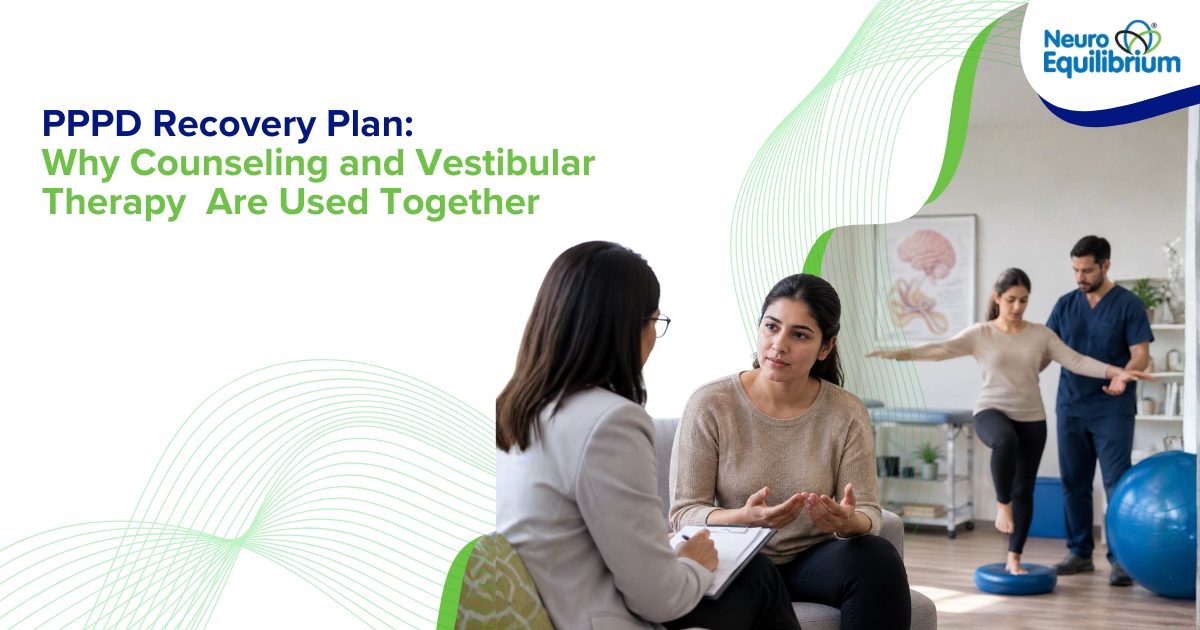
In cases of persistent dizziness in relation to anxiety or motion sensitivity, the counseling treatment methods can be used to relax the nervous system and prevent the fear-dizziness complex.
5. Diet and Lifestyle Guidance
Problems with fluid pressure can be improved by reducing salt, dizziness caused by migraine by reducing caffeine or alcohol, drinking adequate amounts of fluid, and avoiding triggers with time.
6. Short-Term Medical Support
Certain conditions may need nerve inflammation medicines or fluid-control medicines. But dizziness-suppressing pills should not be used for more than a few days, because they can slow down the brain’s ability to recover.
This shows that real recovery comes from long-term solutions, not temporary symptom blockers.
| Treatment Option | How it works | Who it helps most | Key benefit |
| Crystal Repositioning Movements | Guided head and body movements are used to move the misplaced crystals in the inner ear back to their correct position | BPPV patients | Many patients feel relief immediately after the session |
| Balance Retraining Therapy | Special vestibular exercises help the brain relearn how to coordinate balance signals from the ear, eyes and body | Vestibular disorders like neuritis, labyrinthitis, PPPD | Uses the brain’s natural ability to adapt and improve balance over time |
| Real-World Simulation Therapy | Digital environments simulate real movement experiences like markets, streets or directional turns while the patient stays physically supported | Patients who feel overwhelmed or bored with traditional exercises | Makes therapy more engaging and allows balance training in a safe, controlled setting |
| Mental and Stress Support | Counselling techniques help calm the nervous system and break the cycle where fear increases dizziness | Patients with persistent dizziness linked to anxiety or motion sensitivity | Reduces stress and prevents the fear-dizziness loop from getting stronger |
| Diet and Lifestyle Guidance | Adjustments like reducing salt, limiting caffeine or alcohol, drinking enough water and avoiding personal triggers | Ménière’s disease, migraines, fluid pressure or trigger-based dizziness | Helps reduce attacks and improves the inner ear and brain balance system |
| Short-Term Medical Support | Medicines are used briefly to reduce nerve inflammation or control inner ear fluid pressure when needed | Nerve inflammation or fluid pressure related conditions | Provides support without slowing down the brain’s recovery |
| Limited Symptom Control Medicines | Dizziness-suppressing tablets are used only for a few days when symptoms are extreme | Severe early-stage vertigo episodes | Prevents long-term dependency so the brain can recover faster |

Why Choose Neuroequilibrium for Ear Balance Issues
At Neuroequilibrium, we understand that patients want more than basic explanations. When people start looking for treatment, they’re often tired of feeling unheard, unsure of what will trigger the next episode, and frustrated with solutions that only mask symptoms for a short time. What most patients really need is a place that deeply understands how the ear and brain work together for balance, a clinic that tests carefully, explains clearly, and treats the root cause using modern, proven approaches.
A specialised balance clinic like ours offers real advantages. We focus on accurate diagnosis rather than trial-and-error medication. We use advanced technology to analyse balance signals in detail, and we create personalised therapy plans that match each patient’s condition, symptoms, and comfort level. Our treatments are built to target the real cause, guide the brain through safe balance retraining, and include modern therapy formats that simulate real-life movement challenges while keeping the patient physically supported. Everything we do is designed to help the brain adapt and recover without slowing it down, which is what leads to long-term improvement. When patients finally receive structured care that makes sense, they tell us it gives them confidence, a sense of safety, and results that actually last.
What Can Help You The Most During Recovery
We’ve seen that the toughest part of ear balance disorders is not only the dizziness itself, but the fear of unpredictability. For so long, every quick head movement might have felt risky, travelling might have felt stressful, and standing in queues or crowded places might have felt overwhelming. The emotional weight of not knowing what was happening often made the symptoms feel even bigger.
But at Neuroequilibrium, we also see the shift that happens when the right care begins. Once the cause is clearly identified and therapy starts, patients tell us that everyday movement slowly feels normal again. The spinning reduces, walking becomes steadier, screen motion feels less disturbing, and the brain adapts more confidently. Most importantly, the fear begins to fade because the recovery path finally feels clear, logical, and supported. Balance disorders don’t heal overnight, but they do improve when the brain is guided the right way, and that is exactly what we aim to do with every patient who walks through our doors.
Conclusion
When you or those close to you are experiencing ear balance problems, then you will know that you are not the only one. These symptoms are nonspecific, they can be treated and they are not something that you have to live with. It all lies in the ability to notice the symptoms of ear balance problems at a young age, comprehend the cause, and select the treatment that is aimed at the actual recovery, but not temporary relief.
Competency balance care is a big difference in assisting the patient to resume their usual routine with re liability and assurance.
Neuroequilibrium is unique in this field as it guarantees recovery of balance in the long-term by performing proper testing and innovative rehabilitation strategies.
Frequently Asked Questions
What are the common symptoms of ear imbalance or vertigo?
Ear imbalance is frequently the cause of a spinning feeling (vertigo), dizziness, lack of stability and walking difficulties. Nausea, vomiting, fullness of ears, ringing in ears (tinnitus), changes in hearing, and abnormal eye movements are experienced by many people and may severely interfere with the day to day functions.
Why does an inner ear problem cause dizziness and balance issues?
The inner ear is important in the maintenance of balance and space orientation. In case it is compromised by other conditions such as BPPV, Meniere’s disease, or inner ear ear infections, the mistaken signals of balance are transmitted to the brain thereby causing vertigo, swaying, tilting sensations, and loss of stability.
Is dizziness the same as vertigo?
No. Dizziness is a feeling of an overall sense of lightheadedness or wooziness whereas vertigo is a more specific type of feeling where you sense like you are spinning, tilting, or moving. Inner ear balance disorders are more generally associated with vertigo.
Can ear imbalance also affect hearing and vision?
Yes. Ear imbalance may result in hearing related symptoms including tinnitus (ringing), muffled hearing or hearing loss. It may also cause eye issues such as nystagmus (uncontrolled movements of the eye) or inability to focus since balance and eye movements are interrelated.
When should I see a doctor for ear imbalance symptoms?
See the doctor in case the symptoms are sudden, severe, frequent or getting worse, or when they are accompanied by headaches, pain in the neck, vision loss, difficulty in speaking, or weakness. The timely medical examination will assist in determining the precise reason and proper medication.