



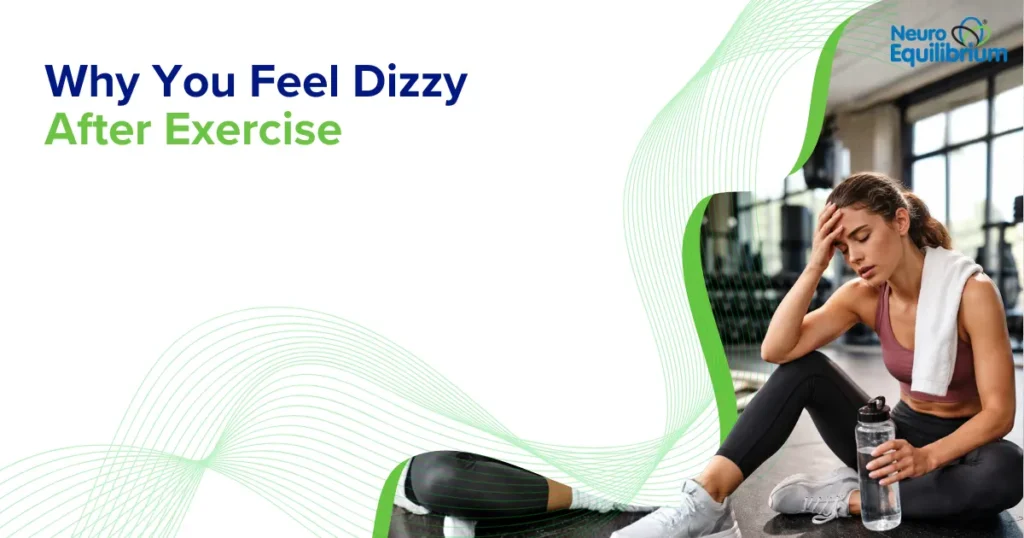
You have just had a wonderful exercise. You get up on your feet, you give a deep breath, and all of a sudden, you feel the room spinning. Your knees are turn-tally weak, and you hold on to the closest wall. Sound familiar?
The feeling of dizziness after the workout is more widespread than you think, and it cannot be ignored or pushed aside. The first step in discovering effective cures for dizziness lies in understanding why it occurs.
What Really Occurs in Your Body When You Feel Dizzy after the Workout
Your muscles require more blood, and your entire system gets into high gear when you exercise, with your heart pumping faster. You feel it the minute you cease, more so when you abruptly cease, your blood is all still stagnant in your legs and limbs of labour. Your brain is temporarily deprived of blood supply, which is what causes the room to tilt.
It is not a slight inconvenience. It refers to the balance system of your body, including the inner ear, your eyes, and your muscles, which is temporarily overburdened. You can imagine it as three individuals struggling to support a table. As soon as one now sat down, the entire thing wobbled.
The good news? With the knowledge of the cause, the cures of dizziness are much clearer.
Know More About
- Vertigo vs Dizziness: Understanding the Key Differences
- 7 Effective Yoga Poses for Vertigo Relief
- Vertigo Exercise Chart: A Simple Guide for Patients
How Oddities in Head Positioning in the Course of Exercise May Prompt a Feeling of Spinning
This is one of the reasons many people disregard it. Yoga, Pilates, sit-ups, or any exercise that makes your head assume an odd shape, e.g., looking up, bending forward or lying down and getting up on your knees in a hurry, may physically dislodge small calcium crystals in your inner ear.
These are the ones that usually sit in one section of your inner ear, and they help your brain perceive gravity. When they are knocked loose and drift into the fluid-filled canals of the inner ear (the so-called semicircular canals), however, your brain is given false signals of movement. The consequence is BPPV, Benign Paroxysmal Positional Vertigo: short but severe spinning pains caused by movement of the head.
BPPV is, in fact, among the most frequent causes of vertigo in the world, and it is not only a surprisingly easy place to provoke it in the gym. The treatments of dizziness due to BPPV are highly particular and are pleasing with the appropriate guided head movement practises (also known as repositioning maneuvers). The majority of individuals experience relief in a short period.
What Makes Dizziness So Bad after a Workout
And herein lies the fact which most people are not aware of: to be dehydrated enough to feel dizzy, you do not necessarily have to be visibly thirsty. Sweat off 1-2 percent of body weight and you will feel light-headed enough to decrease the amount of blood in your body and force your brain to demand more blood than is circulating.
The fact that your body is low in fluids also means it is low in electrolyte minerals such as sodium and potassium, which help maintain healthy blood pressure. This will not be solved completely by plain water. A low-sodium electrolyte beverage is used after strenuous exercise to help your body retain fluids and to offset the pressure changes that can make a person feel lightheaded.
One of the simplest and most effective remedies for post-exercise dizziness is to keep hydrated, but this can only be effective when it is maintained before the exercise fails and the damage is already done.
How the Treadmills and Cross-Trainers Cause Harm to Your Balance System
Not every piece of exercise equipment is similar in regard to dizziness. The treadmills, ellipticals, and cross-trainers, as well as other machines, cause your brain a very particular conflict in sensations. As your legs are moving as though you are travelling forward, what you are looking at is a stationary gym, a wall, a screen, or a mirror.
Two messages are sent to your brain at the same time, the first one saying we are moving and the second one saying we are standing still. This disorientation overwhelms your balance mechanism, particularly when you already have some inner ear sensitivity. Immediately you leave the treadmill, your brain is still telling you that you are moving so that is why you experience that weird wobbling or floating feeling.
The outdoor environment is much more secure and easier to start with when walking on flat ground, in conditions that can cause dizziness in the exercise participant. One of the less well-known remedies of dizziness caused by sensory mismatch, and the gradual reintroduction of machines as your balance system adapts to it, is one of the less emphasized ones.
The Relationship Between Lightheadedness and a Sudden Blood Pressure Drop After Exercise
Leaping off a ground activity, rushing off yoga, or suddenly stopping a workout without cooling down after a cardio activity can cause a state known as orthostatic hypotension. Your blood pressure plummets (as much as 20mm Hg), and your brain does not receive sufficient blood for a few seconds.
- The outcome is fast: lightheadedness, myopia, a sense of weakness, and the possibility of falling. It may seem to be very frightening, yet in the vast majority of instances, it is a
- Mechanical issue: your circulation has not yet adjusted to the change in position.
A decent post-exercise cool-down walk of at least 3-5 minutes keeps your muscle pumps in your legs going, and the blood flows back to your heart and brain. This is one of the most effective and least utilized cures of dizziness in the gym.
The Distinction Between Vertigo and Lightheadedness After Exercise
Not every case of dizziness can be described in the same way, and it is essential to understand what differs.
Lightheadedness refers to the sensation of a head rush, as though you are going to pass out, your vision is a bit grey, and you feel unsteady. It is typically associated with decreasing blood pressure, dehydration, or decreased blood sugar.
True vertigo is a spinning feeling; it feels like the room is spinning, although you are not moving at all. This seems to point more towards an internal ear issue, such as BPPV.
If what you are feeling during or after exercise is a spinning sensation, not a head rush, then that is a different form of vertigo that must be addressed differently. It will not be explained by a blood pressure reading. Who knows, you need a proper balance test in order to determine the cause and correct causes of dizziness in your case.
Practical Cures of Dizziness After Exercise You Can Begin to Use Today
Some things which are really of assistance to the majority of people before you make any reservation are these:
- Hydrate in advance. Water should be consumed throughout the day, not only before going to the gym. At least 2-2.5 litres on workout days.
- Eat before you exercise. A decrease in blood sugar levels, combined with a decrease in blood pressure, is a twofold blow. Eat a light meal containing complex carbohydrates and protein about an hour before exercising.
- Always cool down. Do not exercise in the middle. Take a slow 3-5 minute stroll, allowing your circulation to return to normal before you sit or lie down.
- Stand up slowly. You are either getting out of a mat, a bench, or the floor. Sit up first, wait a few seconds, then stand. This simple practice prevents most blood pressure-related lightheadedness.
- Breathe properly. Breathing in during heavy lifts leads to a shortage of oxygen in the brain. On the effort, breathe out; on the refreshment, breathe in.
- Keep off treadmills and ellipticals when you are delicate. Until your balance system has been checked, walk outside or on a stable surface.
These are free and convenient remedies for dizziness that require only knowledge and practice.
When Post-Workout Dizziness Is a Red Flag You Can No Longer Ignore
Lightheadedness and ad hoc post-overexertion are normal. However, some symptoms indicate that you should seek medical care for your vertigo issue:
- You experience dizziness each time you exercise, even at low intensity.
- You feel a spinning effect (not a lightheadedness)
- With the dizziness, you experience chest pain, palpitations, or shortness of breath.
- You have almost lost consciousness during or after a workout.
- The dizziness occurs at rest as well as during exercise.
- Weeks or months later, your symptoms are increasingly getting worse.
- You experience a lack of consistency between workouts.
These are not symptoms to look up and treat on your own. They need an expert who knows the balance system inside and out, not a check-up.

Why Choose NeuroEquilibrium to Treat Your Vertigo
When your post-exercise dizziness keeps recurring, or when you have been fussing over it for weeks or months and have not made any progress, it is time to seek actual solutions, not speculation.
NeuroEquilibrium is a specialty clinic in India specializing in vertigo and balance disorders. This is not a typical clinic visit where a basic examination is provided. More sophisticated equipment, such as Videonystagmography (VNG), Computerized Posturography, and Video Head Impulse Testing (vHIT), assesses how your inner ear, eyes, and brain communicate as you move. These examinations are used to determine exactly what is causing your vertigo problem: BPPV following exercise, a problem in blood pressure control, the involvement of the nerves of the vestibular apparatus, or another factor altogether.
By determining the cause, treatment of dizziness takes a focused and efficient approach, such as vestibular rehabilitation exercises, individual instructions on safely resuming physical activity, and medical treatment where necessary.
You do not need to keep avoiding the gym and make your workouts around your dizziness. A definite diagnosis is a different thing.
Closing Statement: You must not spin around on your Workout
Your body wants to draw your attention to dizziness after exercise. And it can be as basic as not taking in enough water. Sometimes it is a more serious vertigo issue with your inner ear that needs to be assessed and treated.
The appropriate remedies for dizziness are based solely on the correct diagnosis. And the correct diagnosis is made by the specialists who examine your balance system as a whole, not as a fragment of it.
What gets rid of dizziness fast?
To relieve dizziness as soon as possible, sit or lie down in a safe environment and do not move your head as it will only exacerbate the symptoms. If lightheadedness is caused by dehydration, drinking water might help, and slow, deep breathing can alleviate that. It is not recommended to move suddenly and to work with bright lights until the feeling is gone. In the case of inner-ear problems causing dizziness, certain maneuvers or drugs can produce quicker relief.
What are the top 3 causes of dizziness?
The inner ear issues like Benign Paroxysmal Positional Vertigo, low blood pressure, or dehydration, and a neurological disorder like Vestibular Migraine are the three most prevalent causes of dizziness. It may be caused by other reasons such as infections, anxiety, or drug side effects.
What drink stops dizziness?
The best beverage to use in cases of dizziness is water, more so when one is dehydrated. Electrolyte beverages or oral rehydration solutions may also be used to replace fluids. Some people can have nausea and dizziness reduced with ginger tea. Avoiding alcohol and heavy caffeine is the best idea because they can aggravate symptoms.
What is the red flag for dizziness?
The signs and symptoms of dizziness that can be considered red flags are severe headache, chest pain, inability to speak, feeling weak on one side of the body, confusion, or walking problems. They might signify severe disorders such as Stroke and have to be attended to. Constant dizziness, fainting or post-traumatic dizziness should also be considered an emergency.
How to snap out of dizziness?
To come out of being dizzy fast, sit or lie down, stare at something that is not moving, and breathe slowly but steadily. A light snack or drinking water will do the trick in case of dehydration or low blood sugar. You can not stand up fast and after feeling better stand up slowly so that you do not experience the dizziness again.