


VRT is beneficial for patients with a wide range of vestibular (inner ear) and balance disorders:
Before starting therapy, each patient undergoes a detailed vestibular evaluation at NeuroEquilibrium. The goal is to pinpoint the exact cause and design a customized rehabilitation plan.
Advanced Imaging (if needed): MRI or CT scans rule out central (brain-related) causes such as stroke or tumors when symptoms indicate neurological involvement.
Each VRT plan is personalized according to the diagnosis, patient’s physical condition, and recovery goals. Exercises are designed to stimulate vestibular compensation—the brain’s ability to adapt and restore balance.
Exercise Type | Purpose | Examples |
Gaze Stabilization | Improves coordination between eye and head movements. | Focus on a fixed point while turning the head side to side or up and down. |
Habituation Exercises | Reduces motion sensitivity by repetitive exposure to dizzying movements. | Repeated head turns, rolling, or sitting-to-lying transitions. |
Balance Training | Builds stability in different positions and conditions. | Standing on foam pads, walking on uneven ground, or balancing with eyes closed. |
Dynamic Functional Exercises | Enhances real-world balance and postural control. | Walking while turning the head, navigating obstacles, or controlled quick turns. |
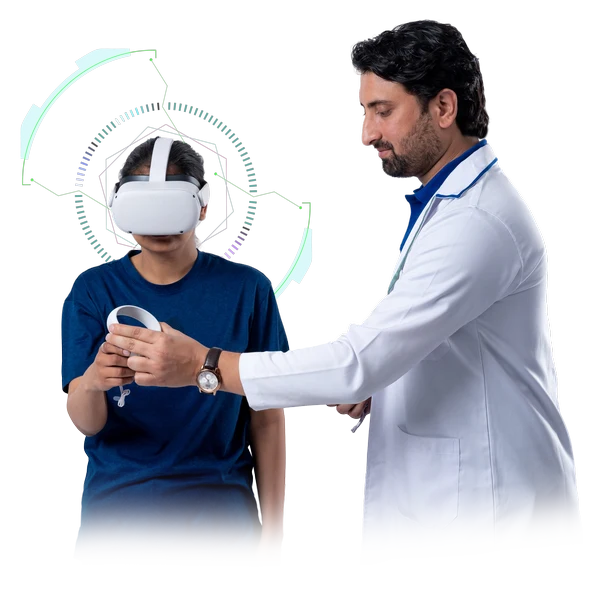
Technology-Enhanced Therapy | Makes rehab engaging and trackable with digital tools. | Virtual Reality (VR) balance games, virtual beam walking, and app-based modules. |
With consistent participation, VRT delivers remarkable outcomes:
VRT is generally safe and well-tolerated, but professional supervision is crucial.
Therapy may be delayed or modified in the following cases:
NeuroEquilibrium offers India’s most advanced Vestibular Rehabilitation Therapy programs powered by digital tracking, virtual reality, and clinician-guided protocols.
Our nationwide network of clinics provides access to expert neurotologists and ENT specialists who personalize every session for faster, lasting recovery.
Book an appointment today at your nearest NeuroEquilibrium Clinic to begin your journey toward balance and confidence.




Vestibular Rehabilitation Therapy (VRT) is a customized exercise-based program that helps people who experience dizziness, vertigo, or balance problems caused by inner ear disorders. It works by retraining the brain to interpret signals from the vestibular system correctly, improving stability, gaze control, and coordination. At NeuroEquilibrium, VRT programs are designed after detailed vestibular testing and use advanced tools such as Virtual Reality–based balance training to accelerate recovery and improve long-term outcomes.
Calming the vestibular nerve involves a combination of rest, controlled movement, and targeted therapy. During the acute phase of vestibular neuritis or nerve inflammation, short-term medications may help manage nausea and vertigo. However, once the acute symptoms subside, Vestibular Rehabilitation Therapy (VRT) becomes the most effective long-term solution. VRT teaches the brain to adapt to any loss of vestibular function through specific gaze and balance exercises. At NeuroEquilibrium, specialists guide patients through safe, progressive movements that help the vestibular system regain stability and reduce dizziness naturally.
Exercises in vestibular rehabilitation are designed to retrain balance, improve eye stability, and reduce motion sensitivity. Common types include:
Dynamic Functional Exercises: Walking while turning the head or changing direction quickly to simulate real-world movements.
At NeuroEquilibrium, advanced programs may include Virtual Reality (VR)-based balance modules, making therapy more immersive and effective.
Medications may be used for short-term symptom control during severe vertigo attacks but are not a long-term solution. Drugs such as betahistine, prochlorperazine, or meclizine may help reduce nausea or spinning sensations during the acute phase. However, prolonged use can delay the brain’s natural adaptation process. For lasting improvement, specialists at NeuroEquilibrium focus on addressing the root cause through diagnostic evaluation and Vestibular Rehabilitation Therapy (VRT), which restores balance without relying on medication.
Corporate Office:
140, Shrigopal Nagar, Gopalpura Bypass Road, Jaipur 302018, Rajasthan, India
Manufacturing Site:
1st Floor, Plot No.3, Pooja Tower, Muktanand Nagar, Gopal pura Mode, Jaipur, Rajasthan 302018
All rights reserved © 2026 NeuroEquilibrium Diagnostic Systems Pvt Ltd.
Vertigo Clinic in Ujjain | Vertigo Clinic in Barwani | Vertigo Clinic in Patna | Vertigo Clinic in Miraj | Vertigo Clinic in Kolhapur | Vertigo Clinic in Nashik | Vertigo Clinic in Jaysingpur | Vertigo Clinic in Amravati | Vertigo Clinic in Solapur | Vertigo Clinic in Pune | Vertigo Clinic in Aurangabad | Vertigo Clinic in Nagpur | Vertigo Clinic in Sagar | Vertigo Clinic in Indore | Vertigo Clinic in Jabalpur | Vertigo Clinic in Bhopal | Vertigo Clinic in Bilaspur | Vertigo Clinic in Ahmedabad | Vertigo Clinic in Vadodara | Vertigo Clinic in Surat | Vertigo Clinic in Navi Mumbai | Vertigo Clinic in Thane | Vertigo Clinic in Mumbai | Vertigo Clinic in Palghar | Vertigo Clinic in Jaipur | Vertigo Clinic in Sriganganagar | Vertigo Clinic in Alwar | Vertigo Clinic in Kota | Vertigo Clinic in Udaipur | Vertigo Clinic in Lucknow | Vertigo Clinic in Prayagraj | Vertigo Clinic in Varanasi | Vertigo Clinic in Gurgaon | Vertigo Clinic in Dehradun | Vertigo Clinic in Rohtak | Vertigo Clinic in Amritsar | Vertigo Clinic in Ludhiana | Vertigo Clinic in Greater Noida | Vertigo Clinic in Delhi | Vertigo Clinic in Kannur | Vertigo Clinic in Trichur | Vertigo Clinic in Cochin | Vertigo Clinic in Coimbatore | Vertigo Clinic in Tiruppur | Vertigo Clinic in Chennai | Vertigo Clinic in Hosur | Vertigo Clinic in Bangalore | Vertigo Clinic in Mangalore | Vertigo Clinic in Hyderabad | Vertigo Clinic in Sangli