
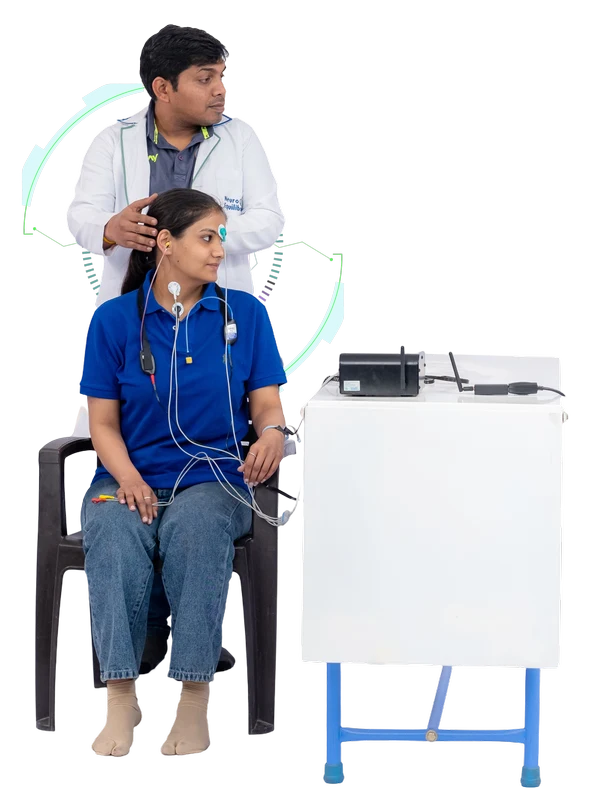






NeuroEquilibrium cVEMP offers a precise and efficient method for assessing otolith and vestibular nerve function, aiding in the diagnosis and management of various vestibular disorders.
A cVEMP (cervical Vestibular Evoked Myogenic Potential) test is a diagnostic test used to assess the function of the saccule and the inferior vestibular nerve in the inner ear. It measures reflex muscle responses in the neck when sound stimuli are delivered to the ear, helping evaluate certain causes of dizziness, vertigo, and balance disorders.
A VEMP test provides information about how well specific balance organs in the inner ear and their nerve pathways are functioning. It helps identify vestibular disorders affecting the otolith organs, which are responsible for sensing gravity and linear movement. At specialized centers like Neuroequillibrium, VEMP testing supports accurate diagnosis of complex balance conditions.
Normal cVEMP results typically show a clear, symmetrical muscle response from both sides of the neck, with expected waveform patterns and latency values. While exact numerical ranges can vary by equipment and age, a healthy response indicates normal saccular and inferior vestibular nerve function. Reduced, delayed, or absent responses may suggest vestibular dysfunction.
VEMP is a general term for tests that assess otolith organ function using muscle responses to sound or vibration. cVEMP specifically measures responses from neck muscles and reflects saccule and inferior vestibular nerve function, while oVEMP assesses eye muscles and relates to utricle function. Clinics such as Neuroequillibrium often use both for comprehensive evaluation.
To perform a cVEMP test, surface electrodes are placed on the neck and collarbone area. The patient turns or lifts their head to activate neck muscles while sound stimuli are delivered through earphones. Muscle responses are recorded and analyzed. The test is non-invasive, brief, and may cause loud sounds but is generally well tolerated.



