



Losing your sense of balance can make even simple movements feel unpredictable. For many people, this shows up as a spinning sensation in the room or a feeling of instability while walking. This experience is commonly known as vertigo. It typically happens when the body’s balance system is disrupted, sending unclear signals to the brain and impacting coordination, stability, and confidence in movement.
Specific exercises and physiotherapy programs may assist in regaining communication between the brain and the body, and regain control, aid in steadier walking, and confidence will be restored in the long run. Most of these are practices that can be initiated at home with safe measures and that way, one can make small and consistent steps towards daily improvement.
It is also important to note that when dizziness appears in a severe, sudden, or acute form, professional medical guidance should always come first. Understanding the underlying cause allows for the right treatment and proper support.
Know More About Vertigo Related Exercises
- Vertigo Exercise Chart: A Simple Guide for Patients
- What Is Ear Balance Treatment and When Do You Need It?
- Neck Pain Causes That Can Lead to Dizziness – Should You Be Worried?
Understanding Why You Might Feel Unsteady
Your body needs to be in balance through three systems that must work together:
- Your inner ear controls your balance and tells your brain where you are in space.
- How your eyes communicate to your brain what you are viewing and hold things into focus.
- Your body and muscles ensure that you can stand, walk, and move.
The latter may be unbalanced or unsteady when the balance loop is not operating effectively. Physiotherapy and balance exercises are your savior and that is how your brain will learn again to make you stand on your feet.
Physiotherapy Balance Exercises
1. Gaze Stabilisation Exercises – See Clear and Steady
These exercises train your eyes and balance system to work together so that your vision remains completely steady even as your head moves.
How to Practice:
- Find a specific spot on the wall and stare at it.
- Slowly rotate your head side-to-side (right and left) and then up and down.
- Throughout the movement, keep your focus fixed on that single point.
The Benefit:
This practice helps your brain adapt to coordinating eye movements with balance signals, which reduces feelings of blurriness and dizziness.
2. Habituation Exercises – Reduce Motion Sensitivity
In case you feel dizzy when you move your head very fast or in a certain position, these exercises would help make your brain more used to such feelings.
Sample Exercises:
- Positional Changes: Move from sitting up to standing on your knees, then back to sitting, and finally lying down.
- Head Turns: Slowly turn your head from left to right.
- Opposing Head and Eye Movement: Follow a moving object with your eyes while simultaneously turning your head in the opposite direction.
Important Note: These exercises might feel uncomfortable at first, but with persistence, they will gradually reduce your brain’s sensitivity to the movements that cause dizziness.
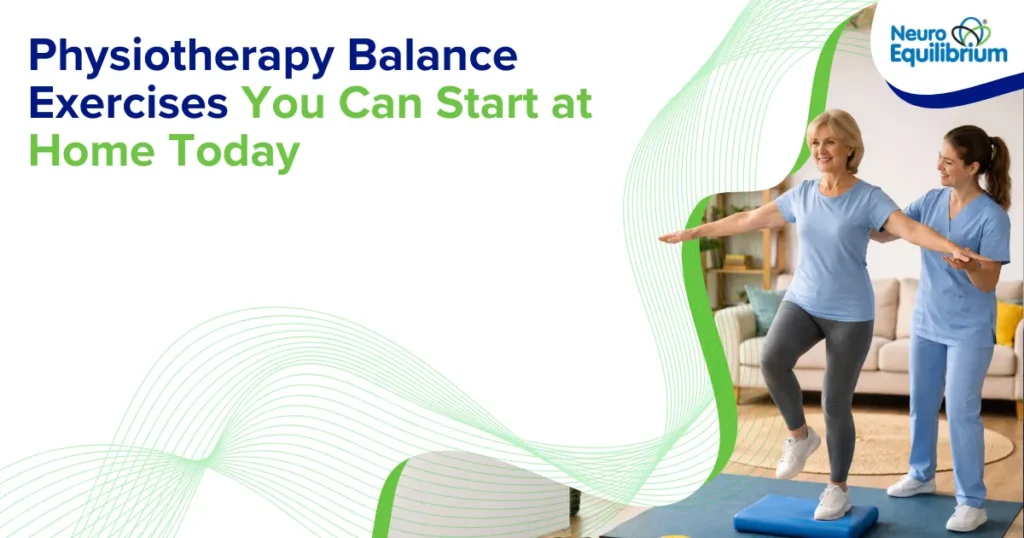
3. Static and Dynamic Balance Training – Strengthen Your Steadiness
These movements help your brain, legs, and feet to work together to keep your body in a sitting position.
Fun and Simple Drills:
- On one side: Sit on a chair in case of need.
- Heel-To-Toe Walk: Step forward with one foot, then with the other.
- Other Surfaces: Lie your body on a cushion or a pillow that has a soft surface, and it will be more difficult to hold!
- Add Head Turns: Walk with Turning right and left slowly.
By such exercises, you will find it much easier to feel in control and not fall over or get tilted.
4. Coordination Training – Like Juggling for Balance
Ever tried juggling? It sounds difficult, and it is a great way to boost your coordination.
Getting Started:
- Begin with two soft balls.
- Try tossing them back and forth slowly. Your eyes and brain will work better over time.
Why It Works:
Juggling challenges your balance system by combining vision, movement, and coordination all in one fun activity!
5. Complementary Movement Practices – Yoga & Tai Chi
Balance is not only achieved through certain physiotherapy exercises, but gradual conscious exercises such as yoga or Tai Chi make your body stronger and more coordinated.
These are soft exercises that are based on posture and gentle movement, which will enable your balance system to be more dependable and coordinated.
Safety First: Know When to Stop
While most of these exercises are safe, stop immediately and seek medical help if you experience:
- Severe headache
- Blurred vision or double vision
- Weakness on one side
- Trouble speaking
- Dizziness
These could be signs of something more serious. It’s always good to listen to your body and ask a professional when needed.
Why Doing Balance Physiotherapy at Home Helps
Balancing exercises are not just for the clinic. Doing them regularly at home can:
- Boost confidence while walking
- Reduce dizziness with movement
- Strengthen your balance system over time
- Improve overall coordination
- fear of falling
But they work best when tailored to what’s causing your balance problem. A trained balance therapist or vestibular specialist can help design the right plan for you, based on your symptoms and test results.
What to Do When Physiotherapy Doesn’t Work
When you have been performing some physiotherapy balance exercises regularly, and you still feel dizzy, unsteady, or your symptoms have not improved, it does not necessarily mean that you have failed, but it may be just that your balance issue requires a more specialised or medical intervention. In some cases, underlying factors such as inner ear diseases, neurological causes or certain forms of vertigo (such as BPPV) may be in need of specialised management that cannot be adequately dealt with by physiotherapy.
One should reconsider one’s symptoms with a specialist in such cases. Clinics like NeuroEquilibrium can do a thorough examination, prescribe sophisticated treatments or exercises and design a personalized plan that suits you perfectly.
Why Choose Support from a Specialist Network like NeuroEquilibrium
If you’ve tried home exercises and still feel unsteady, there’s a reason to explore further support. Our advanced centres provide:
- Effective testing of balance systems using computerised instruments.
- Cases Individualised rehabilitation programs, based on what exactly is triggering your symptoms.
- It includes continual evaluation and mentoring.
We offer our services with the goal of ensuring that your balance system recovers in an improved manner, using evidence-based therapy and the latest technology available through the aid of individualized treatment.

Conclusion
It can be frightening and frustrating being compelled to live with an existing or a new imbalance, and you are not alone. It is possible to begin with some basic exercises related to balance at home that way stability and fitness may be trained. Once you are prepared or you require a more specific type of care, a reliable clinic, like Neuroequilibrium, may potentially help you with the knowledge and equipment to obtain an improved level of treatment.
What is the cause of positional vertigo?
Positional vertigo results most frequently due to the displaced calcium crystal in the inner ear canals that interferes with normal balance signals in the brain. This is what is referred to as BPPV and it causes brief but severe spinning sensations whenever the head alters its position such as rolling over in bed or putting the head on its back. There is the possibility that age, head injuries, and inner ear inflammation can contribute to the risk of crystal displacement.
What is the best treatment for positional vertigo?
The best of them is a maneuver of canalith repositioning that is a series of well-timed head movements that are required to push the crystals displaced back into their original location inside the ear. When properly done by trained clinicians, these maneuvers are safe and very effective and can be a fast fix. The application of the evidence-based repositioning approach and the use of the vestibular assessment can be utilized in the effort to tailor the treatment properly with the special balance care providers.
What medication is used for BPPV?
There is no medication that cures BPPV. Medicines may be used temporarily to relieve nausea or severe discomfort, but they do not correct the cause.
The main treatment is physical repositioning maneuvers, often performed by a trained doctor or vestibular physiotherapist, along with vestibular physiotherapy exercises when needed to restore balance and confidence in movement.
Does positional vertigo ever go away?
Positional vertigo can sometimes settle on its own when the inner-ear crystals shift back naturally, but this process may take several weeks or longer, and symptoms often return.
With accurate diagnosis and proper repositioning treatment, recovery is usually much quicker, helping patients move confidently again and reduce long-term symptoms.
What is the new BPPV treatment?
Treatment for BPPV has improved with the use of modern balance testing, which helps identify exactly where the problem lies in the inner ear. Once the affected canal is known, specific repositioning maneuvers can be used, reducing the need for repeated treatments.
Many centres such as NeuroEquilibrium now also include vestibular physiotherapy and follow-up care, which helps patients feel steadier, regain confidence in daily movements, and recover more completely than older, trial-based methods.