
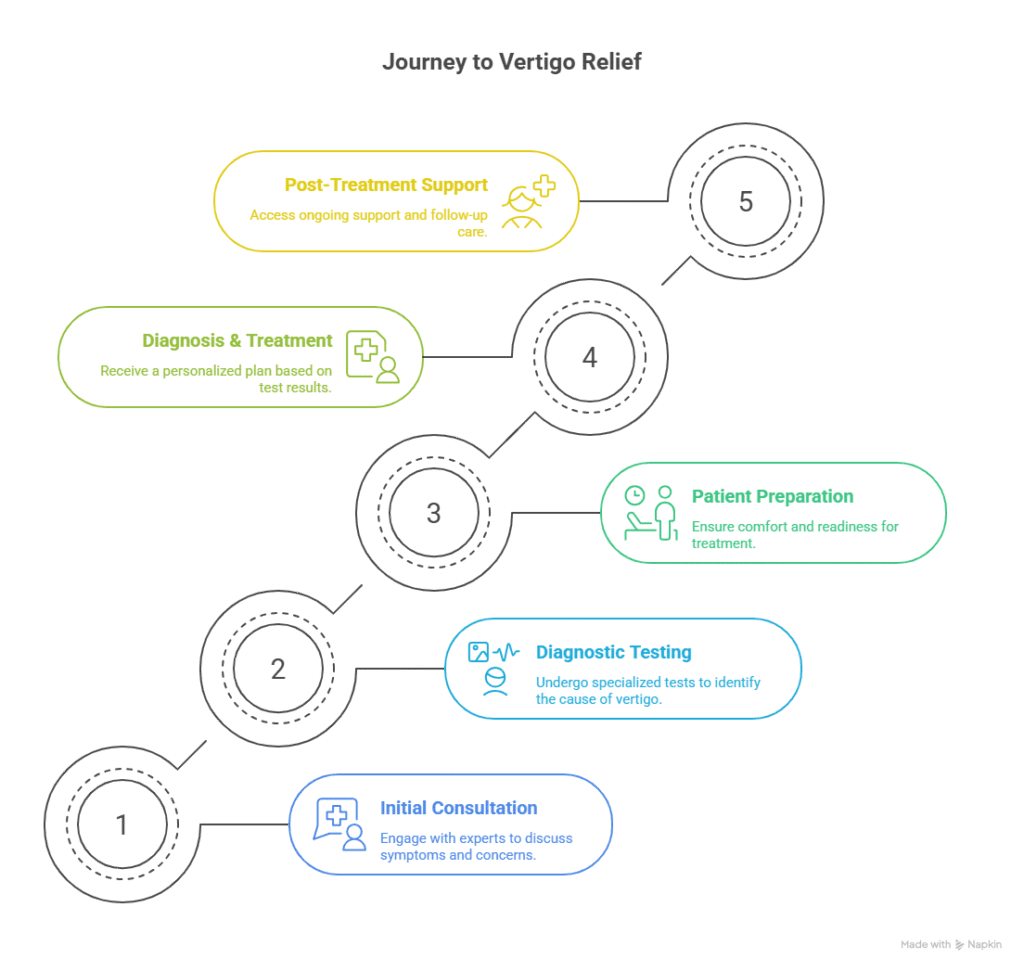


Your experience begins with a consultation by highly trained specialists — typically Neurotologists, ENT specialists, or Neurologists — who have extensive experience in managing complex dizziness and balance disorders.
Stage | What Happens | Purpose |
Detailed History Analysis | The doctor takes a complete medical history, exploring symptoms, their onset, duration, and triggers. Questions may include when dizziness occurs, what movements make it worse, and whether it is associated with nausea, vision changes, or hearing loss. | To identify the pattern and possible cause of dizziness (for example, distinguishing brief BPPV episodes from longer Vestibular Migraine attacks). |
Physical Examination | A focused neurological and vestibular exam that evaluates eye movements, coordination, balance, and reflexes. | To detect signs of vestibular dysfunction and determine which positional tests should be performed next. |
Once the initial assessment is complete, patients undergo a comprehensive Vertigo Profile Test, which combines several specialized tests. These evaluate how the inner ear, eyes, and brain work together to maintain balance. Standard MRI or CT scans cannot show functional inner ear problems, so these tests are essential.
The complete evaluation, including VNG, SVV, and DVA, typically takes about one and a half hours.
Test | What It Measures | Why It Matters |
Videonystagmography (VNG) | Tracks eye movements while the head and body are positioned in different ways. | Crucial for diagnosing BPPV and identifying the exact location of displaced inner ear crystals. |
Subjective Visual Vertical (SVV) | Checks how accurately a person perceives vertical alignment. | Helps detect otolith organ dysfunction, which affects spatial orientation. |
Dynamic Visual Acuity (DVA) | Measures how clearly one can see while moving the head. | Identifies problems with the vestibulo-ocular reflex (VOR), which stabilizes vision during motion. |
Video Head Impulse Test (vHIT) | Records eye responses during small, quick head movements. | Evaluates individual semicircular canal function and vestibular reflexes. |
Audiometry | Tests hearing across different frequencies. | Important for diagnosing disorders like Ménière’s disease or Labyrinthitis that affect both hearing and balance. |
Posturography | Analyzes weight distribution and body movement while standing on a stable or moving surface. | Measures how the body integrates visual, sensory, and inner ear information to maintain balance. |
Imaging (MRI or CT) | Used when a central or neurological cause is suspected. | Rules out serious brain conditions such as stroke or tumor. |
Before the tests, patients are asked to avoid certain medications (such as anti-dizziness or allergy drugs) for 24 to 48 hours, skip heavy meals, and avoid eye makeup.
All procedures are safe, painless, and non-invasive. Some patients may briefly feel lightheaded during positional tests like VNG, but this sensation quickly fades and helps identify the cause of dizziness.
After testing, the doctor reviews all results and provides a clear explanation of the exact cause of dizziness or imbalance. Treatment plans are fully customized based on diagnosis, patient age, and associated health factors.
Diagnosis | Recommended Treatment | Expected Outcome |
BPPV (Benign Paroxysmal Positional Vertigo) | Canalith Repositioning Maneuvers such as Epley, Semont, Barbecue, or Yacovino. The choice depends on which of the 14 types of BPPV is identified. Advanced systems ensure precise head movement during treatment. | Most patients experience immediate relief after one to three sessions. |
Vestibular Migraine | Combination of lifestyle adjustments, dietary regulation, and migraine prophylaxis medication if needed. | Reduces frequency and intensity of migraine-associated dizziness. |
Vestibular Neuritis | Vestibular Rehabilitation Therapy (VRT) to retrain the brain and restore balance, sometimes supported by short-term steroids to reduce nerve inflammation. | Accelerates recovery and promotes long-term stability. |
Chronic Dizziness (PPPD) | Combination of VRT and Cognitive Behavioral Therapy (CBT) to manage anxiety-related imbalance. | Improves confidence, reduces sensitivity to motion, and restores daily function. |
Post-Treatment Imbalance | Continued VRT, often enhanced with Virtual Reality (VR)-based exercises for engagement and precision. | Strengthens balance control and reduces residual dizziness. |
Recovery at NeuroEquilibrium continues beyond the clinic.
The ultimate goal is not just symptom relief but lasting recovery and renewed confidence in daily motion.
At NeuroEquilibrium, every step of your journey — from assessment to rehabilitation — is carefully structured to deliver clarity, comfort, and confidence. Whether your dizziness is caused by an inner ear condition, migraine, or nerve inflammation, our specialists ensure you receive the most precise diagnosis and advanced care available.


Corporate Office:
140, Shrigopal Nagar, Gopalpura Bypass Road, Jaipur 302018, Rajasthan, India
Manufacturing Site:
1st Floor, Plot No.3, Pooja Tower, Muktanand Nagar, Gopal pura Mode, Jaipur, Rajasthan 302018
All rights reserved © 2026 NeuroEquilibrium Diagnostic Systems Pvt Ltd.
Vertigo Clinic in Ujjain | Vertigo Clinic in Barwani | Vertigo Clinic in Patna | Vertigo Clinic in Miraj | Vertigo Clinic in Kolhapur | Vertigo Clinic in Nashik | Vertigo Clinic in Jaysingpur | Vertigo Clinic in Amravati | Vertigo Clinic in Solapur | Vertigo Clinic in Pune | Vertigo Clinic in Aurangabad | Vertigo Clinic in Nagpur | Vertigo Clinic in Sagar | Vertigo Clinic in Indore | Vertigo Clinic in Jabalpur | Vertigo Clinic in Bhopal | Vertigo Clinic in Bilaspur | Vertigo Clinic in Ahmedabad | Vertigo Clinic in Vadodara | Vertigo Clinic in Surat | Vertigo Clinic in Navi Mumbai | Vertigo Clinic in Thane | Vertigo Clinic in Mumbai | Vertigo Clinic in Palghar | Vertigo Clinic in Jaipur | Vertigo Clinic in Sriganganagar | Vertigo Clinic in Alwar | Vertigo Clinic in Kota | Vertigo Clinic in Udaipur | Vertigo Clinic in Lucknow | Vertigo Clinic in Prayagraj | Vertigo Clinic in Varanasi | Vertigo Clinic in Gurgaon | Vertigo Clinic in Dehradun | Vertigo Clinic in Rohtak | Vertigo Clinic in Amritsar | Vertigo Clinic in Ludhiana | Vertigo Clinic in Greater Noida | Vertigo Clinic in Delhi | Vertigo Clinic in Kannur | Vertigo Clinic in Trichur | Vertigo Clinic in Cochin | Vertigo Clinic in Coimbatore | Vertigo Clinic in Tiruppur | Vertigo Clinic in Chennai | Vertigo Clinic in Hosur | Vertigo Clinic in Bangalore | Vertigo Clinic in Mangalore | Vertigo Clinic in Hyderabad | Vertigo Clinic in Sangli