



When the world feels like it is spinning or tilting every time you move your head, fear and confusion quickly follow. Many people rush to a vertigo specialist, hoping that one test will finally explain what is going wrong. One of the first exams performed is the VNG, which monitors eye movements to assess how well the balance system is functioning. While this test is extremely helpful, it does not always provide the full picture. Sometimes results are unclear, or your symptoms do not fully match what appears in the report.
That is when experienced specialists begin to look deeper. They study rapid reflexes, eye behavior during head movements, how the brain responds to gravity, and even tiny delays in eye motion that could signal nerve or brain involvement. In this blog, we explain how vertigo experts evaluate eye movement beyond VNG and why additional testing can play a crucial role in bringing lasting relief.
Know More About Vertigo
- VNG Test: Meaning, Procedure, and Results Explained
- Where to Get a VNG Test in Ahmedabad: Best Clinics & Specialists
- VNG Test in Hyderabad – Types, Diagnosis & Clinic Locations
Why Eye Movements Give a Vertigo Specialist Powerful Clues About Balance Problems
Eyes and inner ears are partners. Whenever you turn your head, your eyes follow you automatically in the opposite direction so that you can maintain a constant vision. This is quick to occur to the extent that you do not even realize it until something goes awry.
A vertigo doctor closely observes when dizziness sets in:
- The way your head turns your eyes.
- Whether they jump or drift
- In case they have been afraid to move.
- Whether they beat this side or that when you move.
These trends are fingerprints. They assist the vertigo specialist in making decisions about the issue is due to:
- The inner ear (so-called peripheral causes)
- The central causes are the brain or nerves.
VNG is only a beginning. Competent interpretation is more than that.
How a Vertigo Doctor Uses High-Speed Head Tests to Detect Problems VNG Can Miss
VNG testing is very helpful because it allows doctors to observe your eye movements during slow, controlled movements. However, in everyday life, we rarely move that way. We turn quickly to cross the street, glance to the side while driving, or nod during a conversation. These faster, natural movements rely on reflexes in the inner ear and brain that may not always be fully challenged during standard VNG testing.
That is why vertigo specialists may recommend an additional exam that looks at rapid head movements. During this test, you are asked to keep your eyes fixed on a small target while the doctor gently but quickly turns your head in different directions. Special cameras record whether your eyes stay focused or briefly jump to catch up. These tiny shifts can reveal subtle balance problems that slower tests may not detect, helping your doctor better understand what is happening inside your balance system and choose the most effective treatment for you.
What the Doctor Looks For
When you are tested in the process of rapid head movement, your doctor observes the response of your eyes with great care. When your inner ear is not sending your brain strong or accurate signals, then your eyes will sometimes momentarily lose track of the target and jump back into position. These swift corrections can be referred to as catch-up movements, and these can give you good indications as to the effectiveness of your balance system.
These subtle eye movements can help your doctor identify exactly which part of the inner ear is weaker than it should be, detect possible nerve inflammation, and explain why sudden head turns trigger dizziness or unsteadiness. By uncovering problems that slower tests might miss, this advanced evaluation allows your vertigo specialist to create a more precise diagnosis and a treatment plan that is tailored to your specific needs.
How Specialists Check Whether Your Vision Stays Clear While You Walk or Turn
At NeuroEquilibrium, many patients tell us things like, “Everything blurs when I move,” or “Road signs bounce when I walk.” When we hear that, we often perform a simple yet informative exam called the Dynamic Visual Acuity test. This test helps us evaluate how well the reflex that connects your inner ear, eyes, and brain is working to keep your vision steady while you move.
During the Dynamic Visual Acuity test, we ask you to read letters on an eye chart first with your head still, and then again while your head gently moves side to side. Special equipment allows us to compare how clearly you can see in both situations. The results help us understand why walking may feel unsafe, why driving can feel frightening, or why scrolling on your phone might make you nauseous. When we find that this reflex is weaker than it should be, it guides us in selecting the right therapy and exercises to strengthen your balance system and restore your confidence in everyday movement.
How Eye-Jump Patterns Help a Vertigo Specialist Spot Brain-Related Causes
Dizziness is not always caused by the inner ear. Certain brain conditions can cause symptoms that closely resemble ear-related vertigo. That is why we carefully study a type of quick eye movement called saccades, which are the rapid jumps your eyes make when shifting focus from one point to another. These movements provide important information about how well the nerve pathways in your brain are functioning.
During this test, we measure how fast your eyes move, whether they hesitate before starting, and whether they slow down as they reach the target. These tiny details matter because delays or reduced speed can signal that the brain is not sending messages normally. This step is especially important for people seeking answers for persistent dizziness, since it helps us rule out serious neurological concerns, decide whether scans or further testing are needed, and make sure nothing important is overlooked
How Vertigo Doctors Use Eye Direction to Identify the Exact Type of BPPV
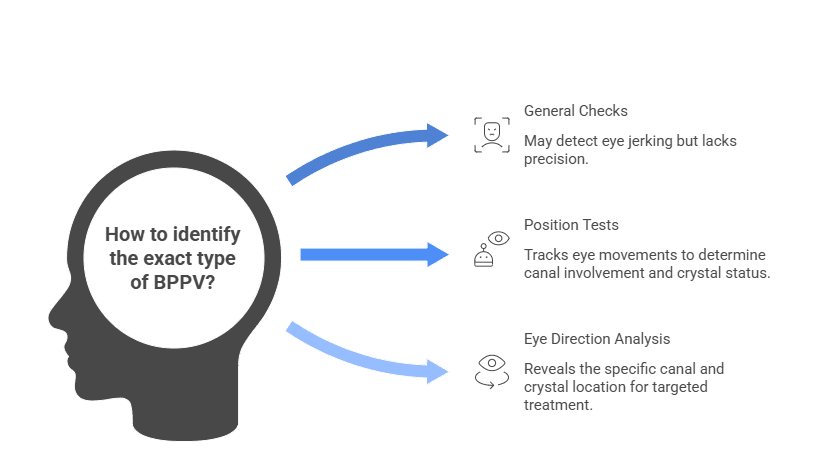
Benign Paroxysmal Positional Vertigo, often called BPPV, is one of the most common causes of vertigo. It occurs when tiny calcium crystals in the inner ear move to the wrong location and interfere with the balance sensors. What makes diagnosis challenging is that these crystals can settle into different balance canals, and each location can cause slightly different symptoms.
At NeuroEquilibrium, we go beyond simple screening checks and perform detailed positional tests while carefully monitoring your eye movements with specialized cameras.
What Happens During Position Tests
As you lie back, turn your head, or roll to one side, we record:
- The direction your eyes move
- Whether the motion is up and down or side to side
- How long does the movement lasts
What Those Eye Movements Tell Us
From these patterns alone, we can determine:
- Which inner ear canal contains the misplaced crystals
- Whether the crystals are floating freely or stuck to a surface
- Which specific repositioning maneuver is most likely to correct the problem
This precise approach allows us to avoid guesswork, choose the right treatment the first time, and help you recover more quickly and safely.
Gravity-Perception Tests Reveal Hidden Balance Weaknesses
Some balance disorders do not appear when your eyes are moving quickly. Instead, they show up when your brain is trying to figure out what “upright” really means. At NeuroEquilibrium, we evaluate this using a specialized exam called the Subjective Visual Vertical test, often shortened to SVV. This test looks at how well the gravity-sensing organs in your inner ear are communicating with your brain.
During the Subjective Visual Vertical test, you sit in a darkened room and are asked to rotate a glowing line until it appears perfectly straight up and down to you. There is no right or wrong answer from your perspective. We simply record how close your perception is to the true vertical.
What We Measure
If the line is tilted significantly from vertical, it may indicate that the gravity sensors in one ear are not sending accurate signals.
Why This Matters
This information helps us detect:
- Subtle inner ear imbalances
- Causes of long-standing or unexplained dizziness
- One-sided weakness that routine exams can miss
For patients who have been dealing with symptoms for months or even years, this test can provide important insights into what has been hidden beneath the surface.

Why Multiple Eye Tests Give Clearer Answers Than One Alone
The reason is simple. The balance system is complex and relies on the inner ears, eyes, nerves, and brain. Each of the tests is crafted to test a certain aspect of that system, and no one exam can give the full picture.
This is the reason we put up tests like VNG testing, video Head Impulse Testing (vHIT), Dynamic Visual Acuity, saccade testing, positional testing of BPPV, and Subjective Visual Vertical. The combination of these results can assist us:
- Differentiate brain-related and inner ear etiologies.
- Determine the specific organ of the balance that is not functioning well.
- Measure healing and progress over time.
- Targeted design therapy plans.
Instead of guesswork, an experienced vertigo expert constructs an elaborate map of the way your balance system is operating. Answers and care can be provided more rapidly and more efficiently, and individually.
Final Thoughts
At NeuroEquilibrium, we believe that understanding vertigo requires more than a single test. Our clinics use detailed balance assessments that combine advanced eye movement analysis, gravity perception testing, and motion-based evaluations to uncover the true cause of your symptoms. This careful, step-by-step approach allows us to move beyond guesswork and toward real answers, so you can stop feeling like the ground is constantly shifting beneath you.
Eye movements hold powerful clues about why vertigo occurs. While VNG is an important starting point, experienced specialists look deeper by examining high-speed reflexes, visual stability during movement, gravity perception, and subtle neurological signs that basic tests can miss. These deeper insights lead to smarter treatment plans and genuine recovery. If you are tired of uncertainty and want your symptoms evaluated with precision and compassion, we invite you to visit NeuroEquilibrium for a thorough, advanced assessment of your vertigo.
What doctor do you see for vertigo?
An ENT (ear, nose, and throat) doctor is what you are generally supposed to see in case of vertigo because most cases pertain to the inner ear. They can identify balance disorders and prescribe appropriate medication. In case of necessity, they can refer you to a neurologist.
Is vertigo an ENT or neurologist issue?
It typically originates in the inner ear. Nonetheless, a neurologist can also be consulted for symptoms of a brain or nerve issue. The two experts can collaborate to properly diagnose.
Which doctor is best to treat vertigo?
An ENT doctor is typically the best doctor to treat vertigo, particularly when it is due to inner-ear conditions such as BPPV or infections. A neurologist treats vertigo when it is neurological in origin. Vestibular therapy may also benefit some patients.
How do I know if my vertigo is neurological?
Vertigo can be neurological if accompanied by weakness, numbness, slurred speech, blurred vision, severe headache, or walking difficulties. These are symptoms that need immediate treatment. Tests can be used to establish the cause by a doctor.
What illness can be mistaken for vertigo?
Low blood pressure, anemia, dehydration, anxiety, migraine and heart problems are some of the conditions that may be confused with vertigo. Similar dizziness may be caused by some neurological disorders. Proper diagnosis is done through a medical examination.