







The initial inflammation from vestibular neuritis has usually settled, but that doesn’t mean the balance system feels normal again. Weeks later, some vagueness – less steady walking, a flicker of dizziness on quick head turns, tiredness after screens or driving – is common, and it isn’t necessarily a sign anything went wrong. It usually just means the brain hasn’t finished adjusting yet, and how that process is supported can make a real difference to how it goes.
What’s Really Happening If You’re Still Unsteady
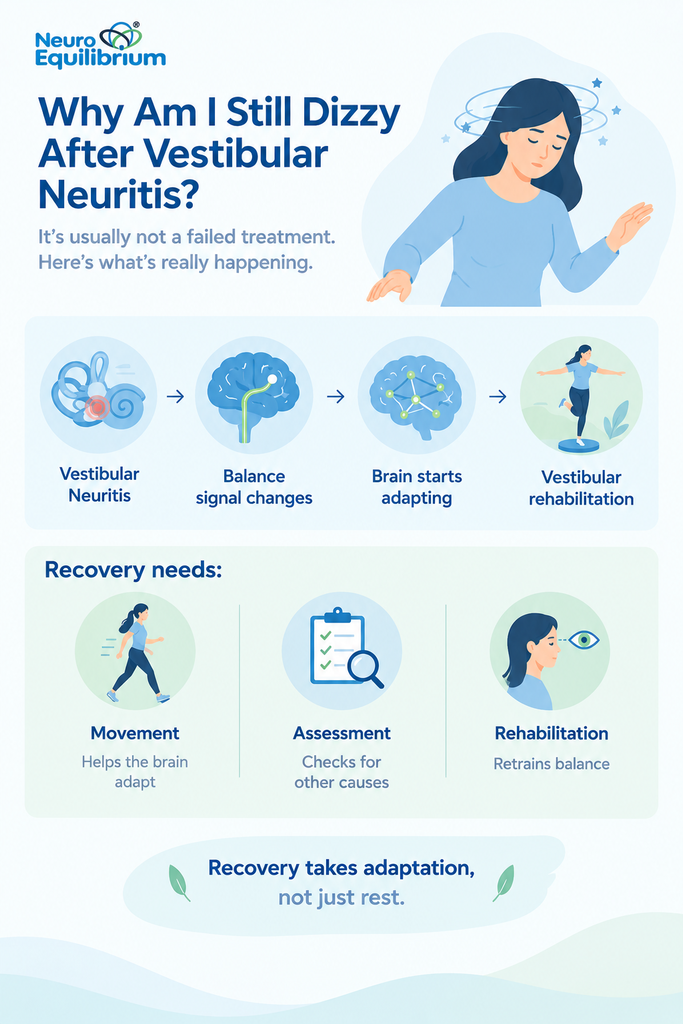
Feeling unsteady weeks after the acute episode doesn’t mean the underlying problem was missed, and it doesn’t mean treatment has failed. Most of the time, it simply means your brain is still adjusting to a change in the signal coming from one side of your vestibular system.
It’s worth noting how different this feels from the original attack. Instead of the room spinning, people tend to describe something vaguer – a general sense of not being fully steady, needing more effort than usual to walk confidently (especially outdoors or somewhere crowded), a flicker of dizziness when turning the head quickly, tiredness after screen use or driving, or simply less trust in their own movement than they used to have.
Why This Happens: The Brain’s Compensation Process
Vestibular neuritis and labyrinthitis affect the nerve or structures in the inner ear that send balance information to the brain, usually just on one side. Once the inflammation itself has settled, that side often doesn’t go back to sending a fully normal signal – it may stay reduced or altered for good.
So what actually improves, then? The brain does. Through a process called vestibular compensation, it gradually learns to rely more heavily on the input it still has – your eyes, and the sense of position coming from your joints and muscles – while adapting to whatever the affected ear is now sending. This is essentially neuroplasticity at work: the nervous system reorganising how it processes balance information, rather than the ear itself healing back to full function.
Here’s the part that isn’t always explained clearly: compensation isn’t automatic, at least not to the same degree for everyone, and it isn’t instant. It depends heavily on how much the balance system gets used and challenged during recovery. Staying still and avoiding movement because it feels unpleasant can actually slow this process down – while movement done in the right way, at the right pace, tends to help it along.
Where Rehabilitation Fits Into This
Vestibular rehabilitation therapy exists precisely because of this compensation process. Rather than trying to treat the inner ear directly, it gives the brain the structured, repeated movement it needs to compensate more efficiently and more completely.
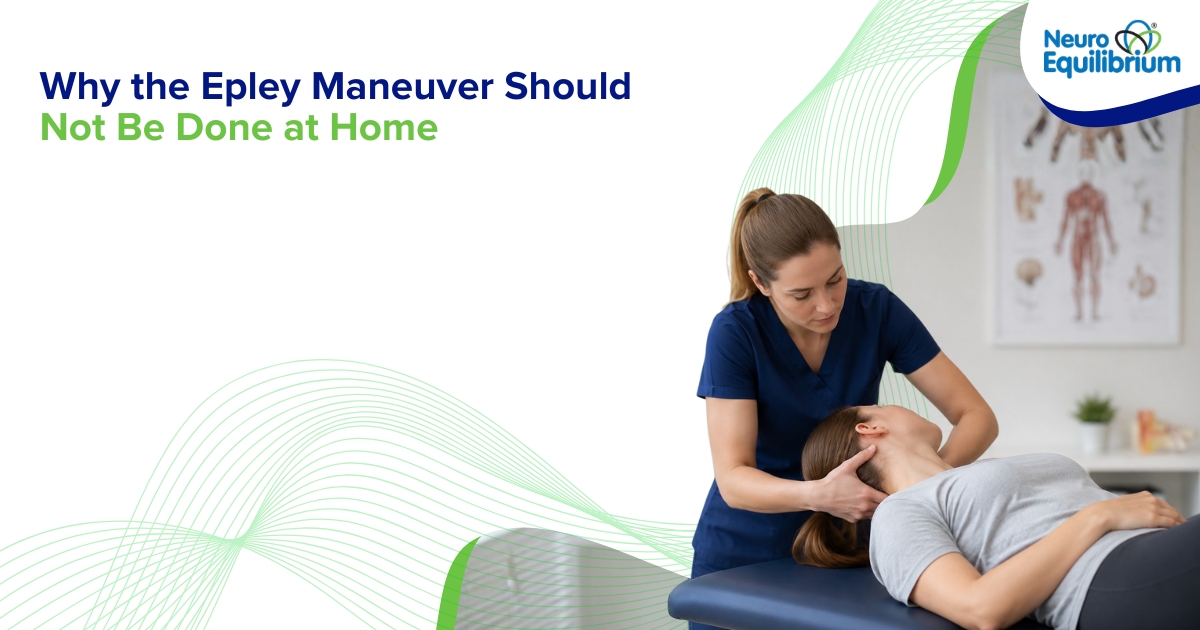
That’s a genuinely different approach from how BPPV is treated. With BPPV, a specific maneuver repositions displaced crystals in the inner ear – there’s a clear mechanical problem, and a clear mechanical fix. With vestibular neuritis, there’s usually nothing to reposition. The goal here isn’t correcting a fault; it’s actively training the brain’s own adaptation process.
If your dizziness has lingered past the acute phase, this is a good point to book a vestibular assessment rather than simply waiting it out.
Know More About
- What Happens in a Vertigo Physiotherapy Session? Tests, Exercises and Recovery Plan
- Gaze Stabilization Exercises for Vertigo & Balance Recovery
- Physiotherapy Balance Exercises You Can Start at Home Today
What an Assessment Usually Looks At
Before jumping into rehabilitation, or continuing with it, it helps to confirm what’s actually going on and rule out anything else that might be contributing. Depending on your history, this can involve a detailed conversation about how the initial episode started and how things have evolved since; tests of eye movement and the vestibulo-ocular reflex, such as VNG or vHIT, to see how the affected side is functioning now; a look at balance and walking; and a check for whether something else – BPPV developing afterward, for instance – might also be playing a role.
This step matters more than people sometimes assume. Not every case of lingering dizziness after neuritis is simply “compensation still in progress.” Occasionally there’s a second, separately treatable issue sitting alongside it, and an assessment is really the only way to tell the difference.
What Rehabilitation Might Actually Involve
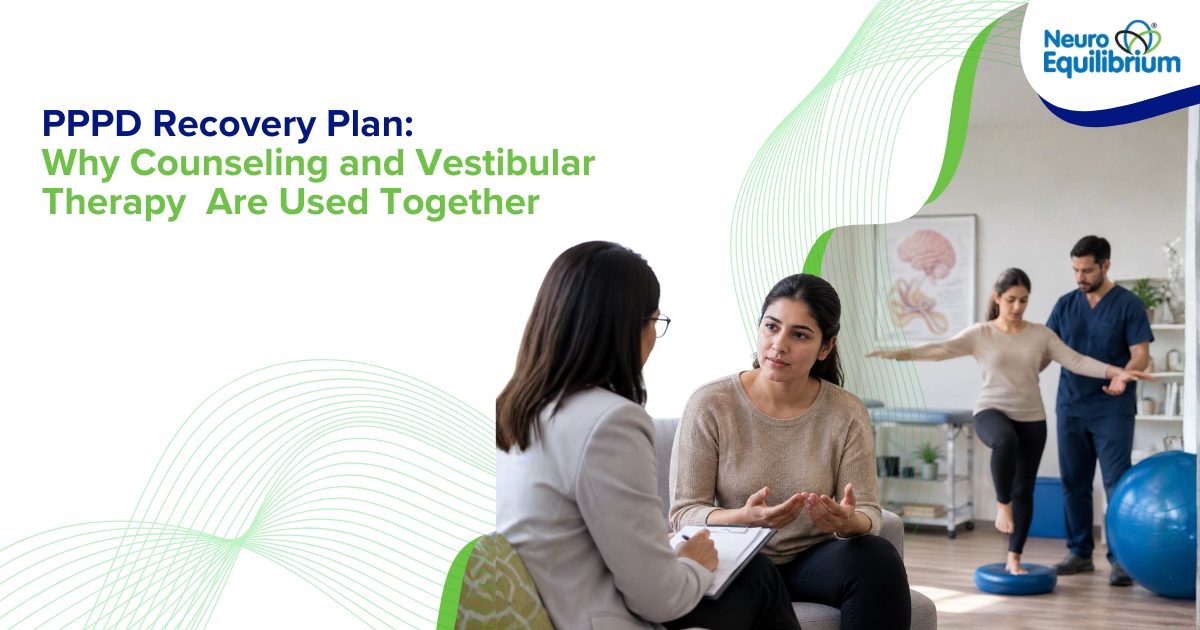
A programme built around post-neuritis recovery is generally designed to challenge the compensation process directly. That often means adaptation exercises – gaze stabilisation drills that pair head movement with a fixed visual target, aimed at retraining the vestibulo-ocular reflex. It can include habituation exercises too: controlled, repeated exposure to whatever movements or environments are currently triggering mild symptoms, so the brain gradually becomes less reactive to them. And balance and gait retraining usually rounds it out, helping rebuild steadiness and confidence during ordinary walking, turning, and daily activity.
Exactly which exercises, at what intensity, and how quickly they progress should come from the assessment findings and how you’re responding – not from a fixed, one-size-fits-all routine.
What Recovery Tends to Look Like
Recovery from vestibular neuritis is almost never a straight upward line. Most people have genuinely good days mixed in with less steady ones, particularly when they’re tired, run down, or somewhere visually overwhelming. That’s a normal feature of a compensating system doing its work – not necessarily a sign that things have gone backwards.
The timeline itself varies quite a bit. Some people notice real improvement within a few weeks. Others, especially with more significant vestibular loss to begin with, need a longer and more gradual course of rehabilitation. Age, how consistently the exercises get done, and general health all play a part in how quickly things move.
Rather than symptoms vanishing overnight, progress usually shows up in smaller, practical ways – steadier walking, head-turns settling faster, better tolerance for busy or visually cluttered places, and a gradual return to things like driving or exercise.
Misconceptions Worth Untangling
One of the most common: the inflammation is gone, so I should feel completely normal by now. But resolving the initial inflammation and the brain fully compensating for the balance change are two separate things entirely. It’s entirely possible to feel physically recovered from the illness itself while your brain is still in the middle of adapting.
Another: resting and avoiding movement is the safest thing to do. Rest genuinely does make sense in the first few days of an acute attack. But keeping that avoidance going for weeks afterward tends to work against you rather than protect you. Movement – done thoughtfully and at an appropriate pace – is usually part of the answer, not something to fear.
And then there’s medication. It’s a reasonable assumption that if something’s still wrong, more medicine should fix it. But vestibular suppressants are really meant for short-term control during the acute phase. Taken for a prolonged stretch afterward, they can actually get in the way of the brain’s natural compensation rather than support it. This is genuinely worth raising directly with your treating doctor.
When It’s Worth Getting Checked
A few situations are worth acting on rather than waiting out: unsteadiness or dizziness that’s still affecting daily life several weeks after the acute episode, new brief spinning episodes triggered by specific head positions (which could mean BPPV has developed on top of the original problem), symptoms that seem to be getting worse instead of gradually easing, or noticing that you’ve started avoiding certain movements or places out of fear of triggering symptoms.
On the other hand, if dizziness shows up alongside weakness, numbness, slurred speech, double vision, fainting, a sudden severe headache, chest pain, or real difficulty standing or walking – that calls for urgent medical attention.
How long does recovery from vestibular neuritis usually take?
It genuinely varies. Many people see steady improvement over a few weeks, while others with more significant vestibular loss need a longer stretch of rehabilitation. There’s no single timeline that applies to everyone.
Can compensation just. stop working, or fail?
For some people, yes – compensation can end up incomplete without structured rehabilitation, particularly if movement was avoided during recovery or if another contributing issue was never identified. That’s really the argument for a proper assessment and guided exercise programme rather than simply waiting for things to settle on their own.
Is this the same kind of recovery as BPPV?
Not really. BPPV comes down to a mechanical problem – displaced crystals in the inner ear – usually resolved with a specific repositioning maneuver. Recovering from vestibular neuritis relies on the brain’s own compensation process, supported by rehabilitation exercises rather than a single corrective move.
Does age make a difference to how well someone compensates?
It can be one factor, alongside overall health and how consistently the rehabilitation exercises get done – but people across a wide age range recover well with the right guidance.