







What would happen if you had to deal with dizziness all day, every day? The world rotates when you stand up, walking in a busy supermarket seems impossible, and even turning your head too fast makes you feel ill. This is what a life with a vestibular disorder is like for millions of people. The good news? Science has advanced to the point where virtual reality vestibular rehab is transforming the recovery process from vertigo, making it quicker, smarter, and much more effective.
This blog explains what VR therapy for vertigo is, how it works in the brain, the research behind it, and what patients can expect during a session.
Why Traditional Vestibular Rehab Has Limitations and How VR Is Changing That
What Conventional Vestibular Rehabilitation Therapy Looks Like
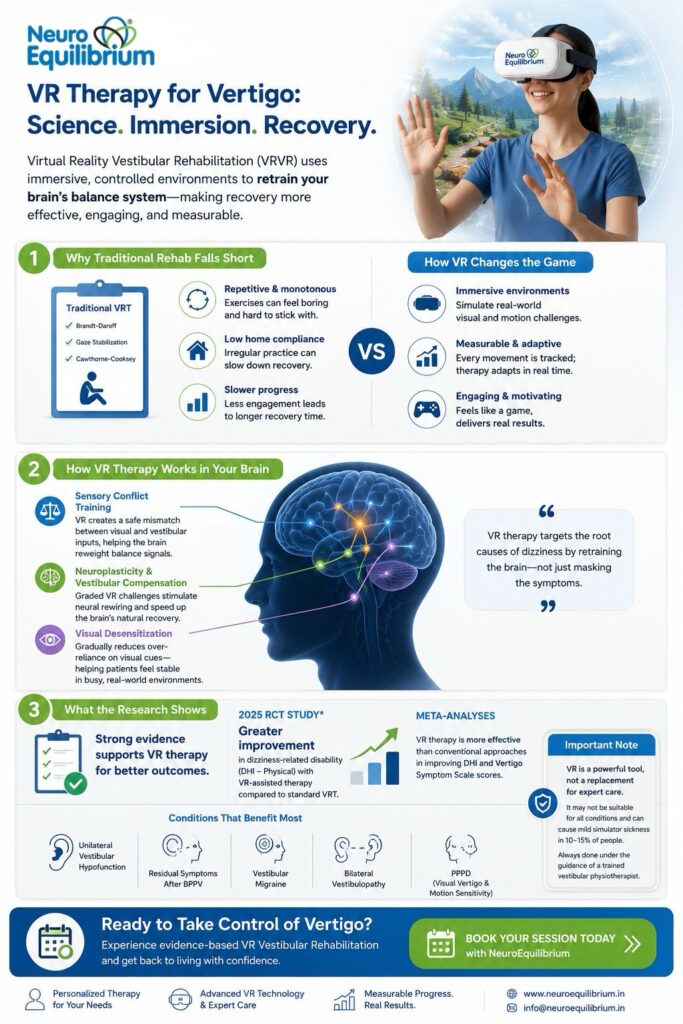
Traditional vestibular rehabilitation has often included repetitive balance, eye-movement, and habituation exercises. While these approaches may help some patients, they can feel monotonous, which may reduce motivation and make it harder to continue them consistently at home. Not performing these exercises regularly can lengthen recovery time. This has long been one of the biggest challenges in traditional vestibular rehabilitation therapy.
Where Virtual Reality Vestibular Rehabilitation Enters the Picture
VR Vestibular Rehabilitation (VRVR) uses computer-generated environments delivered through VR headsets or interactive screens to create controlled visual and motion-based stimuli. The environments are well-planned to challenge your balance system in a safe, gradual manner. Imagine your therapy functioning like a video game, where every movement is measured, tracked, and used to improve your recovery.
The Neuroscience of Why VR Therapy for Vertigo Works on Your Brain
Sensory Conflict Theory: Training the Brain to Reweight Balance Signals
Your balance relies on three systems: the inner ear (vestibular), the eye (vision), and the muscles and joints (proprioception). When one of these systems is damaged or misfires, your brain becomes confused, which can cause dizziness or vertigo.
VR vertigo therapy intentionally creates a mismatch between visual and vestibular inputs to accelerate the brain’s natural adaptation process, known as central compensation. It builds on traditional VRT exercises while offering greater engagement and measurable progress.
Neuroplasticity and Vestibular Compensation: How the Brain Rewires Itself
One remarkable feature of the human brain is its ability to rewire itself. Following damage to the vestibular system (such as from vestibular neuritis or labyrinthitis), the brain undergoes a recovery period during which it attempts to compensate. This recovery window is targeted in VRT exercises. Graded challenges in VR-based vestibular rehab therapy enable precise targeting while keeping the brain in an optimal learning state.
Visual Dependency in Vertigo Patients: Why VR Directly Targets the Root Problem
Patients with chronic dizziness often become overly dependent on visual cues for balance, making busy environments such as malls, traffic, or escalators overwhelming. VR vestibular rehabilitation directly addresses this issue by gradually desensitizing patients to these visual triggers. This is one of the reasons why VR is particularly effective for disorders such as PPPD (Persistent Postural-Perceptual Dizziness).
What the Research Actually Says About VR Vestibular Therapy Outcomes
Key Studies: VR vs. Conventional VRT and What the Trials Tell Us
The evidence for VRVR is rapidly accumulating and strong. In a 2025 randomized controlled study of patients with acute unilateral vestibulopathy, both VR-assisted and standard VRT therapy resulted in significant improvements, with the VR group showing greater gains in the physical dimension of a commonly used questionnaire evaluating the impact of vertigo on quality of life, the Dizziness Handicap Inventory (DHI). Meta-analyses have consistently found VR therapy to be more effective than standard approaches in improving DHI and Vertigo Symptom Scale scores.
Which Vestibular Conditions Benefit Most from VR Therapy
The strongest evidence currently supports VR therapy for vertigo treatment in the following conditions:
- Unilateral vestibular hypofunction
- Residual symptoms after BPPV (benign paroxysmal positional vertigo)
- Vestibular migraine
- Bilateral vestibulopathy
- PPPD (visual vertigo and motion sensitivity)
Honest Limitations: What VR Cannot Replace in Vestibular Care
However, VR therapy for vertigo is a valuable tool, not a magical cure-all. It is not suitable for repositioning maneuvers (such as the Epley maneuver for active BPPV), has not been validated for all conditions affecting the vestibular system, and causes simulator sickness in about 10-15% of people, characterized by temporary nausea that can be managed with professional assistance. That’s why it is always important to have a trained vestibular physiotherapist to supervise VR therapy.
Inside a VR Vestibular Therapy Session: What Patients Actually Experience Step by Step
The Initial Assessment: Matching VR Protocol to Your Specific Deficit
Vestibular disorders are unique to each person. A complete evaluation is performed prior to any VRT exercises to determine exactly which part of your balance system is impaired, using advanced testing equipment such as Videonystagmography (VNG) and Vestibular Evoked Myogenic Potentials (VEMPs). The VR program is then customized to the specific findings. This is not a “one-size-fits-all” approach.
Common VR Exercise Environments Used in Vestibular Rehabilitation Therapy
In a session, the patient is given a variety of simulated environments that challenge balance and recalibrate the brain, including:
- Visual scenes designed to reduce visual dependency in moving crowds and busy street environments.
- Optic flow corridors, which mimic head and forward movement.
- Balance platform exercises help patients practice stability and balance on uneven surfaces.
- Gaze stabilization tasks that train the eye-inner ear reflex (VOR).
- Exposure to a variety of environments, such as the supermarket or the escalator, as a graded exposure, for patients with motion sensitivity
The VRT exercises will not only be visual experiences. As you improve, the difficulty level also increases. Advanced motion sensors precisely track your body’s responses in real time, giving your physiotherapist valuable insight into your movements.
Session Frequency, Duration, and Progression in a Typical VR Program
Generally, evidence-based VR vestibular rehabilitation consists of 5–10 sessions lasting 20–30 minutes each, conducted twice per week. Progress is objectively measured using DHI scores, allowing both the patient and physiotherapist to track improvement over time. Videos for home use are frequently used to consolidate learning between sessions.
Managing Simulator Sickness: What to Do If VR Makes Symptoms Temporarily Worse
Dizziness is a common sensation during the first couple of VR experiences. This is the therapy at work; the brain is being challenged. If simulator sickness occurs, the physiotherapist will alter the session as soon as possible. This is temporary and controllable and should never be an excuse for not going to therapy. It’s just an additional reason why supervised VR therapy is more effective than having consumers with consumer headsets at home.
VR at Home vs. In-Clinic: Why Supervised Vestibular Rehabilitation Technology Matters
Are Consumer VR Headsets and Vertigo Apps Safe to Use Alone?
As VR headsets become more accessible, many patients wonder whether they can simply download a vertigo app and begin self-treatment. However, this raises significant safety concerns. If not done correctly, VR can exacerbate certain conditions, especially BPPV and central vertigo disorders. The visual input and movement activities will be based on your diagnosis, so it is important that they be assessed first.
Why Supervised VR Therapy with Real-Time Physiotherapist Guidance Delivers Superior Results
Supervised vertigo treatment technology that integrates diagnostic data, objective motion testing, and real-time physiotherapist adjustments. Your therapist can adjust the protocol in real time while observing your head movements, balance responses, and symptom changes, something an app or consumer headset cannot provide. The outcome: substantially improved results, quicker recovery times, and reduced risk of recurrence.

Why NeuroEquilibrium Is the Right Choice for Your VR Vestibular Rehabilitation Journey
At NeuroEquilibrium, virtual reality vestibular rehabilitation is not treated as an add-on. It is integrated into a comprehensive physiotherapist-led rehabilitation program tailored to your diagnosis and recovery goals.
The approach is unique in the following ways:
- Diagnosis-first approach: Advanced diagnostic testing, VNG, VEMP, Dynamic Visual Acuity, Computerized Posturography, and more ensure you are using the best VR protocol for your vestibular deficit.
- Structured VR program: Twice-weekly in-clinic sessions for 5 weeks, followed by home video exercises to keep the momentum going between sessions led by a physio.
- AI progress tracking: An intelligent platform tracks your progress during each video session, and your physiotherapist adjusts the difficulty level in real time based on objective data.
- 300+ centers spread throughout India: Specialist vestibular care and VR therapy for vertigo in over 17+countries, with video-call-supervised sessions for patients unable to attend.
- One-stop team: Vestibular specialists, physiotherapists & audiologists together under one roof, and nothing can be missed.
If you have BPPV, vestibular migraine, PPPD, or chronic dizziness for which no diagnosis has been established, the proper VRT exercises with the proper experts can help restore your life.
Conclusion: VR Therapy Is Not Science Fiction, It Is Today’s Standard of Care for Vertigo
The concept of using virtual reality for vestibular rehab has come a long way since the early days. The clinically proven and neuroscience-backed vestibular rehabilitation therapy is improving the recovery of thousands of patients suffering from vertigo, chronic dizziness, and balance disorders in a faster way. VR therapy for vertigo is truly transforming lives by integrating VR technology with real-time tracking and exposure levels, grounded in proven principles of VRT exercises.
Don’t delay getting help if you or someone close to you is dizzy. Talk with your vestibular specialist about the use of VR/vestibular rehab therapy for your condition. Thanks to the right vertigo treatment technology and the right team on your side, recovery is not only possible but expected.
It’s ready to go, are you? NeuroEquilibrium’s vestibular experts are here to evaluate, diagnose, and create a customized virtual-reality vestibular-rehabilitation program to help you live life to the fullest, with confidence and without fear of the next dizziness attack.
Frequently Asked Questions
Is VR good for people with vertigo?
VRT, an evidence-based therapy that incorporates virtual reality techniques, can help some people with vertigo when supervised by a healthcare professional. VR balance exercise training seems to enhance motion tolerance and brain adaptation, but excessive VR gaming or visual stimulation can exacerbate dizziness in susceptible persons.
How long does VRT typically last?
VRT typically involves a few weeks to several months of treatment, depending on the severity and cause of vertigo. Depending on the individual, some will make rapid progress with simple exercises to improve their balance skills, while others have chronic vestibular disorders that may require more time in balance rehab and regular at-home exercises.
What are the disadvantages of VR therapy?
A few people might feel dizzy, nauseous, strained, or develop a headache, or experience “sea sickness” from VR therapy. Certain VR venues could cause extreme balance disorders, Vision Sensitivity, Migraine, or Epilepsy to some people.
Who shouldn’t use VR?
VR should not be used by those with uncontrolled epilepsy, severe migraine disorder, serious balance instability, medical illness, or certain neurological disorders, and should be used with caution. Those who have suffered a couple of episodes of active vertigo may end up having more eye movement symptoms as the exposure to visual motion extends.