


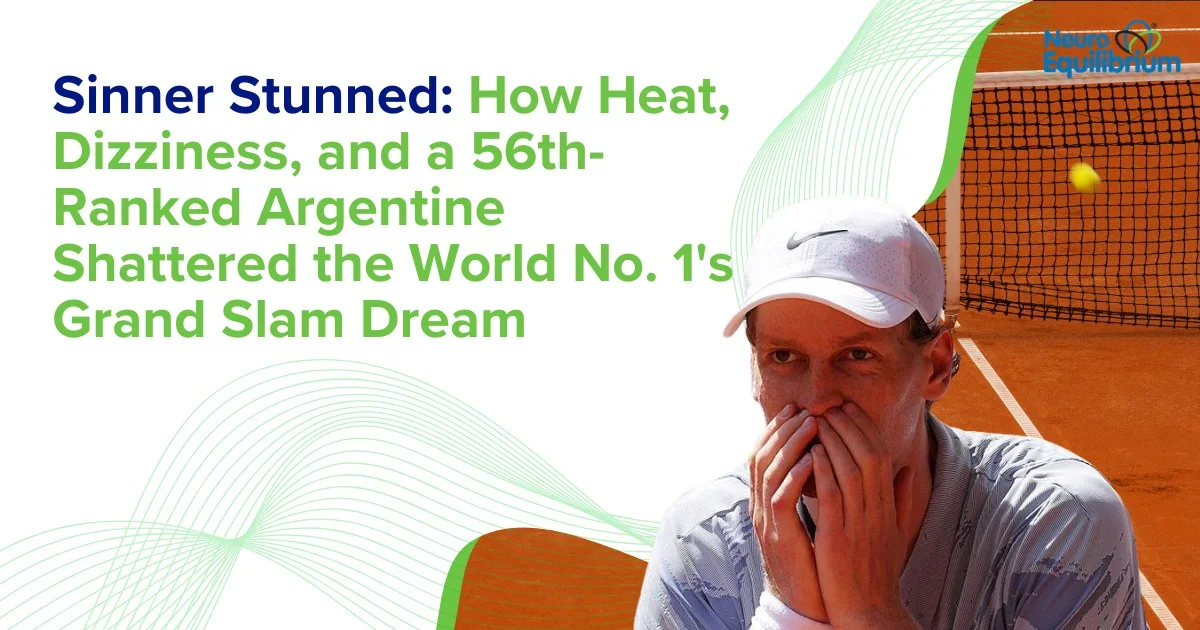





He walked onto Court Philippe-Chatrier as the most dominant player in men’s tennis, carrying a 30-match winning streak, three straight clay Masters titles, and the advantage of entering a draw without an injured Carlos Alcaraz. Jannik Sinner was more than just a favourite for the 2026 French Open. By most measures, he looked almost unbeatable.
By Thursday evening, the Italian world No. 1 was out of the tournament. He was beaten 3-6, 2-6, 7-5, 6-1, 6-1 by 56th-ranked Argentine Juan Manuel Cerundolo, who had only two Grand Slam match wins to his name before this tournament.
The matchup on May 28, 2026, at Roland Garros was more than an upset. It became one of the most dramatic collapses in recent Grand Slam history, and at its center was a symptom millions of people experience every day but often fail to take seriously: dizziness.
A Match That Seemed Won Before It Began
The opening two sets were everything Sinner’s fans had come to expect. Clinical. Controlled. Efficient. He took both sets 6-3 and 6-2 against a Cerundolo who, while combative, could find no answer to the Italian’s relentless baseline depth and serve precision.
Then Sinner moved to 5-1 in the third set, and the match appeared as good as over. He had two chances to serve it out. The crowd began to sense the formality of it all.
It was at 5-4 and 0-40 in the third that the script was torn up entirely.
Know More About
- World Health Day 2026: Why Your Balance Health Deserves Attention
- Why You Feel Dizzy After Exercise
- Dizziness in the Shower: Heat & Blood Pressure Explained
The Collapse: Dizziness, Dehydration, and a Race Against the Heat
The match was in its climactic stages as temperatures hit 33°C (91°F) at Roland Garros during a record heat wave in France. Any athlete would have found those conditions difficult. For Sinner, they became unmanageable.
At 5-4, Sinner was visibly distressed on the court, made his way to his chair, and asked for a doctor. His light-blue outfit was drenched in sweat. He left the court.
When he returned, electrolytes appeared to have been added to his drink. But the damage was not only physical; the interruption also changed the rhythm of the match.
“I wasn’t feeling too well on court. I started to feel very dizzy and very low on energy,” Sinner said in his post-match press conference.
Later that day, the Italian said he had felt something was wrong from the moment he woke up on match day. He said he felt dizzy and low on energy, and at one point appeared nauseous on court.
Sinner tried to shorten the points with drop shots and occasional serve-and-volley plays, while using the shade between rallies to conserve energy. A hand-held fan. Bags of ice around his neck. Nothing worked.
Cerundolo’s Stunning Comeback: 18 Consecutive Points
To his credit, the Argentine did not panic. Once the opportunity appeared, he seized it.
After Sinner’s medical timeout in the third set, Cerundolo took control of the match and won a long run of consecutive points. He rallied from 5-1 down in the third set, broke Sinner repeatedly, and took the set 7-5.
The fourth and fifth sets followed a similar pattern. A weak Sinner was able to find three break points early in the fourth, but failed to convert them. Cerundolo broke twice and ran away with the fourth set 6-1, before repeating the scoreline in the decider.
“It’s hard for him. I feel sorry for him, and I think I was fortunate in this match. He was really supposed to be the winner,” Cerundolo said.
The Scale of the Upset
To understand the scale of Thursday’s upset, it is important to look at the form Sinner carried into Roland Garros:
- Won 5 straight Masters 1000s
- Won three of those titles on clay – the surface where he was eliminated
- Carried an active 30-match winning streak
- Entered the French Open as the clear favourite, with Carlos Alcaraz absent due to a wrist injury.
The level of expectation around Sinner drew comparisons with the dominance Rafael Nadal once carried into Roland Garros, where he won a record 14 titles.
It was also Sinner’s earliest Grand Slam exit since the 2023 French Open and put his pursuit of a career Grand Slam on hold. He won the Australian Open and US Open titles at 24. The only major he has yet to add to his collection is the French Open.
What Happened to Sinner? Understanding Dizziness in Extreme Heat
No formal medical diagnosis was publicly announced after the match. He admitted to feeling dizzy and low on energy, and that he hadn’t felt well since he woke up that morning. There was no medical condition declared.
But his on-court performance, combined with his sudden dizziness, loss of energy, nausea, and inability to perform at his full potential, is a similar experience many millions of people endure each day, with no clear explanation.
Dizziness does not always come out of nowhere, and it is not always the same as simply “feeling faint.” It may be linked to dehydration, heat stress, inner-ear problems, vestibular disorders, or a combination of factors. Extreme heat, fatigue, and illness can affect balance, energy levels, and spatial orientation, but without a formal diagnosis, it would be inaccurate to say exactly what caused Sinner’s dizziness. This is the same system that causes dizziness or vertigo in clinical patients, while Sinner was maintaining balance and spatial orientation.
This was not the first time Sinner had appeared to struggle physically in hot or demanding conditions at a major. He had previously spoken about dizziness after his 2026 Australian Open match against Eliot Spizzirri. He also battled physical discomfort during his 2025 Australian Open match against Holger Rune but still managed to win.
In Paris, under intense clay-court heat, there was no escape.
Precautions: What Sinner’s Collapse Teaches Us About Dizziness
Dizziness and sudden loss of balance are warning signs that can not be ignored, whether on a tennis court or in everyday life. Here are some precautions people should keep in mind:
- Drink plenty of fluids before and during exercise: Dizziness is often caused by dehydration, particularly in warm weather. During extended activity, electrolytes, in addition to water, are needed.
- Never push through extreme dizziness: If dizziness is severe enough to cause fear of falling, nausea, vomiting, or confusion, stop the activity and seek medical help.
- Understand the difference between lightheadedness and vertigo: Lightheadedness may have many causes, including dehydration or low blood pressure. But if a person feels that they or their surroundings are spinning, it may indicate vertigo and should be clinically evaluated.
- If dizziness is frequent, get medical attention: Sinner has previously struggled physically in demanding match conditions. Persistent dizziness with stress or heat indicates that the cause has not been identified or treated.
- Don’t self-medicate: When someone has dizziness, they may turn to over-the-counter medications without knowing the cause. The right treatment depends on the right diagnosis.
If you or someone you know experiences recurring dizziness, imbalance, or unexplained spinning sensations, consult a specialist. You can learn more about what vertigo really is and what causes it, understand whether BPPV, the most common inner ear cause of vertigo, could be responsible, or explore how vestibular migraine can trigger dizziness even without a headache. For those experiencing persistent dizziness after an illness or infection, vestibular neuritis may be worth discussing with a doctor.

Why Choose NeuroEquilibrium for Dizziness and Vertigo Care
Dizziness can happen at any time and turn your entire day upside down in just seconds, as Sinner’s match proved. But when dizziness is not a one-time struggle on a tennis court, and instead affects daily life, getting out of bed, climbing stairs, driving, or working, the consequences can be far more serious than a lost match.
NeuroEquilibrium is one of India’s leading vertigo and dizziness care networks. More than 150,000 patients across 90+ cities have trusted NeuroEquilibrium for these reasons:
- Accurate diagnosis first, treatment second. Many cases of dizziness remain undiagnosed or misdiagnosed because routine scans may not detect inner-ear or vestibular problems. NeuroEquilibrium uses a comprehensive Vertigo Profile Test, a battery of specialized vestibular tests including VNG, vHIT, CDP, and cVEMP to find the exact cause of your dizziness before recommending any treatment.
- Specialists, not generalists. Our clinics are staffed by trained vertigo and balance specialists who deal exclusively with vestibular disorders. This is not a general ENT visit. It is focused, expert care.
- Proven outcomes. We have successfully treated over 150,000 patients across India, spanning all age groups and all major vestibular conditions, from BPPV to Meniere’s disease to vestibular migraine.
- 90+ cities, one standard of care. Whether you are in a metro area or a smaller city, NeuroEquilibrium clinics use the same diagnostic equipment and clinical protocols nationwide.
- Treatment without guesswork. Because we diagnose correctly, we treat correctly. That means faster recovery, fewer repeat episodes, and no unnecessary long-term medication. You can also explore online vestibular rehabilitation if regular clinic visits are not possible.
Conclusion
Jannik Sinner’s French Open shock served as a powerful reminder that even the strongest athletes in the world can be affected by dizziness, dehydration, illness, and heat stress. Dehydration, heat stress, and early signs may have life-changing implications.
Millions of people can experience the same symptoms and find that they begin to affect their everyday life, with walking, driving, work, or getting out of bed feeling like a risky endeavor.
The lesson is clear: dizziness should not be dismissed as “just weakness” or “just tiredness.” It can occur during heavy exercise, in hot climates, or in many other circumstances throughout the day, and requires the right assessment. The key to finding the right treatment is to determine the actual cause, whether it is dehydration, BPPV, vestibular migraine, vestibular neuritis, or another form of balance disorder.
At NeuroEquilibrium, we believe every episode of recurring dizziness deserves careful evaluation, and every patient deserves an accurate diagnosis before treatment begins. With clinics in 90+ cities, trained specialists, and advanced vestibular testing, NeuroEquilibrium helps patients move beyond uncertainty and return to daily life with confidence.
If you notice that you get dizzy, feel off-balance, or feel like you are spinning a lot, don’t wait for it to become an emergency. Schedule a consultation with NeuroEquilibrium to take the first step toward identifying the cause and finding the right treatment.
Sources
- Gulf News / AFP — ‘Dizzy’ Sinner wilts in French Open heat, out in second round — gulfnews.com
- CBC Sports — Top-ranked Jannik Sinner bounced from French Open in 2nd round — cbc.ca
Frequently Asked Questions
Is it normal to be dizzy in the heat?
It is normal to feel dizzy in warm temperatures. Dehydration, low blood pressure, and overheating can reduce blood flow to the brain, causing dizziness or lightheadedness.
What does cardiac dizziness feel like?
When a person experiences a dizzy spell due to heart problems, it is sometimes described as lightheadedness, faintness, weakness, or a feeling of being on the verge of fainting. It occurs when the heart isn’t pumping enough blood to the brain due to a heart rhythm disturbance and/or low blood pressure.
What is the red flag for dizziness?
The following symptoms should be viewed as red flags for dizziness: sudden, severe headache; difficulty speaking; weakness on one side of the body; double vision; chest pain; fainting; or trouble walking. These may be symptoms that demand immediate medical care.
Why can’t I tolerate heat anymore?
Dehydration, some medications, hormonal changes, anemia, thyroid diseases, heart disease, and nervous system abnormalities are potential causes of heat intolerance. Other people may be more sensitive to heat with age.
What deficiency makes you sensitive to heat?
Iron, vitamin B12, magnesium, and electrolyte deficiencies sometimes make individuals more sensitive to the heat and more tired. Iron-deficiency anemia can cause fatigue, headaches, and heat intolerance.