







Sometimes, it feels like stepping off a merry-go-round. The room is spinning; you can’t even focus on your eyes, and when you turn your head to check the clock, you get a wave of dizziness that washes through your entire body. If you feel that way, you’re not alone, and more importantly, not doomed to feeling that way for the rest of your life.
The brain is very adaptable and learns. Your visual and balance systems can be retrained to work together with the proper gait stabilization exercises. We’ll explain the process step by step in this blog briefly.
Why Your Eyes and Inner Ear Must Work Together for Balance to Feel Normal
Imagine your inner ear is a small GPS system in your body. It continually communicates to your brain which direction you are going and how quickly. Meanwhile, your eyes are like a camera that must remain stable while you’re in motion.
There is a very fast connection between these two systems known as the Vestibulo-Ocular Reflex (VOR). If your head rotates to the left, the VOR immediately rotates your eyes to the right by the same amount, thus keeping your gaze stable. It’s so fast, one barely knows it’s happening.
If inner ear disease, such as a BPPV attack or a vestibular neuritis attack, affects this connection, the VOR will break down. This causes a condition known as oscillopsia, in which the world “bounces” or “blurs” each time your head moves. It becomes a lot more challenging to read a menu, view a phone screen, or stroll down a congested street. That’s why vestibular rehab therapy always starts with focusing on this eye-ear disconnect.
Know More About
- Office Ergonomics & Vertigo – How Desk Setup Can Trigger Dizziness
- Medication vs Maneuvers vs Therapy: A Vertigo Doctor’s Treatment Algorithm
- Travel-Induced Vertigo: Flights, High Altitude & Motion Triggers
What Happens to Your Vision When the Vestibular System Is Damaged
Now, if you run around with a camera without a camera stabilizer, what happens? This is similar to what happens to your vision when your VOR is not functioning properly.
A “camera shake” effect is created for each tiny movement of the head. The text on a sheet of paper vibrates. Text randomly moves on a page. When you turn around to look at people, they appear fuzzy. Driving, working on a computer, or even watching a fan spin can feel overwhelming. These are not symptoms of eye problems; they are symptoms of a problem with your balance system that needs rehabilitation.
Vertigo isn’t simply about spinning sensations. It interferes with all communication between your inner ear, brain, and eyes. This is why gaze stabilization exercises are considered the cornerstone of recovery rather than just one of the many.
How Gaze Stabilization Exercises Actually Retrain Your Brain
The brain is malleable. It has an amazing quality called neuroplasticity – literally changes its wiring when consistently repeated signals are received. This is the direct benefit of using gaze stabilization exercises.
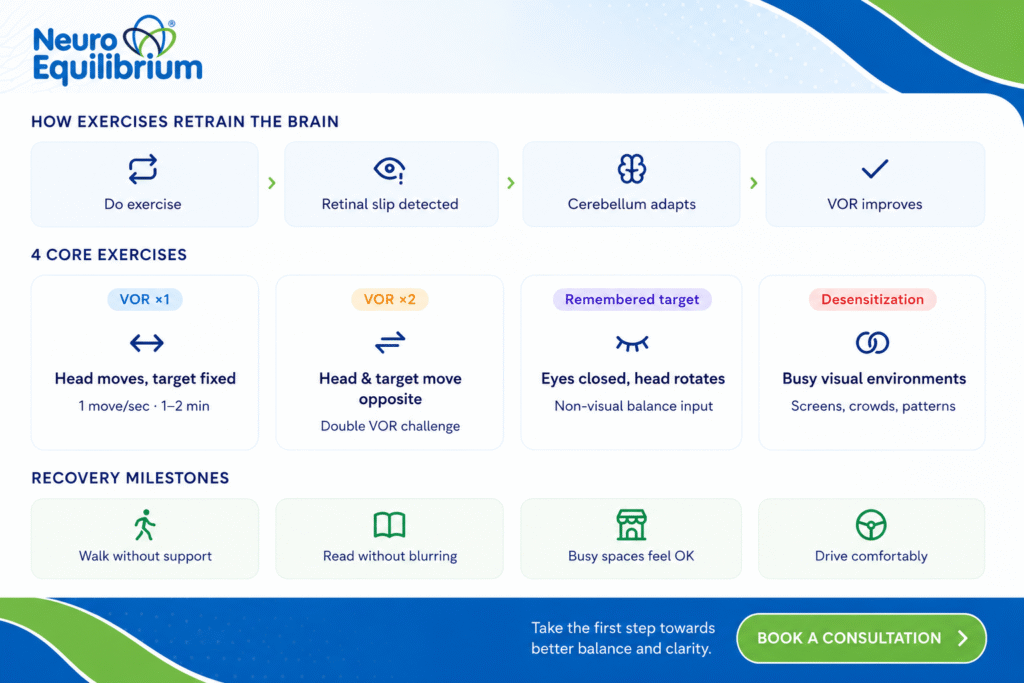
At the brain level, this is what happens: When you do these exercises, you get a signal in your brain, in the part known as the cerebellum, that your vision is slipping (this is referred to as a retinal slip signal). It then uses this error signal to automatically adjust the VOR to the new normal over time. The miscommunication between your inner ear and eyes is gradually “corrected” over days or weeks.
That’s why it’s not a bad thing to get a little dizzy when you are exercising; it’s a sign that it is working the way it is supposed to. All the discomfort is from the brain getting the error signal it needs to adapt to. It is important to be consistent, but not comfortable.
Note: There are two types of vestibular rehab exercises:
- Classic habituation exercises use repeated movements that intentionally trigger mild dizziness, helping the brain gradually become less sensitive to those movements.
- The adaptation exercises, which include VOR x1 and VOR x2 (described below), are different: They directly challenge and improve the accuracy of the VOR reflex itself. Today, both contribute, but VOR adaptation exercises serve as the basis for balance recovery exercises after vertigo.
The Core Gaze Stabilization Exercises Explained Step by Step
VOR x1 The Starting Point for Almost Every Vertigo Patient
This is the most basic of all the VOR exercises. How it works:
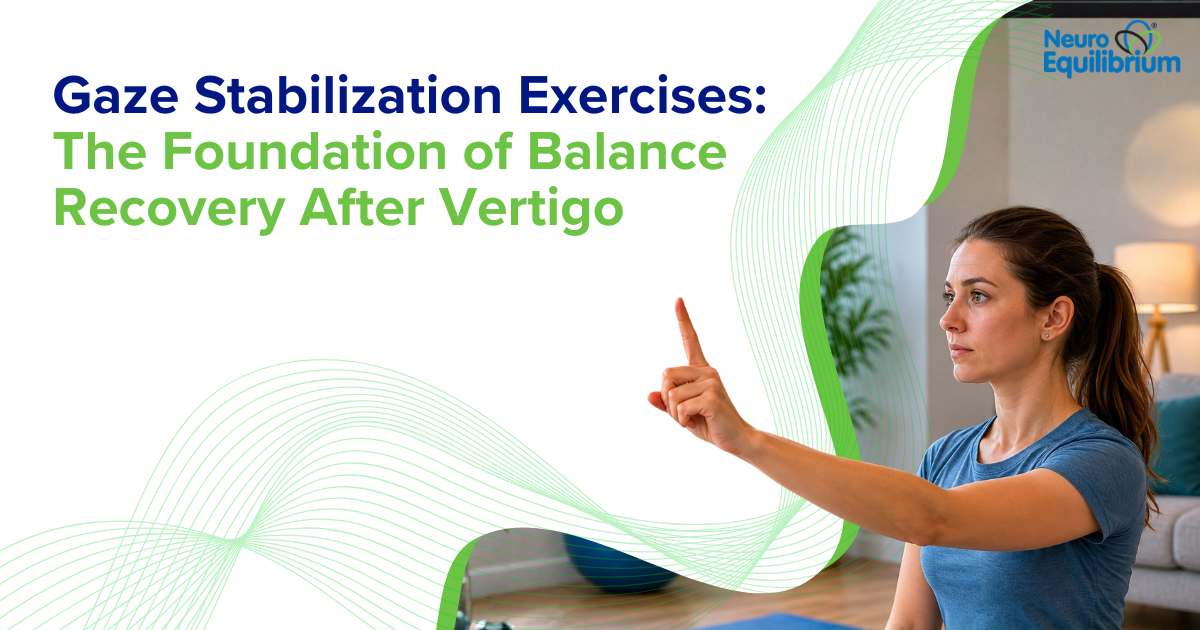
At eye level, about an arm’s length, hold a small object (thumb, letter on the wall, business card) as a target. Look at it! Move your head slowly from side to side (left and right), eyes on the target. The goal should never go out of focus.
Do at a comfortable speed (approximately 1 head movement per second) for 1-2 minutes each time. In the following days, gradually increase the speed of your head movements, as your brain adapts. Because no equipment is required, this is one of the best exercises for vertigo at home and can be performed sitting, standing, or even walking.
VOR x2 Increasing the Challenge as the Brain Adapts
After the VOR x1 becomes manageable, the next level of difficulty is to raise the demand. For VOR x2, the target is moving towards the opposite direction from your head. The target card moves to the right as your head moves to the left. The card will flip to the left as you turn your head to the right.
This means you need twice the VOR gain, which is essentially a double challenge for your brain to maintain focus. This exercise is usually taught after you have established a baseline for progress, depending on how you monitor it.
Remembered Target Exercise Training Without Visual Feedback
Concentrate on a goal. Then shut your eyes and maintain your gaze towards the target. Rotate your head slowly, then open your eyes and see if you still see the object.
In this exercise, you are working on the components of your balance system that are not vision-dependent, your somatosensory and vestibular inputs. It is particularly helpful when visual environments (such as crowded shopping centers or traffic) make you feel extremely dizzy.
Full-Field Motion Desensitization Tackling Visual Vertigo
For some people with vertigo, the thing that makes them most uncomfortable is not the motion of the head, but the motion of the rest of the world – for example, scrolling screens, a busy supermarket line, or striped patterns. This is known as visual dependency, and targeted balance recovery exercises gradually introduce the brain to movement in the visual environment in a safe, controlled manner.
Common Mistakes Patients Make with Gaze Stabilization and How to Avoid Them
- Head speed too high or too low: Studies indicate that the fastest and slowest rates of head movement at which the VOR can be adapted are 1 and 2 Hz (one full left-right cycle per second). Too slow – insufficient challenge for the brain to adapt. If it is too quick, the eyes cannot maintain accurate fixation, and the exercise cannot have its intended effect.
- Halting at sharp rises of dizziness: The tendency to stop immediately. Generally, it’s perfectly okay to push through mild dizziness, since being uncomfortable can be productive. But if vomiting is severe, headache is intense, hearing loss, numbness, or weakness occur, these are warnings to stop and seek assessment.
- Working without a confirmed diagnosis: This is the most crucial warning of all. When BPPV is undiagnosed, it can make it worse to perform VOR exercises. If you experience central vertigo (which comes from issues in the brain rather than the inner ear), home exercises might not be safe and are not advisable to do without supervision. Always the correct diagnosis first.
How to Track Your Progress: Signs That the Exercises Are Working
The recovery from vertigo is gradual, but measurable. The Dizziness Handicap Inventory (DHI) is a widely used self-assessment instrument containing 25 questions regarding the impact of dizziness on one’s life. Pre- and post-scores are conducted after six weeks of rehab. Most patients will notice improvements in their scores within this range.
In real-life terms, the following functional milestones are looked for:
- Walking without touching walls, furniture, etc.
- Does not see the words when they are swimming or blurring.
- Running a supermarket or a very busy street without getting overwhelmed!
- Checking the rearview mirror while driving becomes easier and less unsettling.
These milestones not only represent symptom reduction but also true VOR improvement.
A Note on Innovative Ways to Practice Gaze Stabilization
The classic VOR exercises work well but can be repetitive. Experts have found that certain real-world activities are effective training for VOR. The juggling exercise is, in itself, a dynamic VOR exercise, as one must constantly track the moving objects in order to make tiny adjustments with the head. Another intervention is virtual reality (VR)- based rehabilitation, which immerses patients in simulated environments where they can engage safely in gaze and body-stability exercises while monitoring their progress in real time.
Interestingly, the challenge is the same for NASA astronauts who return from months in space: their inner ear systems are completely out of sync with the pull of Earth’s gravity. They use the same gaze stabilization exercises used in clinical vestibular rehabilitation as part of their protocol for recovering balance and visual stability.

Why NeuroEquilibrium Is the Right Partner for Your Recovery
Recovery from vertigo should not depend on guessing which exercises to perform and hoping they work. It requires understanding exactly how impaired your VOR is before selecting the right speed, frequency, duration, and progression.
The first step at NeuroEquilibrium is a clinical assessment supported, where indicated, by VNG, SVV, DVA and Caloric Testing. The findings help guide an individualized rehabilitation programme., such as Videonystagmography (VNG) and the Video Head Impulse Test (vHIT), to measure your true VOR gain deficit. These findings directly inform a personalized vestibular rehabilitation program, depending on the stage of recovery and condition.
The specialist team is present in 17+ countries and has helped more than 1,50,000 patients, making it the perfect combination of diagnostic precision and compassion. Supervised sessions, video-call options for patients who cannot travel, home exercise guidance, and ongoing progress monitoring ensure that your recovery is both safe and effective.
Don’t “make a guess” for recovery. The difference is a personalized vestibular rehabilitation plan.
Conclusion: Consistent Practice Is the Real Treatment
The key to gaze stabilization exercises is that five to ten minutes of consistent daily practice is always more effective than an hour of haphazard or misdirected practice. Repetition is the way the brain changes. Over time, small, regular challenges create real neurological change.
Vertigo can leave a person feeling alone and terrified. However, when the brain receives the proper inputs, its ability to recover is truly amazing. Most people can regain balance if they are diagnosed correctly and receive the right exercises and guidance.
Frequently Asked Questions
Do gaze stabilization exercises work?
Yes, VR can incorporate gaze stabilization exercises, which can help reduce dizziness, difficulty seeing during movement, and balance problems. These exercises are designed to facilitate brain-inner ear communication – especially after a vestibular disorder or vertigo.
How to do gaze stabilization exercises?
One of the easiest eye-stabilizing exercises is to look at a fixed object, such as a letter on a wall, and then slowly move your head from side to side or up and down while trying to maintain your focus on the fixed object. This exercise is usually repeated a few times a day and slowly ramped up in intensity as tolerance increases, under the supervision of an expert.
Do vestibular exercises actually work?
Yes – vestibular exercises are often administered to help with balance, decrease dizziness, and acclimate the brain to an inner ear malfunction. They are especially helpful in cases of chronic imbalance and vertigo when done regularly and adjusted to the person’s symptoms.
How long does it take for gaze stabilization exercises to work?
Most people feel better in a few weeks with regular exercise, depending on the severity of the vestibular disorder and the regularity of the exercise. Chronic balance impairments can be more of a challenge and may take longer to rehabilitate with Vestibular Rehabilitation Therapy.
What vitamin deficiency causes vestibular problems?
Recurrent vertigo and/or vestibular symptoms are usually associated with low Vitamin D, particularly with Benign Paroxysmal Positional Vertigo (BPPV). Other causes of unsteadiness include low levels of B12 and iron, which can lead to problems with nerve balance. Low iron and B12 can also lead to nerve balance issues and fatigue.